California Puts ADU Utility Hookups on a Clock. The Big Ones Wait.
Chris Koss, AIA|Published: October 2, 2026
Builders say a finished ADU can wait a year for power. SB 1196 orders the CPUC to set hookup deadlines and penalties by September 2027, but ADUs that need grid upgrades are left out of the new clock.
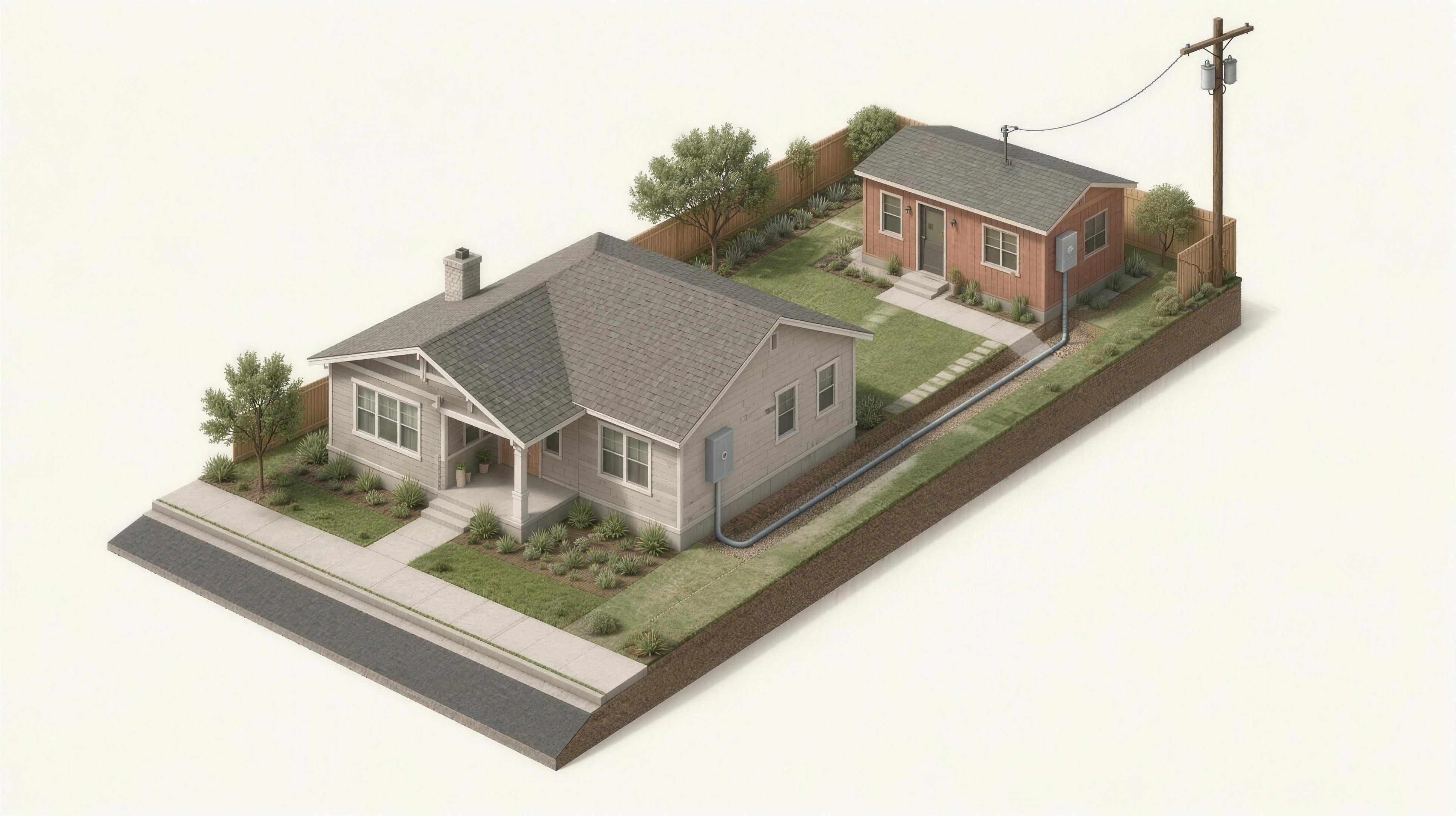
AI-generated illustration for A-du Insights. It shows no real project, address, or person.
The ADU is finished, inspected, and empty, because the power company has not shown up to connect it, and California builders say that wait now runs nine to 12 months. Under SB 1196, signed by Governor Newsom on September 27, 2026, the California Public Utilities Commission must set deadlines and penalties for how fast investor-owned utilities process ADU power hookups, with the rules due by September 30, 2027.
The short version:
- SB 1196 (McNerney), now Chapter 684 of 2026, orders the CPUC to set timelines and penalties for utilities that handle "small energization projects," a category that covers most simple ADU hookups.
- Once the CPUC acts, you can file your utility application the same day you file for a building permit, and the utility cannot cancel it without your consent.
- The bill covers only investor-owned utilities like PG&E, SCE, and SDG&E, and only projects that need no line extension or grid upgrade beyond a new meter.
What changed
California has spent a decade clearing the path to an ADU permit. The last mile, the wire from the pole to your new meter, never got the same treatment. According to Senator Jerry McNerney's office, PG&E itself estimates that energizing a home addition can take up to 182 days, and builders report that utilities refuse to accept a service application until the building permit is issued, then sometimes cancel the application without asking. That is half a year of a finished unit earning nothing, on a build the senator's office pegs at $200,000 or more.
The chaptered text of SB 1196 adds Section 934.5 to the Public Utilities Code. It gives the CPUC until September 30, 2027 to set the clocks: how long a utility has to decide whether your application is complete, how it must tell you, and what it pays if it misses. An incomplete application has to come back with a written list of deficiencies and instructions for fixing them. It is a short paragraph. It is also the first time a utility has to tell you, in writing, what is wrong with your file.
The bill also requires the utility to offer a pre-application review with its staff and to hand you a cost estimate covering "all related fees, charges, and potential upgrades." If you have ever had a utility invoice arrive after the framing went up, that line is the one to remember.
From the text
The provision most homeowners will feel first is the one that ends the permit-first rule. Section 934.5(d)(1) directs the CPUC to require utilities to:
"Allow an application for energization to be submitted with the electrical corporation at the same time an applicant applies for a building permit with the local permitting agency."
Today, in the sequence builders describe, the utility queue starts after the city's queue ends. Under SB 1196, the two run in parallel. For a first-time ADU client, that is the difference between a schedule with one long wait and a schedule with two.
Who wins and who loses
The winners. Owners building a modest ADU that can ride on the existing service drop or needs only a new meter. The bill defines a "small energization project" as one that requires no distribution or service line extension or upgrade under the utilities' Rule 15 and Rule 16 tariffs, and it expressly includes projects whose only upgrade is a new meter. A separately metered backyard studio on a lot with adequate capacity fits that description. Note that the definition is not ADU-specific: any qualifying small project shares the same queue and the same clock.
The ones left waiting. Owners whose ADU needs a new pole, heavier utility equipment, or a line extension. Those are Rule 15 and Rule 16 jobs, and by definition they fall outside the new timelines. They stay under the broader targets that the 2023 Powering Up Californians Act required the CPUC to set, in Section 934, which called for average and maximum energization targets by September 30, 2024.
Our read: SB 1196 fixes the paperwork, not the pole. The slowest ADU hookups are usually the ones that need grid work, and those are precisely the projects the definition excludes, so we expect the bill to shorten the easy cases and leave the hard ones roughly where they are.
The cross-street check. SB 1196 speaks only to "electrical corporations," the investor-owned utilities the CPUC regulates under Section 218. City-run power is a separate category in Section 224.3 of the same code, and the bill does not mention it. So the line runs by power bill, not by county: an LA-area owner billed by Southern California Edison is inside the new rules, while an owner in the City of Los Angeles billed by the city's Department of Water and Power should not count on them. San Diego owners billed by SDG&E and San Francisco owners billed by PG&E are covered. Outside California, nothing changes: a Seattle backyard cottage, a Portland ADU, or a Queens accessory unit answers to its own utility and regulator, and whether any of them will copy California's same-day filing rule is an open question worth asking at your next utility meeting.
What to watch
The statute takes effect January 1, 2027, but the clocks do not exist until the CPUC writes them, and the deadline for that is September 30, 2027. The bill lets the CPUC use a new or existing proceeding, and an energization rulemaking, R.24-01-018, is already open. Watch for the penalty numbers, which will decide whether the timelines bite. The bill passed the Senate 29 to 5 in May, per McNerney's office, so the politics are settled. The engineering is not.
It also arrives in a busy week. The same signing season brought AB 956, the two-detached-ADU bill we flagged in September as an HOA loss, onto the books, per the Governor's September 29 announcement. Two detached units can mean two new meters, which is exactly the hookup this bill is meant to speed. And if you are deciding whether your ADU gets its own meter at all, as we covered in August, the meter also decides who pays the bill.
If you are building now, the practical move is the same before and after 2027: ask your utility for a pre-application review early, get the upgrade question answered in writing, and budget the fees you can see with A-du's permit fee calculator so the utility's estimate is the only surprise.
The real test comes in late 2027, when the CPUC puts a number of days, and a penalty, on paper.
Elsewhere on the ADU beat
- A Whatcom County judge ruled Bellingham's ban on short-term rentals of detached ADUs unconstitutional because the city allows them in attached units, Cascadia Daily News.
- East Hampton drew ten homeowners by lottery for a $100,000 interest-free ADU construction loan from its Community Housing Fund, 27east.