NY State Plus One ADU Program: Grants Up to $175K, Explained
Chris Koss, AIA|Published: June 20, 2026
Last updated: September 25, 2026
New York State's Plus One ADU program offers grants up to $175,000 for NYC homeowners and $125,000 elsewhere to build or legalize a unit, administered through income-eligible local partner intake.
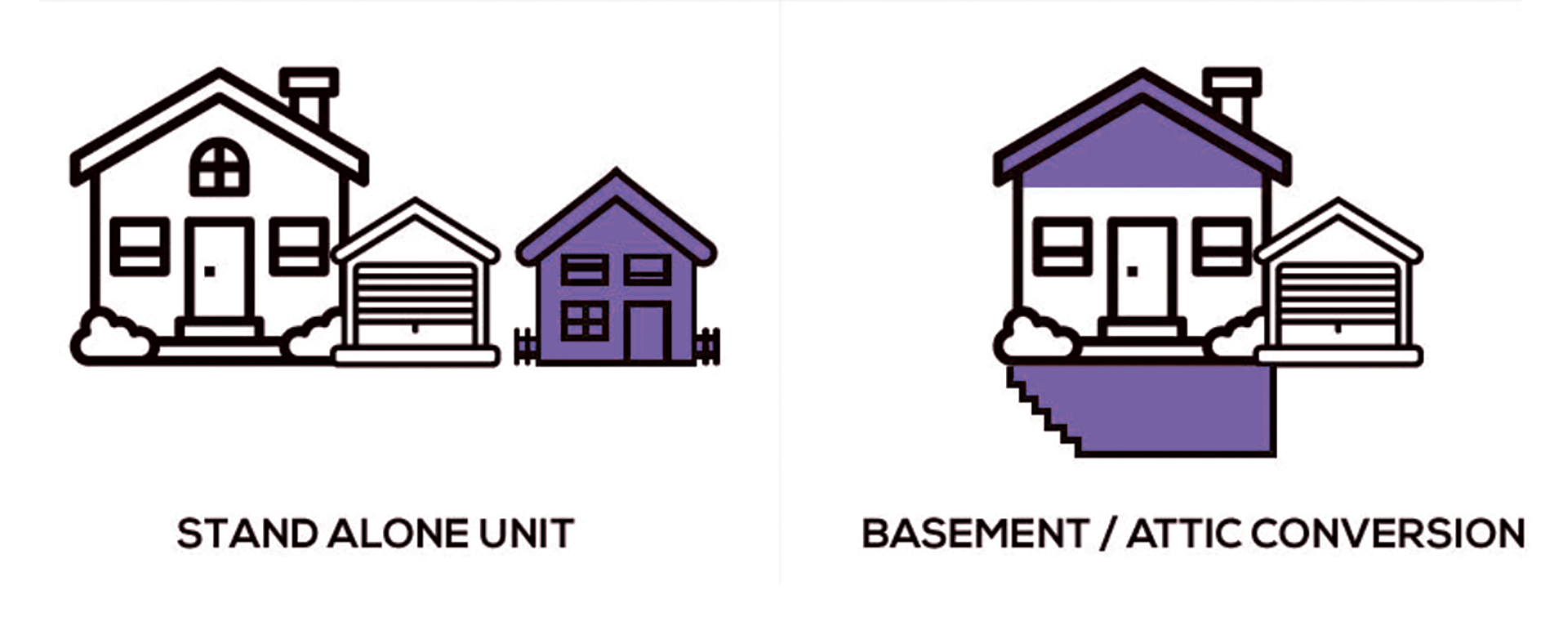
ADU examples from New York State's Plus One program. NY State Homes and Community Renewal.
New York State set aside $85 million in its 2022-2023 capital budget to help low- and middle-income homeowners build or legalize accessory dwelling units, and nearly $60 million of that went out in the first two funding rounds, for roughly 500 ADUs statewide. The vehicle is the Plus One ADU Program, administered by NY State Homes and Community Renewal (HCR). For a first-time ADU client wondering whether a backyard cottage or basement legalization is financially realistic in New York City, this is where state money meets your project, at amounts that can shift the math significantly.
What the Plus One program actually is
The Plus One ADU Program does not give grants directly to homeowners. HCR awards money to local governments and nonprofits, called program administrators, who then work one-on-one with homeowners in their service area. Round One distributed $22 million through 17 municipalities, targeting 200 ADU builds. Round Two added $36.5 million for another 300-plus ADUs and brought the number of participating municipalities to 50. Ten municipalities from Round One earned a second round award because homeowner demand outpaced supply.
Your program administrator handles paperwork, manages contractor procurement in many cases, and guides you through design, permitting, and construction. You do not apply directly to Albany or to HCR. You apply through whoever HCR has designated for your neighborhood, which means the first question to answer is whether a funded administrator covers your area.
Who qualifies and who does not
Eligibility has two hard requirements that apply statewide:
Income limit. Under the state rules, your household must earn at or below 100% of the Area Median Income (AMI) for your location. NYC's version of the program, run by HPD, accepts household incomes up to 165% of AMI, with preference for those at or below 120%. AMI is set by region, so the same percentage means different dollar limits in different places. Outside NYC, the HCR program page at hcr.ny.gov/adu links to its ADU AMI chart; in NYC, HPD's Area Median Income chart gives the dollar limits for your household size.
Owner-occupancy. You must currently live in the primary unit of a one- or two-family home. The program is designed for owner-occupants, not investor-landlords. A rental property you do not live in is not eligible regardless of income.
Beyond those two, the rules depend on your program administrator. Some cover only new detached backyard cottages. Others include garage conversions, attic conversions, and basement legalizations. If you are a NYC homeowner evaluating a basement legalization under Local Law 126, ask your local administrator upfront whether that type of work falls within their program agreement with HCR.
What the money pays for
Eligible costs are broad: architectural and engineering fees, permit applications, surveys, construction labor and materials, utility connections, and project management. The grant typically is not a reimbursement that arrives after you spend your own money. In most programs, the administrator manages the disbursement on your behalf, which limits your financial exposure during construction.
The grant portion does not have to be repaid, provided you comply with any affordability covenants your administrator requires. Those covenants usually require that the unit be rented (not used as short-term or vacation rental) for a set period after completion. In practice, that aligns with what most participating homeowners intended anyway.
NYC versus the rest of New York State
The program amounts differ sharply between New York City and everywhere else:
Outside NYC: up to $125,000 per unit as a direct grant from HCR. That is a state grant, no repayment required.
Inside NYC: up to $175,000 from HCR, plus a separate loan of up to $220,000 from the NYC Department of Housing Preservation and Development, for a combined maximum of $395,000. The HPD portion is a loan with its own terms. NYC applications come through HPD's Plus One ADU program, administered by the nonprofit Restored Homes HDFC.
For a Queens or Brooklyn homeowner, that $395,000 ceiling is material. The city's pre-approved plan library estimates costs for its designs from $85,000 for a 300-square-foot studio to $650,000 at the top, and most come in under $395,000, so if you qualify, the combined grant-and-loan package can cover the full estimated cost of most of the library's designs. Basement legalization costs depend heavily on the condition of the space, so get a contractor's estimate before assuming the package covers yours.
The local partner model and what it means in practice
The through-administrator structure has real consequences for applicants. Funding exists only in the service territories of HCR-funded administrators. If no administrator covers your neighborhood, you cannot access the program regardless of income or property type. Inside New York City, HPD's program covers all five boroughs, so the limits there come from property type, zoning and flood-zone rules rather than service territory.
Administrators also have their own intake timelines and waitlists. The NYC Plus One application window that opened March 18, 2026 closed June 12, 2026. If you missed that window, HPD has not announced the next intake; you can join its Plus One ADU mailing list on the program page for updates.
When you do get in front of an administrator, ask how many ADUs they have completed under the program. The quality of the experience, from contractor vetting to permit tracking, varies considerably across partners.
What to watch for next
The first two HCR funding rounds totaled about $59 million of the $85 million program. HCR offered up to $25 million more in a third round in November 2024, open only to jurisdictions not already in the program, and has since posted a fourth-round request for proposals; by March 2026 it described the program as having 14 partners working on more than 550 ADUs statewide. For New York City homeowners, the thing to watch is HPD reopening Plus One intake. The Mamdani administration has made housing production a stated priority, and the Plus One program is one of the cleaner tools it has for moving units in the lower-density residential neighborhoods where most of the city's eligible homeowners live.
If you own a one- or two-family home in New York City and think you might eventually build or legalize an ADU, the preparation work you do now (survey, income documentation, preliminary design conversations) puts you in position to move quickly when the next window opens. Homeowners who are application-ready when intake opens have historically been served faster than those who start paperwork after the announcement.
A-du's permit fee calculator can help you work out the city and state fees before you sit down with a program administrator, so the full financial picture is clear before any commitments are made. Start at A-du's permit fee calculator.