California Caps Prefab ADU Fees. The Inspection Fix Waits for 2029.
Chris Koss, AIA|Published: October 7, 2026
California's AB 2058 caps what cities may charge to permit and inspect factory-built ADUs, likely at half the site-built fee, from 2027. The option of a state-supervised inspector waits for HCD rules due in 2029.
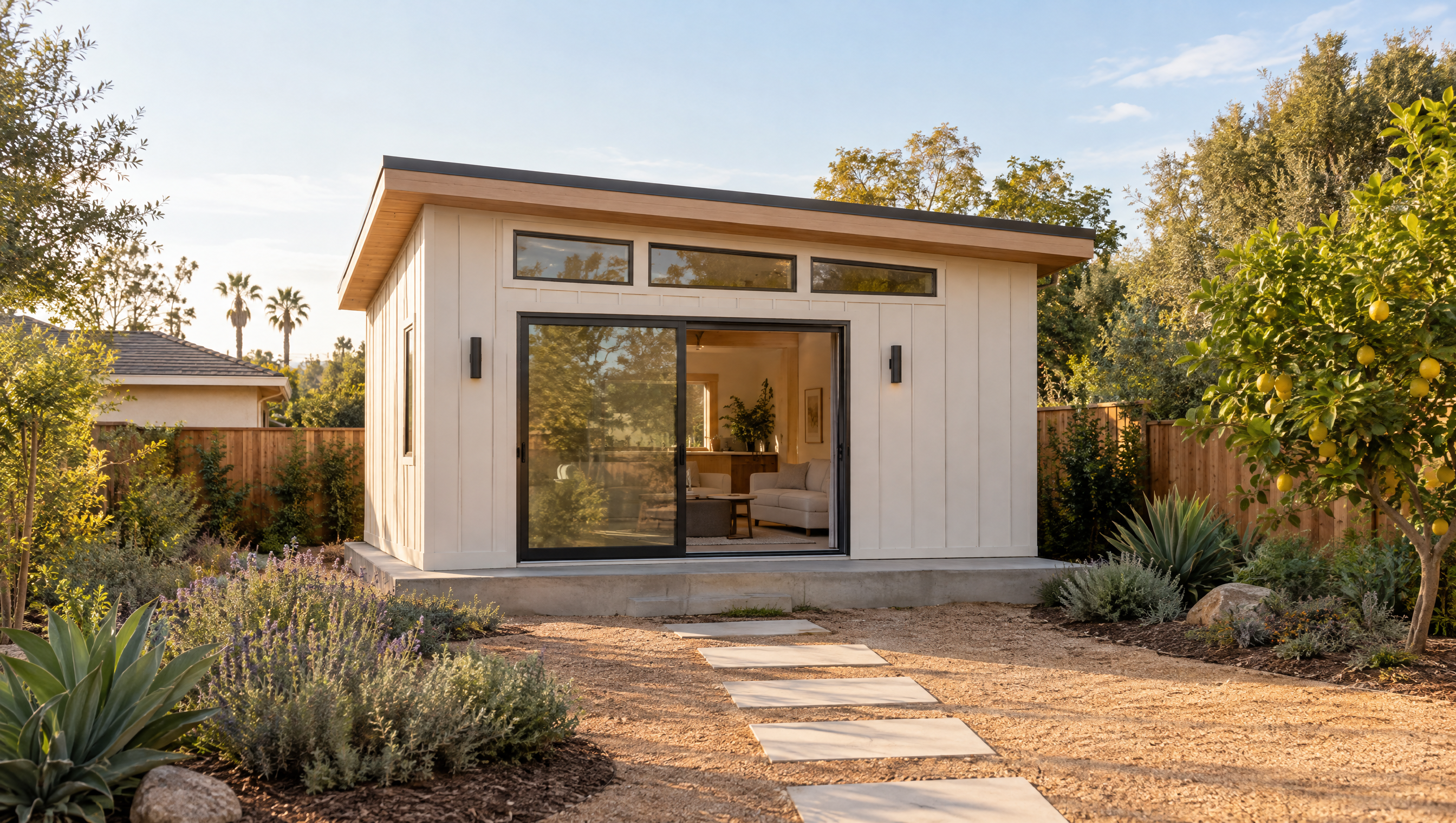
AI-generated illustration for A-du Insights. It shows no real project, address, or person.
A modular ADU rolls onto your lot inspected at the factory, and until now a California building department could still bill you full price to permit and inspect it again. AB 2058, signed by Governor Newsom on September 29, 2026, as Chapter 783, sets a ceiling on the fees a local building department may charge to permit and inspect factory-built housing, and lets the buyer pick a state-supervised inspector for the installation once HCD writes the rules, due by January 1, 2029.
The short version:
- AB 2058 (Harabedian) caps local permitting and inspection fees on factory-built housing; the version the Assembly Local Government Committee analyzed in April set each cap at 50 percent of the equivalent fee for site-built housing.
- If you choose a state-supervised quality assurance agency to inspect the installation, the local building department may not charge an inspection fee, but that option opens only after HCD adopts regulations, due by January 1, 2029.
- A companion bill, AB 1815 (Wicks), bars local building standards stricter than the state code on housing projects that include factory-built housing; the package takes effect January 1, 2027.
What changed
Factory-built housing is the legal name for what most homeowners call modular or prefab: a building, or a single dwelling unit, made in a plant and assembled on your lot. State law already treats a unit carrying an HCD insignia of approval as compliant with local construction ordinances, and HCD's own guidance says the design and construction are inspected and approved in the factory by HCD-certified third-party agencies. What stayed local was the installation. The building department inspected the set, the foundation, and the hookups, and charged what it charged.
Assemblymember Buffy Wicks put the problem plainly when the bill cleared its first committee, as Pasadena Now reported: "Factory-built housing is still a niche market in California, which creates confusion at the local level for well-meaning inspectors who end up treating factory-built housing products in the same way they would treat traditional site-built units." The Terner Center, which interviewed 65 people across the industry for the Assembly's select committee on construction innovation, heard about building elements inspected locally after they had already passed inspection in the factory. That double charge is what AB 2058 goes after.
The bill does three things. It makes the installation inspector a choice: the local building department, or a quality assurance agency working under HCD's supervision. It caps local fees. And it bars any inspector, public or private, from disassembling, damaging, or destroying the unit to see inside it. The legislature also declared housing supply a matter of statewide concern, so the law reaches charter cities as well as general-law ones.
From the text
"The bill would set the maximum fees that a local enforcement agency is authorized to impose for the inspection or permitting of factory-built housing, and prohibit a local enforcement agency from imposing fees under certain circumstances."
AB 2058, Legislative Counsel's Digest, as chaptered September 29, 2026 (Chapter 783, Statutes of 2026), via Digital Democracy
The digest does not print the number. The Assembly Local Government Committee analysis of the bill as amended March 19 does: an installation inspection fee no higher than 50 percent of the equivalent fee for non-factory-built housing, no inspection fee at all when you pick a quality assurance agency, and no permitting fee above 50 percent of the site-built equivalent. The Senate amended the bill again before the Assembly concurred 78 to 0 on August 28, so read the chaptered section before you put "half" into a spreadsheet.
If the cap survived as analyzed, the math is simple. Whatever your building department charges to permit and inspect a site-built ADU of the same size, the factory-built version tops out at half of it. That is easy arithmetic. It is also real money, and it lands on the line items homeowners rarely see coming until the invoice arrives.
Who wins and who loses
Modular ADU buyers. First-time ADU clients weighing a factory unit against a site-built one get a cheaper permit stack starting in 2027, on top of the shorter build that made modular attractive in the first place. The insignia is the key. Ask any supplier whether the unit will carry an HCD insignia of approval, because the bill's protections attach to factory-built housing as state law defines it.
Not every prefab qualifies. The state definition excludes mobile homes, recreational vehicles, and commercial modulars, according to the committee analysis. A HUD-code manufactured home parked behind the house is a different legal animal, and the cap does not follow it.
Building departments. They lose fee revenue on a product type that is still small, and from 2029 they may lose the installation inspection entirely when owners choose a state-supervised agency. They keep what matters most to your site plan: local zoning, setbacks, fire zones, and architectural review all stay with the city under existing law.
The open question. AB 1815 and a third bill in the same package, AB 1621, which limits a city to two plan checks before it must justify a third in writing, are both written around housing development projects, per Allen Matkins' summary of the package. Whether a single backyard ADU counts is a question to put to your building department in writing; we have not seen the chaptered text answer it.
Our read: for anyone building in 2027, AB 2058 is a fee law, not an inspection law. The cap can show up on your permit invoice next year. The state-supervised inspector cannot show up until HCD finishes rules it has until 2029 to write, and rulemaking deadlines are not the kind of date that arrives early.
The cross-street check. Washington took a similar half-off approach from a different angle: as we covered in August, HB 1337 caps ADU impact fees at 50 percent of the single-family charge, no matter how the unit is built. California's new cap is narrower, covering permitting and inspection fees on factory-built units only, but it stacks with the impact-fee change in SB 1117, which we flagged in September and which also starts January 1, 2027. New York City went another way: rather than discount the factory box, it published a library of DOB-reviewed backyard designs through ADU for You, so the review happens once, on the drawing. Does Oregon or Washington offer a fee break aimed at factory-built ADUs specifically? We have not found one.
What to watch
Three things. January 1, 2027, when the package takes effect and your city's fee schedule either reflects the cap or earns a phone call. The HCD rulemaking for quality assurance agencies, which has a January 1, 2029 deadline. And the fire-rebuild lots around Altadena, where modular construction is already part of the recovery; the state budget set aside $1 million for San Gabriel Valley Habitat for Humanity to deploy modular homes in fire-affected areas, Pasadena Now reported. If the cap changes behavior anywhere first, it will be on streets that need many units quickly.
Before you call a modular supplier, run the site-built baseline in A-du's permit fee calculator, since that is the number any half is measured against.
The next move belongs to HCD, and its deadline is January 1, 2029.
Elsewhere on the ADU beat
- Tacoma counted 581 ADUs permitted under its post-2019 rules through July 2025 and now runs an ADU accelerator with pre-approved designs, Yahoo News.
- ADU developer SDRE has joined Infill Innovation, a San Diego company with 84 projects and about 1,400 apartments in its portfolio, San Diego Business Journal.