California Will Charge ADU Fees Only on the Space Over 750 Feet
Chris Koss, AIA|Published: September 9, 2026
Last updated: October 1, 2026
California already waives impact fees on ADUs of 750 square feet or less. SB 1117, which Governor Newsom signed on September 29, 2026, charges the fees on a larger unit only for the square footage above 750, not the whole thing, on lots with up to two ADUs, starting January 1, 2027.
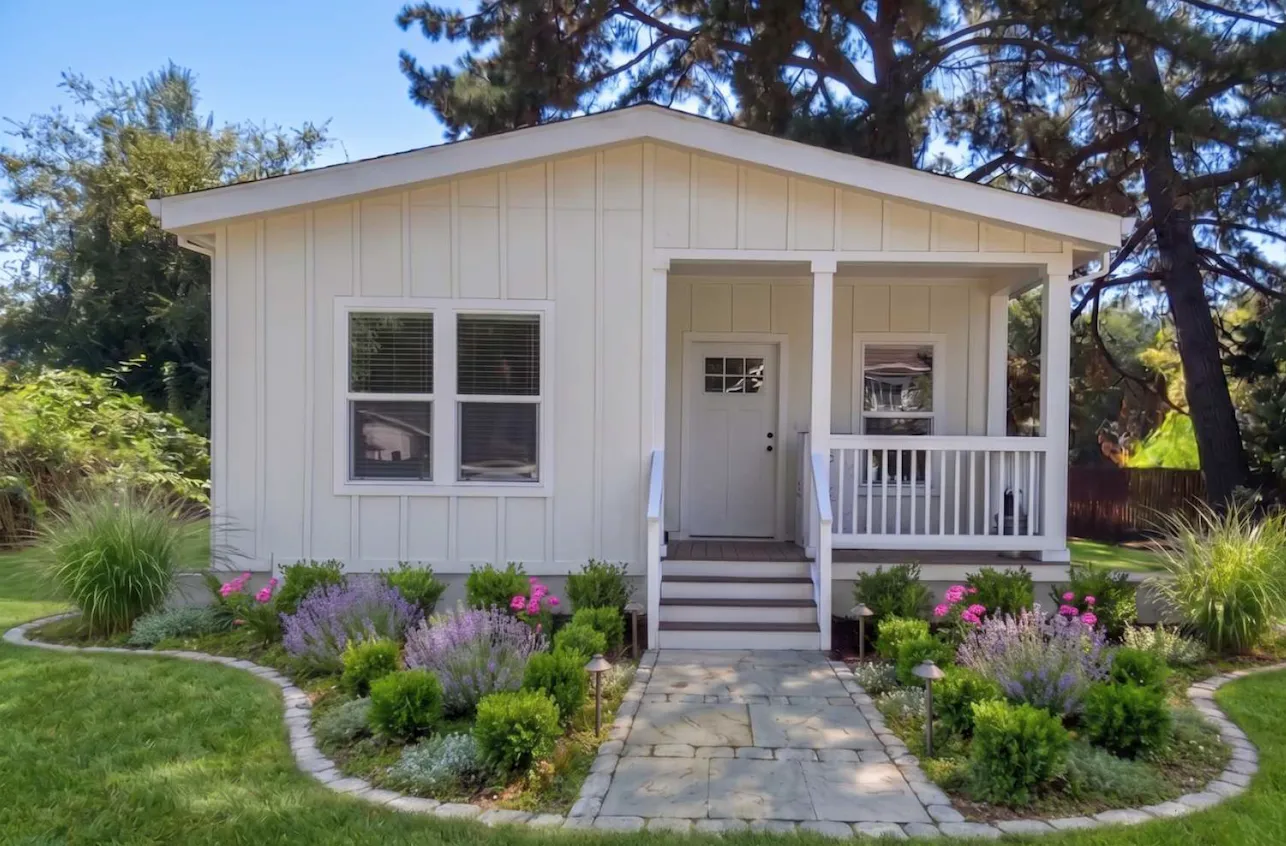
Photo: the Elmore Bay ADU, a detached California accessory dwelling unit, via Perpetual Homes ADU. Bill text via California Legislative Information.
You budgeted your 1,000-square-foot backyard house down to the impact fees, and then the counter billed you as if all 1,000 feet were fresh demand on the city's sewers, roads, and parks. SB 1117, which Governor Newsom signed on September 29, 2026, lets California charge those fees on only the space above 750 square feet starting January 1, 2027, so a 1,000-square-foot ADU is billed on 250 feet, not the whole unit.
The short version:
- SB 1117 amends Government Code Section 66311.5 so that impact fees on an ADU larger than 750 square feet are calculated on the area above 750, not the unit's full size, for up to two ADUs on a lot.
- ADUs of 750 square feet or less, and junior ADUs of 500 square feet or less, already owe no impact fees at all. That floor does not move.
- The bill cleared both houses, reached the Governor on August 30, 2026, and was signed on September 29, 2026 (Chapter 809, Statutes of 2026). It takes effect January 1, 2027; until then, the fee on a unit over 750 square feet is charged on the whole unit.
The number: 250 feet, not 1,000
Impact fees are the charges a city collects to offset a new home's draw on shared infrastructure, and California already sorts ADUs into two boxes by size. Build 750 square feet or less and the fee is zero. Build bigger and the fee has, for years, been charged "proportionately in relation to the square footage of the primary dwelling unit." That sentence has no deduction in it: the proportional fee runs on the whole ADU, so a unit one foot over 750 is billed on every foot.
SB 1117 changes the base and writes it into the code. Starting January 1, 2027, on a lot with up to two ADUs, the fee is charged only on the square footage past 750. Here is what that does to the billable area, holding everything else equal:
| ADU size | Fee base today (full unit) | Fee base under SB 1117 (space over 750) |
|---|---|---|
| 750 square feet or less | 0 feet | 0 feet |
| 800 square feet | 800 feet | 50 feet |
| 1,000 square feet | 1,000 feet | 250 feet |
| 1,200 square feet | 1,200 feet | 450 feet |
Read the bottom rows like a homeowner, not a planner. For a 1,000-square-foot unit, the fee base drops from 1,000 feet to 250, roughly a 75 percent cut in the number the city multiplies against. For an 800-foot unit it lands a rounding error away from the exemption you would have kept by building 50 feet smaller. The dollar figure still depends entirely on your city's fee schedule, because impact fees are set locally within the limits California's ADU law allows, and they range from modest to brutal. SB 1117 does not cap the rate. It shrinks the number of feet the rate applies to.
From the text
"For up to two accessory dwelling units on a lot, any impact fees charged for an accessory dwelling unit that has more than 750 square feet of interior livable space shall be charged proportionately in relation to the square footage of the primary dwelling unit, and only on the area in excess of 750 square feet of interior livable space."
That is Government Code Section 66311.5, subdivision (c)(1)(B), as SB 1117 amends it, effective January 1, 2027. The two operative words are "only on." They take the first 750 feet out of the fee base. Note the ceiling, though: the relief covers lots with up to two ADUs. On a lot with more than two, the next subdivision charges every ADU over 750 square feet on its full size, which is worth reading if you are stacking units. We flagged where this 750-foot line already sits when we walked the LA school-fee math, and SB 1117 is that same line, drawn more cleanly.
The cross-street check. California is moving a fee base here, not inventing generosity, and the contrast with the other markets we cover makes that plain. Washington did not wait for a base-versus-excess argument: HB 1337 simply caps an ADU's impact fees at 50 percent of the single-family charge outright, a blunter and arguably stronger tool than California's size formula, as we covered when Washington halved its fees and scrapped transit parking. New York City runs no size-tiered impact-fee waiver like this at all; the money question there is not a fee base but the retrofit bill, the sprinklers and egress a basement needs before it can go legal. Same goal, three regimes, and only California writes into law which square feet count.
The decision this changes
Our read: SB 1117 is a real cut to the fee base, not a clarification. The 750-foot threshold has been law for years; what changes on January 1, 2027, is that, on a lot with up to two ADUs, the first 750 feet of a bigger unit stop counting. If you are planning an ADU larger than 750 square feet, the law lowers the penalty for every foot above the floor, which means the old reflex to shrink under 750 to dodge fees loses some of its pull. Going a little bigger, a real second bedroom instead of a sleeping nook, will carry its impact fee on the extra feet alone rather than on the whole footprint. For a first-time owner weighing a 720-foot studio against a 950-foot one-bedroom, that gap gets smaller on January 1, 2027.
The caveat is that a smaller base is not no bill. In a city with an aggressive fee schedule, 250 feet of impact fee is still real money, and it lands on the same permit stack as your plan check, your school fees, and your utility connection. Budget it as one line among many, not as a windfall.
If you want to see how your own city's charges add up before you lock in a size, A-du's permit fee calculator breaks the number down line by line.
What happens next: the change takes effect January 1, 2027, in time for the 2027 permit season. Cities and special districts that charge ADU impact fees will need to update their fee schedules before then, and if your fees will be assessed near the turn of the year, ask your city which formula it will apply.
Elsewhere on the ADU beat
- LADBS revised its ADU and JADU standards bulletin (P/BC 2026-150) in July and issued a separate bulletin, P/BC 2026-161, for streamlined permitting of unpermitted units under AB 2533, per the City of Los Angeles Department of Building and Safety.
- Seattle is refreshing its pre-approved backyard-cottage catalog and extended the design-submission window, according to Seattle's Office of Planning and Community Development.
- San Francisco updated its State ADU Program guidance in Planning Director Bulletin No. 3, via SF Planning.