Your SF In-Law Is Getting Legalized. Your Rent Control Stays.
Chris Koss, AIA|Published: October 26, 2026
San Francisco lets owners legalize one unwarranted in-law per lot. If you rent it, rent control survives, and a temporary move-out for the work pays $8,245 per tenant. The notice is where it goes wrong.
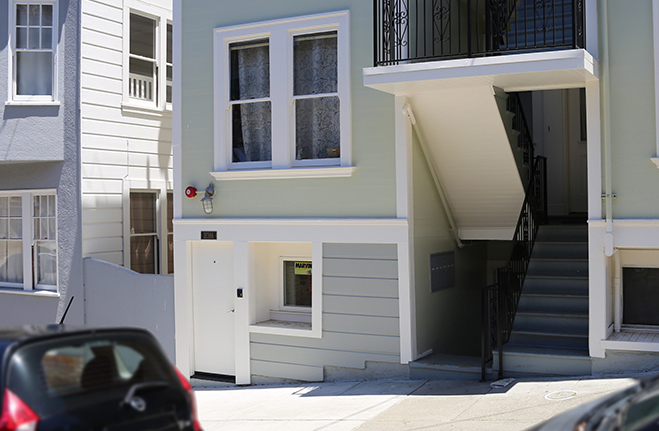
A ground-floor accessory unit carved out of a garage level, photographed for SF Planning's ADU program. SF Planning.
Your landlord just told you that the unit you rent, the one behind the garage door that never had a permit, is about to become legal, and your first thought is whether you are about to lose it. In San Francisco, an unwarranted in-law that was under rent control before legalization stays under rent control after it, and if the work forces you out for 20 days or more, the 2026 relocation payment is $8,245 per tenant.
The short version:
- San Francisco's Dwelling Unit Legalization Program lets an owner legalize one unwarranted unit per lot under Planning Code Section 207.3, and a unit that was rent controlled before legalization stays rent controlled after.
- If the work makes the unit hazardous or uninhabitable, the owner can move you out temporarily under Rent Ordinance Section 37.9(a)(11), but only after the permits are issued, and the notice must give you a month and year to move back.
- For notices served March 1, 2026 through February 28, 2027, relocation for a displacement of 20 days or more is $8,245 per tenant, capped at $24,733 per unit, plus $5,497 for each senior, disabled, or child household.
Step 1: Find out which door your landlord walked through
The program is voluntary. According to SF Planning's Dwelling Unit Legalization Program FAQ, last updated May 10, 2026, it exists for owners who converted unused space into a rentable unauthorized dwelling unit, which the city abbreviates UDU. The Department of Building Inspection decides whether a unit is eligible. The owner can get a free, non-binding DBI screening that estimates the cost, then must file a Project Application with Planning and receive a Planning Approval Letter before the building permit application goes in.
The same FAQ notes that an owner may have other options, including the State or Local ADU programs. Ask, in writing, which route your landlord is using. This walkthrough covers the legalization program; a different program raises different rent questions.
The program waives five Planning Code requirements: density, rear yard, open space, exposure, and parking. It waives nothing in the Building Code. Ceiling height, ventilation, light, fire safety, and egress all have to be met, which is where the construction, and your temporary move, comes from.
Step 2: Check the two dates that can stop the application
The city built an eviction screen into the program. It cannot be used to legalize a unit that had an owner move-in eviction filed after March 13, 2014, if the notice was served within five years before the legalization permit application. For other no-fault evictions filed after that date, the lookback is ten years.
If you are the sitting tenant, the effect is simple: an owner who clears a unit with a no-fault eviction cannot turn around and legalize it for years. An owner who wants the legal unit has a reason to keep you.
Step 3: Read the one sentence that protects your rent
From the text, in the city's own FAQ:
A dwelling unit that was subject to the Residential Rent Stabilization and Arbitration Ordinance prior to legalization shall remain subject to said Ordinance after legalization.
SF Planning, Dwelling Unit Legalization Program FAQ, "Rent Control"
That sentence carries most of the weight. The allowable annual increase on a covered unit for March 1, 2026 through February 28, 2027 is 1.6 percent, per the Rent Board's current rates. That is $16 a month on every $1,000 of rent. Legalization is not a route around it.
Two more rules keep the unit in the rental stock. Legalized units cannot be subdivided, so yours cannot be sold off as a separate condo. And folding the legal unit back into the main house requires a Conditional Use Authorization from the Planning Commission at a public hearing, under the residential merger rules in Planning Code Section 317.
Step 4: If the work moves you out
Bringing a unit up to the Building Code can mean real construction, and some of it cannot happen with you asleep in the next room. The Rent Board's guidance on temporary evictions for capital improvements sets the rules. The owner may temporarily remove you only if the unit will be hazardous, unhealthy, or uninhabitable while the work is underway. You can contest that in court.
The paperwork has to arrive in a specific order. The owner must obtain the permits first. The notice must include copies of those permits, a description of the work, a reasonable approximate month and year when you can move back, your current lawful rent, and a statement of your relocation rights. It has to be filed with the Rent Board within ten days of service on you.
If the owner knows the work will take more than three months, a Petition for Extension of Time must be filed with the Rent Board before you get the notice, and a hearing tests whether the time estimate is reasonable.
The cost ledger
| Situation | What the owner owes (notices served 3/1/26 to 2/28/27) |
|---|---|
| Displaced 20 days or more | $8,245 per tenant, up to $24,733 per unit |
| Senior (60+), disabled tenant, or household with minor children | An additional $5,497 |
| Displaced fewer than 20 days | $446 per day, plus actual moving expenses (Civil Code Section 1947.9) |
| Lower-income household out more than three months | Additional monthly payments, up to 39 months |
The 20-day payment goes to each authorized occupant who has lived in the unit for at least one year. Half is due when the notice is served and half when you vacate. Run the numbers for a household of one and the short stay can pay more than the long one: 19 days at $446 is $8,474, which is $229 more than the lump sum for 20 days. The cliff runs backward.
The monthly payments are new. A law that took effect February 9, 2026, according to the Rent Board, covers lower-income tenants, meaning households below 80 percent of Area Median Income, who are out for more than three months. The payment covers the gap between your old rent and the lower of the Housing Authority payment standard for the unit size or your actual temporary housing cost. You request it on Rent Board Form 1004, and the Board has 30 days to calculate it, or 45 if the landlord also submits information.
Where people get stuck
The vague notice. A notice with no permits attached or no move-back month is not a technicality. It is your strongest evidence that the timeline was never real.
The 30-day claim window. The notice must warn you to tell the landlord in writing within 30 days if you claim protected status. Miss it, and the Rent Board treats your silence as an admission that you are not protected.
The wrong forum. The Rent Board does not decide disputes over the extra payment for age, disability, or children. Those go elsewhere, so keep your proof of eligibility in writing from day one.
Our read: for a sitting tenant, legalization is mostly good news. Rent control survives it, the unit cannot be sold off, and the money for a temporary move is real. The risk lives almost entirely in the move-out paperwork, so the notice is the document to read twice.
The cross-street check. Elsewhere in California, the owner's side of this story is governed by AB 2533, which, as we walked through in August, bars a city from denying a permit for a pre-2020 unpermitted ADU over code violations or charging it impact fees. That law protects the owner's permit. It says nothing about the tenant's rent. In Los Angeles, does a newly legal garage unit inherit the main house's rent rules, or does it start fresh? That turns on a certificate-of-occupancy test, a very different question from San Francisco's one-sentence answer. New York's basement pilot is a third model; whether its tenants get a guarantee this plain is the question to ask of its rules.
If legalization work is coming to your unit, start with the official resources: the Rent Board's temporary eviction guidance, its current relocation rates, and the Planning FAQ, which also points tenants to the San Francisco Tenants Union.
Watch the ceiling-height ordinance we flagged in September: if San Francisco's 7-foot-6-inch rule drops to the state's 7 feet, more owners will be able to legalize, and more tenants will need this page.
Elsewhere on the ADU beat
- An appeals court revived a homeowner's suit over a three-year ADU permit delay in Palos Verdes Estates, Justia
- Montgomery County, Maryland's executive vowed to veto a bill waiving ADU permit fees and owner-occupancy rules, Bethesda Magazine
- New Maryland and Virginia laws push D.C.-area jurisdictions to allow ADUs, Axios