San Francisco Will Let You Sell an In-Law as a Condo. LA Won't.
Chris Koss, AIA|Published: July 3, 2026
Last updated: September 25, 2026
San Francisco now lets owners sell a new detached in-law unit as a separate condo, but only if its permit application was submitted on or after May 1, 2025. Who it helps, what it does to your exit math, and why Los Angeles still says no.
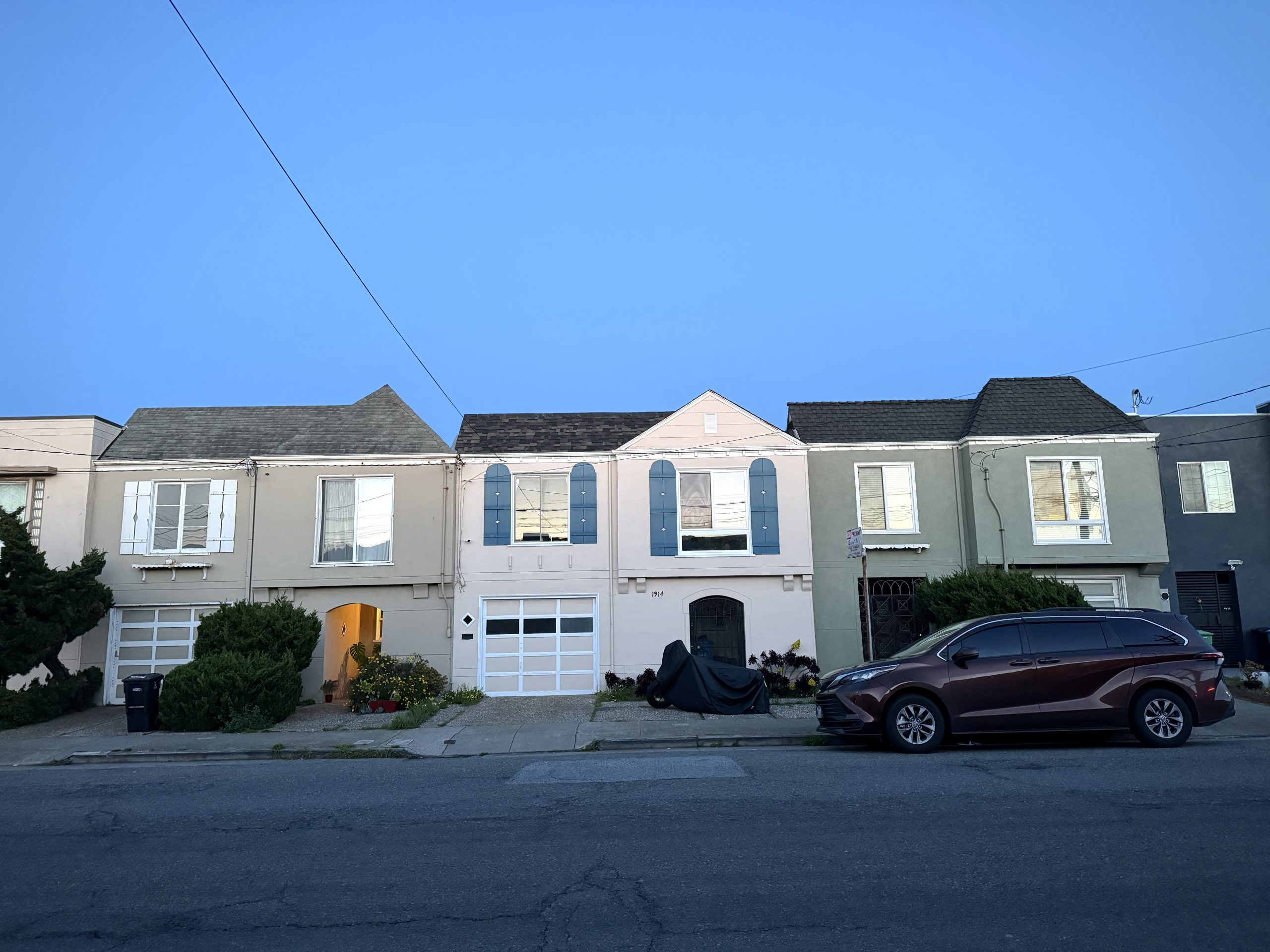
Sunset District single-family homes, the heart of San Francisco's in-law belt. Mission Local.
For decades the deal on a San Francisco in-law unit was one-sided: you could build it and you could rent it, but you could never sell it on its own. San Francisco's new ordinance, File 241069, now lets owners of single-family homes and small condo buildings sell a new accessory dwelling unit as a separate condominium, but only if the application to build it was submitted on or after May 1, 2025. One date decides everything.
The short version:
- San Francisco now allows one new ADU on a lot with four or fewer existing units, whether a single-family home or an all-condo building, to be sold separately as its own condo. On an existing property, the ADU must be detached. Older in-law units do not qualify.
- Only ADUs whose permit application was submitted on or after May 1, 2025 are eligible, a line drawn to keep rent-controlled tenants in existing in-laws from being pushed out by a conversion.
- The state law behind it, AB 1033, is opt-in. San Francisco, San Jose and the City of San Diego have adopted it, San Diego County followed in March 2026, and Los Angeles has not.
From the text
The default rule for an ADU in California has always been that it stays attached to the house, at least on paper:
Existing law requires the ordinance to include specified standards, including prohibiting the accessory dwelling unit from being sold or otherwise conveyed separate from the primary residence, except as provided by a specified law. Legislative Counsel's Digest, AB 1033 (2023).
AB 1033, authored by Assemblymember Phil Ting and signed as Chapter 752 of 2023, let cities opt out of that prohibition by passing a local ordinance. It is a permission slip, not a mandate. A city has to actually vote. On July 8, 2025 the San Francisco Board of Supervisors did, unanimously, and the ordinance took effect August 10.
What actually changed
The ordinance, sponsored by District 4 Supervisor Joel Engardio, amends the Planning and Subdivision Codes so that a qualifying ADU and its primary home can be split into separate condominium units and sold to different owners. It is aimed squarely at the west and south of the city, the Sunset, the Richmond, and the Excelsior, where single-family homes dominate and where, in Engardio's Sunset and Parkside, about 62 percent of homes are owner-occupied, nearly double the citywide rate. The pitch to those owners is blunt. "It's taking the one asset that you have that is the most valuable, and maximizing it," Engardio said, and selling a finished unit lets a homeowner recoup construction costs far faster than waiting on monthly rent. The eligibility is narrower than that pitch sounds. On a lot with an existing house or an all-condo building, only a detached ADU approved under the city's state-mandated (No-Waiver) program qualifies, and it cannot convert space inside any existing structure. That rules out the ground-floor and garage in-law conversions the Sunset and Richmond are known for, and most units built under the city's Local (Waiver) Program as well.
Here is the part that matters if you are a first-time ADU client running the numbers. The application to construct the ADU has to have been submitted on or after May 1, 2025. Not the finish date, not the sale date, the application date. If you applied for a permit in April 2025, or built your in-law in 2019, the condo path is closed to you. That cutoff is not an accident. It exists so that owners cannot take an older in-law occupied by a rent-controlled tenant, carve it off, and sell the tenant out of a home. If you rent an in-law that predates the cutoff, this ordinance does not put your unit on the market over your head.
Our read: the May 1, 2025 line is the whole ballgame. It makes the ordinance humane and nearly inert at the same time. From 2020 through 2024 San Francisco added only about 1,300 in-law units, and every one of them is disqualified, so the near-term supply of sellable ADU condos is close to zero. This is a bet on new construction that pays off years from now, not a switch that lights up the stock the city already has.
The cross-street check. This is where the three metros split hard. Los Angeles has the same state permission slip and has not signed it: Councilmember Nithya Raman introduced a motion in July 2025 to let Angelenos sell ADUs separately, but it has not become an ordinance, so as of mid-2026 an LA owner still cannot sell an ADU as a condo, a gap we flagged when San Diego County opted in. New York City is not even playing the same game. As we covered when A-du launched in New York, the City of Yes rules and the basement pilot are about legalizing an accessory unit and renting it, not titling it and selling it; a New York homeowner's ADU is a tenant and a certificate, not a condo deed. Same three letters, three completely different exits.
Who wins, and who waits
The clear winners are owner-occupants with land and a long horizon: the "house-rich, cash-poor" elders that an April 2025 report from the Sunset Chinese Cultural District described, families who want to build a second small home, keep it or sell it, and stay put either way. If you are the A-du-curious homeowner just starting to research where an ADU fits your finances, the honest read is that this changes your exit math, not your monthly math. A sellable condo at the end raises the ceiling on what you can recover, but you still have to finance and build the thing first, and you still have to want a saleable unit rather than rental income.
The people who wait are everyone with an existing in-law, plus the whole city's supply picture. For a policy meant to grow "affordable, entry-level" homes toward San Francisco's mandate of 82,000 units by 2031, a rule that only touches units built after last spring is a slow-acting one.
If you are weighing whether to build an in-law now that it can become a saleable condo, A-du's build marketplace lets you compare plans and builders before you commit to that permit date.
The ordinance is live, but the first San Francisco in-law condo will not close until a unit it covers is actually built and finaled, which makes the next year less a test of the law than of whether a sale at the end changes what owners are willing to start.