Your California ADU Bathroom Will Meet a Tenant. Build for Year Five.
Chris Koss, AIA|Published: October 30, 2026
California landlords cannot deduct normal wear and tear from a deposit, so a tired ADU bathroom is your bill. Here is how to pick tile, fixtures and a fan that still look like a choice, not a dispute, in year five.
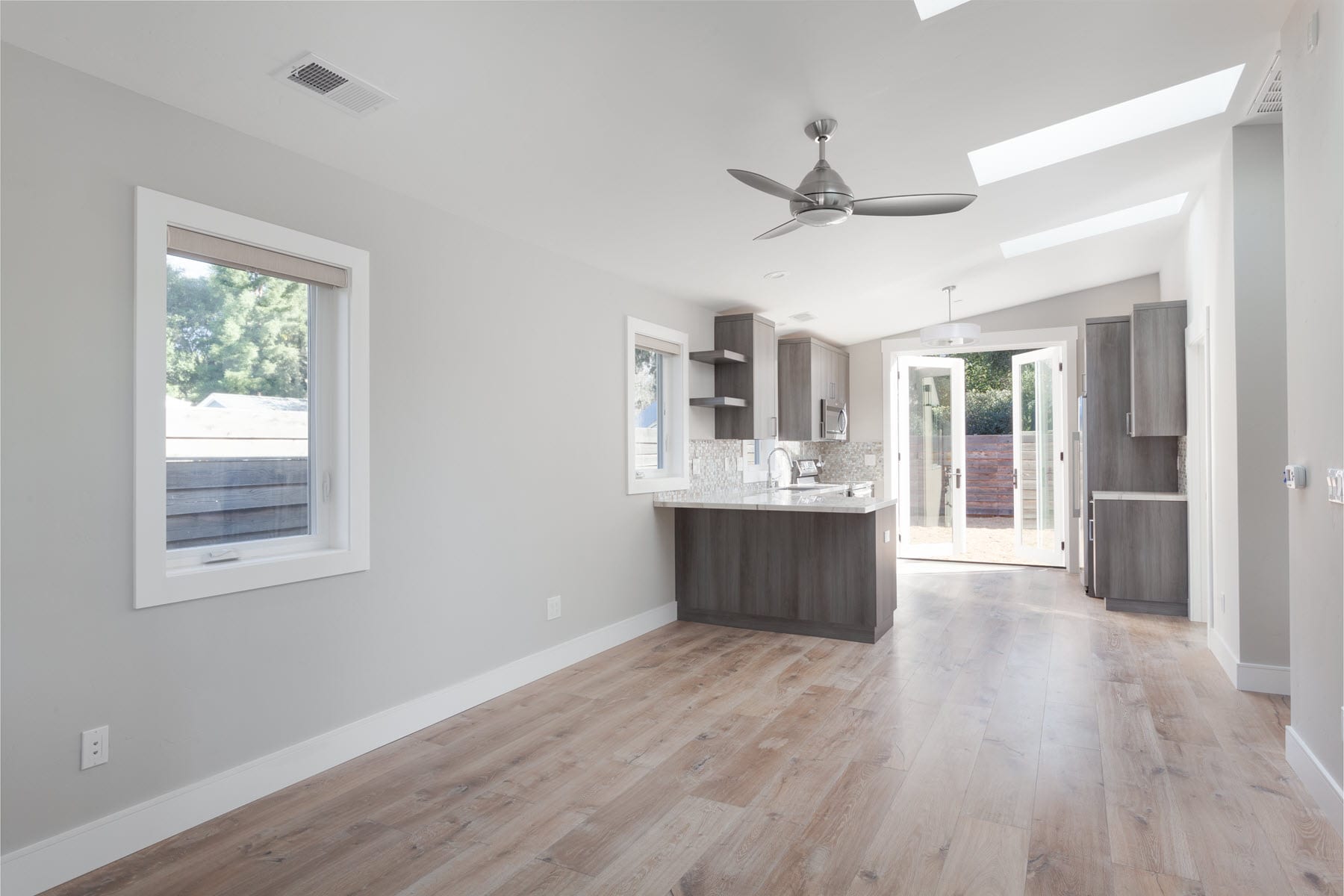
Inside the two-bedroom Open Ranch ADU in Mountain View, California. Photo by Kurt Manley, via Saikley Architects.
The bathroom you pick in a showroom is not the one your tenant will hand back in year five, after a few thousand showers and at least one winter of nobody running the fan. In California, the landlord gets 21 days after move-out to return the deposit, and can deduct only for cleaning and for damage beyond normal wear and tear, so every finish that wears out on schedule comes out of your pocket, not the tenant's.
The short version:
- California landlords must return a deposit, or itemize deductions, within 21 days of move-out, and normal wear and tear is never deductible.
- Any deduction over $125 needs copies of the invoices or receipts; if you do the repair yourself, you must list the work, the hours, and a reasonable hourly rate.
- EPA WaterSense toilets use 1.28 gallons per flush or less, 20 percent under the 1.6-gallon federal standard, and toilets drive nearly 30 percent of a home's indoor water use.
This is a walkthrough for first-time ADU clients finishing out a unit they plan to rent, and for the tenants who will live with those choices. The goal is not the cheapest bathroom or the prettiest one. It is the one that still looks like a decision in year five, instead of a dispute.
Step 1: Know what the law lets you charge for
Start with the rule, because it sets the budget. Under California's deposit statute, Civil Code Section 1950.5, the state courts' self-help guide on security deposits spells out what a landlord can deduct: cleaning, but only back to how clean the unit was at move-in, and repairs for damage "other than normal wear and tear" caused by the tenant or their guests. A tenant who disputes the deductions can sue for the deposit, plus up to twice its amount in damages if the landlord kept it in bad faith, in small claims court up to $12,500.
Translate that into a bathroom. Dull grout, a faucet cartridge that drips after thousands of uses, a vanity edge that swelled because water sat on it every morning: those are what ordinary living does to a room. They are yours. A cracked sink from a dropped bottle is not. Most of what fails in a small bathroom fails slowly, and slow failure is wear.
So the finish schedule is the deposit policy. Pick materials that age into "used" rather than "damaged," and the year-five conversation gets short.
Step 2: Buy fewer seams
Water finds joints. Every grout line, every caulk bead, and every place two materials meet is a place where a bathroom starts to look tired before anything is actually broken.
- Floor and shower tile. Larger-format porcelain means fewer grout lines to stain. A mid-tone grout hides what a white one shows by month six.
- Shower enclosure. A single fixed glass panel has fewer moving parts than a hinged door. No hinges to sag, no sweep to tear, no track collecting soap.
- Vanity. A one-piece top with an integrated sink removes the rim where water pools against the counter. A wall-hung cabinet keeps its base out of mop water.
- Walls. A scrubbable, moisture-resistant paint costs little more than flat paint and survives the inevitable wipe-down.
None of this is exotic. It is the same logic a good rental kitchen follows: fewer joints, fewer places for a tired look to start.
Step 3: Choose fixtures you can fix
The fixture question has two halves: what it uses, and what happens when it breaks.
What it uses. The federal WaterSense program labels toilets at 1.28 gallons per flush or less, against a 1.6-gallon federal standard. It labels showerheads at no more than 2.0 gallons per minute, against a 2.5-gallon standard, and bathroom faucets at a 1.5-gallon maximum, against a 2.2-gallon standard. California's own green building code sets mandatory limits for new homes in Chapter 4 of CALGreen, so confirm your fixture schedule against it before you order. On a new ADU, expect plan check to ask.
Those flow numbers matter more on an ADU than on a house, because of who pays. As we covered when we walked through who pays the ADU water bill, a unit on the main house's meter often leaves the owner absorbing the tenant's water, and EPA says showers alone run nearly 40 gallons a day for the average family. A low-flow fixture is a rent decision dressed up as a plumbing one.
What happens when it breaks. EPA also notes that household leaks can waste 180 gallons a week, with toilets often the culprit. Choose faucets and valves with replaceable cartridges from a maker whose parts you can still buy, put accessible shut-off valves under the sink and behind the toilet, and keep the model numbers in the lease file. Matte or brushed finishes hide water spots that polished chrome advertises.
Step 4: Design the fan for the tenant you will actually get
The most expensive bathroom failure is the one nobody notices: moisture. A tenant who never runs the exhaust fan is not causing damage on purpose, and a slow mildew bloom on the ceiling over five years can look a lot like wear. Assume the fan will be forgotten. Put it on a humidity sensor or a timer switch so it runs whether anyone remembers or not, pick a quiet one so nobody has a reason to disable it, and put an operable window over the shower if the layout allows.
Our read: in a rented ADU, the bathroom upgrade with the best return is not a finish at all. It is the paperwork. Date-stamped move-in photos of every surface, plus a fan that runs itself, will settle more year-five arguments than any tile you can buy.
Step 5: Document it, both of you
If you're a tenant, this part protects you too. After you give notice, California requires the landlord to tell you in writing that you can ask for a pre-inspection, which gives you a chance to fix things before move-out. Ask for it. Photograph the bathroom on the day you move in and the day you leave, and note the grout, the caulk, the fan, and anything that already drips. If the landlord does the repairs personally, the itemized statement has to show the work, the time, and a reasonable rate.
The cross-street check. Washington draws the same wear-and-tear line but adds a paperwork test with teeth. Under RCW 59.18.280, a Washington landlord has 30 days, not 21, to return the deposit with a full and specific statement, and cannot withhold anything for fixtures, equipment, or furnishings whose condition was not reasonably documented in the written move-in checklist. The same section caps a partial-damage charge at the cost of repairing the damaged portion, not the whole item. As we noted in our guide to Washington ADU tenant rights, a standalone ADU there is a dwelling unit under RCW 59.18 with the same deposit protections as any rental. The California courts' summary describes no such checklist bar, which raises a fair question for California owners: why rent without one anyway?
If the finish schedule calls for a tile setter or a plumber, A-du's services marketplace lists local contractors you can contact and hire directly; look up any California contractor's license yourself at cslb.ca.gov before you sign.
Build the bathroom for the fifth tenant, document it for the first, and year five becomes a cleaning bill instead of a small claims date.
Elsewhere on the ADU beat
- LADBS laid out how owners can permit an unpermitted ADU or JADU built before 2020 in Information Bulletin P/BC 2026-161, LADBS.
- Unincorporated LA County's 2026 ADU ordinance amendment comes with separate single-family and multifamily guides, LA County Regional Planning.
- Tacoma takes stock of its 2019 ADU reform and asks whether gentle density is working, KNKX.