California Taxes Your ADU Rent Up to 13.3%. Washington Doesn't.
Chris Koss, AIA|Published: August 23, 2026
Last updated: October 1, 2026
Rent out a California ADU and the income is taxed as ordinary money, up to 13.3 percent at the state level. Depreciation quietly shields part of it, while a Washington landlord across the state line owes zero state tax.
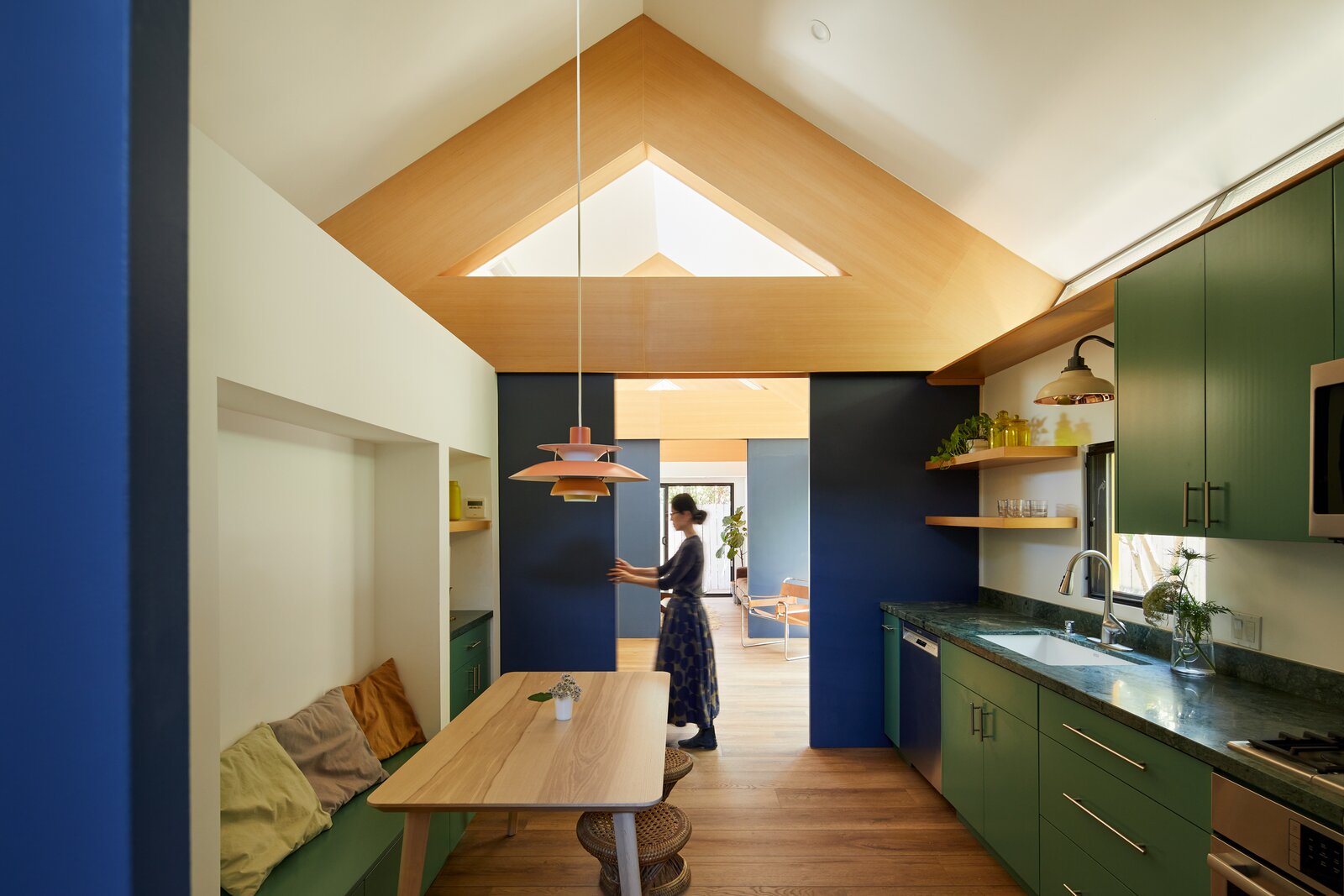
A 750-square-foot ADU in Los Angeles's Atwater Village, designed by Bo Sundius and Hisako Ichiki of Bunch Design. Photo via Dwell.
You built the ADU, found a tenant, and the first rent check cleared. Here is the part nobody mentions at the permit counter: that check is ordinary income, and California taxes it at your marginal rate, as high as 13.3 percent on top of the federal bill. The number that matters is not the rent. It is the taxable slice left after depreciation and expenses, and for most owners that slice is less than half of what the tenant actually pays.
The short version:
- ADU rent is reported on federal Schedule E and taxed as ordinary income; California adds a state tax of up to 13.3 percent, while Washington adds nothing at all.
- You depreciate the ADU's construction cost over 27.5 years, a paper deduction of roughly $10,900 a year on a $300,000 unit that quietly offsets rent you actually collected.
- Operating costs (a share of property tax and insurance, repairs, utilities you cover, management fees) come off before tax; capital improvements do not, they depreciate instead.
Rent is not taxed. Net income is.
The Internal Revenue Service treats an ADU exactly like any other residential rental: you report gross rent, subtract the ordinary and necessary costs of running it, subtract depreciation, and pay tax on what remains. The rules live in IRS Publication 527, and the arithmetic runs through Schedule E. None of it is California-specific; the federal return is the same whether the unit sits in Mar Vista or Modesto.
Suppose your detached ADU rents for $2,400 a month, or $28,800 a year. Here is where that money lands by April:
| Line item | Illustrative amount |
|---|---|
| Gross annual rent ($2,400 per month) | $28,800 |
| Less operating expenses (property-tax share, insurance, repairs, utilities, management) | ($6,000) |
| Less depreciation ($300,000 building basis, over 27.5 years) | ($10,900) |
| Taxable rental income | $11,900 |
The tenant paid $28,800. You are taxed on $11,900. Depreciation did most of that work, and here is the trick worth understanding: it is a deduction you take without spending a dollar that year. The IRS lets you write the building down as if it were slowly wearing out, one 27.5th at a time, at a steady rate of about 3.636 percent of the building's cost. On a $300,000 ADU that is roughly $10,900 a year of shelter from tax, or close to four and a half months of that rent, kept off the return entirely.
Repairs versus improvements. Fixing a leaking valve or repainting is a repair, deducted the year you pay it. Replacing the roof or the HVAC is an improvement, and it depreciates on its own schedule. First-time landlords blur the two constantly, usually to their own disadvantage, because a repair deducted today is worth more than an improvement spread across three decades.
One more line most owners meet by surprise: when you eventually sell, the IRS recaptures the depreciation you claimed, taxing it at up to 25 percent. Depreciation is a loan against your future basis, not a gift. It is still worth taking, but budget for the recapture the way you would budget for any deferred bill.
When the deductions run past the rent
In an ADU's early years, depreciation plus expenses can exceed the rent, producing a paper loss. Whether you can use that loss against your salary depends on your income: the tax code allows up to $25,000 of rental loss to offset other income if you actively participate and your adjusted gross income is under $100,000, phasing out to nothing by $150,000. Above that, the loss waits, carrying forward until you have rental profit or sell. If you are a first-time ADU client still deciding whether to rent the unit at market rate or house a relative, note that the whole machine only switches on once a paying tenant moves in; a unit lived in by family is not a rental at all.
The cross-street check. The federal half of this is identical whether your ADU sits in Mar Vista, the Outer Sunset, or Chula Vista; Schedule E and the 27.5-year clock do not care about your zip code. The state half is where the map redraws itself. California taxes the $11,900 as income, up to 13.3 percent at the very top. A Seattle owner with the same unit and the same tenant owes zero state income tax, because Washington has no personal income tax (a new 9.9 percent tax arrives in 2028, but only on income above $1 million, which no single-ADU landlord will see). Oregon taxes the same slice at up to 9.9 percent. And a Queens owner pays the heaviest combined bill of any market we cover, because New York City layers its own local income tax on top of New York State's. Same rent, six markets, six different keep-rates.
We ran the rent side of this once before, comparing San Francisco's Waiver-track ADUs against the No-Waiver track in our look at the rent-control tradeoff, where the variable moving the yield was rent control, not the tax code. And on the resale side, we flagged that the value an ADU adds to your home rarely matches what you spent. The tax return is where the unit earns its keep in the years between.
Our read: depreciation is the most valuable line on an ADU landlord's return, and the one most first-timers leave blank. It costs nothing to claim, it shields close to four and a half months of the rent in a typical year, and the only thing it demands is that you keep records from the day the unit is placed in service. Skip it and you are not saving trouble, you are lending the government an interest-free deduction you were owed.
Once the unit is rented, the records that make depreciation and every deduction hold up are the same records a good manager keeps by default; A-du's manager marketplace is where owners hand that off rather than reconstruct it every April.
The rates above are today's, and the one worth watching is Washington's 2028 tax on income over $1 million; for now, a backyard unit in Seattle remains the rare ADU whose rent the state never touches.
Elsewhere on the ADU beat
- Governor Newsom signed SB 1117 on September 29, 2026: starting January 1, 2027, impact fees on an ADU over 750 square feet are charged only on the area above 750 on lots with up to two ADUs, per the chaptered bill text. California YIMBY tracked it through the session's final weeks.
- San Diego County is weighing owner-occupancy and tenant right-of-first-refusal rules for separately sold ADUs, a follow-up to its March condo-sale ordinance, via Times of San Diego.