Renting a Washington ADU? The Landlord Can Live Anywhere.
Chris Koss, AIA|Published: September 14, 2026
Last updated: September 25, 2026
Washington bars cities from making ADU owners live on-site, so your backyard-cottage landlord may be miles away. The Landlord-Tenant Act still guarantees repairs, your deposit, and 90 days' notice before a rent hike.
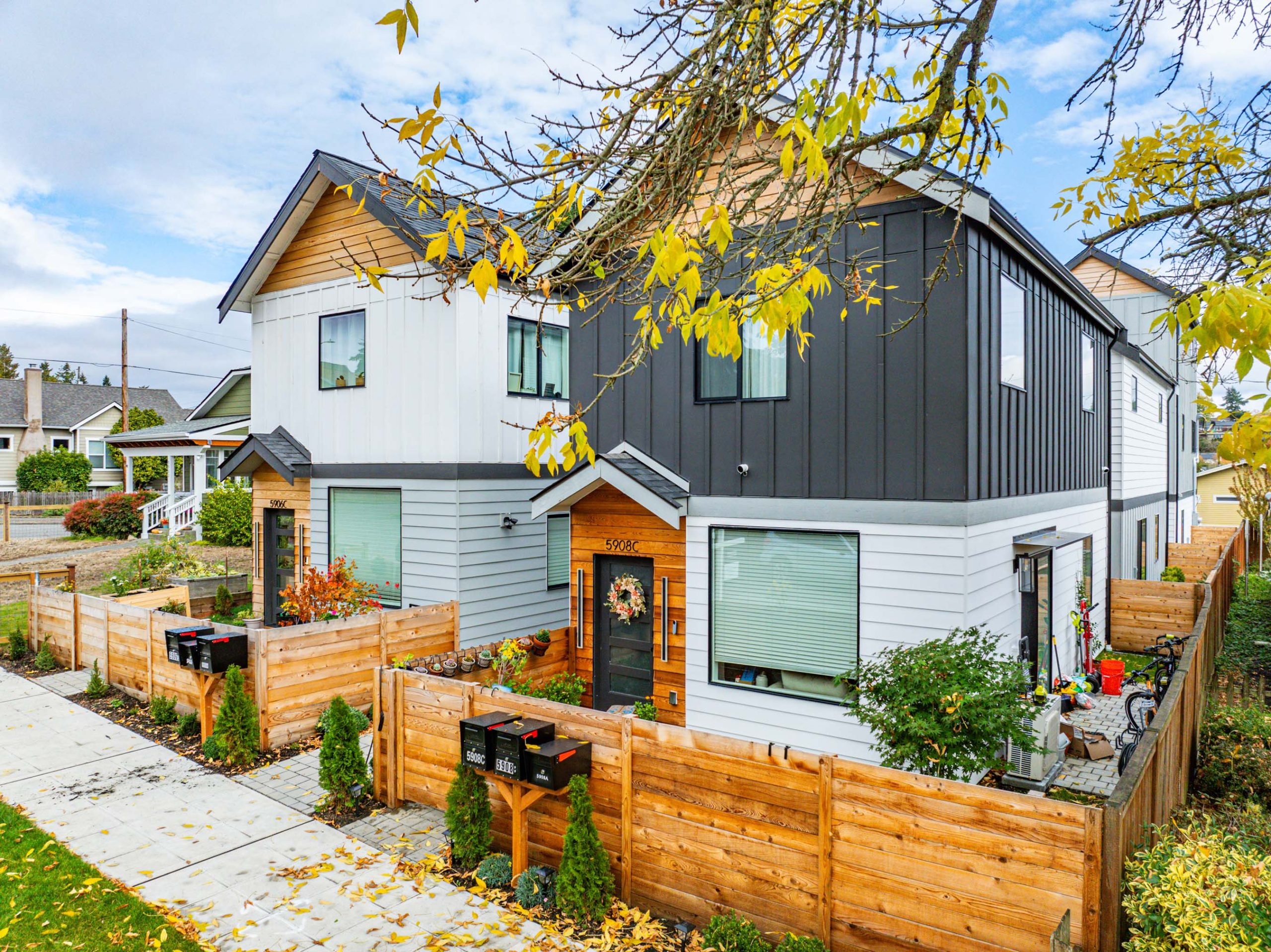
A completed backyard cottage (DADU) in Seattle. New Image Construction.
You find a backyard cottage to rent in a Seattle or Spokane neighborhood, the light is good and the kitchen is new, and then you learn the owner lives three zip codes away and you start to wonder what that costs you. In Washington it costs you nothing: state law forbids cities from making an ADU owner live on the lot, and a self-contained accessory dwelling unit you rent on its own is a full dwelling unit under the Residential Landlord-Tenant Act, so the same rulebook that covers a downtown apartment covers your cottage.
The short version:
- Washington's HB 1337 bars cities from requiring an ADU owner to live on the lot, so an off-site landlord is legal and says nothing bad about the unit's status.
- A standalone ADU you rent is a dwelling unit under the Residential Landlord-Tenant Act (RCW 59.18), which gives you the same repair, deposit, and notice protections as any Washington tenant.
- Your landlord must give at least 90 days' written notice before raising the rent, and 30 days before changing any other rule of the tenancy.
If you are a tenant, that is the whole reassurance in three lines. The rest is how to check it against the actual unit, because a protection is only as good as the paperwork under the cottage.
First, confirm it is a legal ADU
Washington defines an accessory dwelling unit as a residential unit with its own permanent kitchen, bathroom, and sleeping space on the same lot as a house. If the cottage has all four and its own entrance, it is a dwelling unit, and the tenant law follows automatically. Ask the landlord for the permit or the address on file with the city, then confirm the unit was built or converted with a permit. A converted garage that skipped the permit counter is a different and riskier conversation, and it is the one place where the clean protections below get murky.
One nuance worth knowing before you sign. Renting a whole detached cottage is covered by the Residential Landlord-Tenant Act. Renting a single room inside the owner's own house, sharing their kitchen, is not the same tenancy and carries fewer protections. The wall between those two situations is exactly the wall that makes an ADU an ADU.
The owner does not have to live here, and that is the law working
The most common worry renters bring to an accessory unit is that the absent owner means the unit is somehow off the books. In Washington the opposite is true. The legislature took owner-occupancy off the table statewide in HB 1337.
"The city or county may not require the owner of a lot on which there is an accessory dwelling unit to reside in or occupy the accessory dwelling unit or another housing unit on the same lot." RCW 36.70A.681(1)(b).
The state defines an "owner" as anyone holding at least 50 percent of the property (RCW 36.70A.696), and it never asks that person to sleep on the lot. The same law makes cities allow two ADUs on a single-family lot, so the quiet corollary for you is that a second cottage may go in behind the same house. Your lease covers your unit. It does not promise you the backyard to yourself.
What the Landlord-Tenant Act actually guarantees you
Once the unit is a legal dwelling, the protections are the same ones every Washington renter gets, and two of them are worth memorizing. Your landlord must give at least 90 days' written notice before any rent increase, and that increase cannot land in the middle of a lease term (RCW 59.18.140). Any other change to the rules of the tenancy, a new pet policy, a parking change, needs 30 days. The landlord also owes you a habitable unit and the deposit and repair duties spelled out across the rest of Chapter 59.18. Washington has also added a statewide cap on annual rent increases, though newly built units can be temporarily exempt, so ask directly whether the cap applies to the cottage you are looking at.
The cross-street check. This clean, one-rulebook picture is a Washington luxury. In Los Angeles, whether an ADU is even under rent control turns on a single document, the unit's own certificate of occupancy, and a converted garage can inherit the main house's protections while a new detached unit next door skips them for years, a split we walked through in our LA rent-control guide. California also still lets local owner-occupancy rules attach to some junior units. In New York City the basement-legalization pilot layers on sitting-tenant rights and a right of first return that have no Washington equivalent, because Washington never needed a pilot; it just deleted the owner-occupancy rule for everyone at once.
Where people get stuck: the owner sells the cottage
Here is the twist the absent-owner setup sets up. Because HB 1337 also bars cities from blocking the sale of an ADU as its own condominium (RCW 36.70A.681(1)(k)), the person who signed your lease may not be the person who owns the unit at renewal, a shift we covered when Washington opened ADU condo sales. A sale does not cancel your lease. A new owner steps into the old one and keeps the same notice obligations. So the question to ask is not whether the owner lives here, but whether the unit is a separate legal parcel that could be sold on its own, and what your lease says about a change in ownership.
The move-in ledger, and the three questions that settle it
Budget your move-in money the way you would for any apartment: a deposit, likely the first month, and any nonrefundable fees named in writing before you pay them. Then, standing in the doorway, settle the unit's legal shape with three questions. Was this built or converted with a permit, and what is its address on file? Is it its own parcel that could be sold separately, or is it tied to the house? And does the statewide rent cap apply, or is the unit new enough to be exempt? Get those three answered and the off-site landlord becomes a non-issue, which, under Washington law, is exactly what it is.
Our read: Washington wrote the cleanest renter deal on the West Coast, no owner-occupancy asterisk, the full Residential Landlord-Tenant Act, a 90-day floor under every rent increase. The catch is not in the tenant law at all. It is that the same statute lets the cottage be sold out from under the lot as a condominium, so read the ownership structure as carefully as you read the finishes.
If you are hunting for a legal backyard cottage to rent, A-du's rental map lets you filter Washington ADU listings so you can see the unit's status before you tour it.
The next thing to watch is Seattle's refreshed plan catalog, which will decide how many of these cottages get built to rent in the first place.
Elsewhere on the ADU beat
- Seattle is picking a new round of pre-approved backyard-cottage designs, with a refreshed gallery now expected in January 2027, per Seattle OPCD.
- Portland's temporary system development charge waiver for new housing pointedly leaves ADUs off the eligibility list, per Portland.gov.
- Massachusetts opened a public comment window on revised statewide ADU regulations through early October, per Mass.gov.