ADU Loans in California: What Lenders Ask For Before You Apply
Chris Koss, AIA|Published: November 19, 2026
Most ADU loans want you living in the home, a member card, plans with a priced estimate and often permits. Here is what the lenders listed on A-du publish, by area, and why Los Angeles and San Diego have no local option.
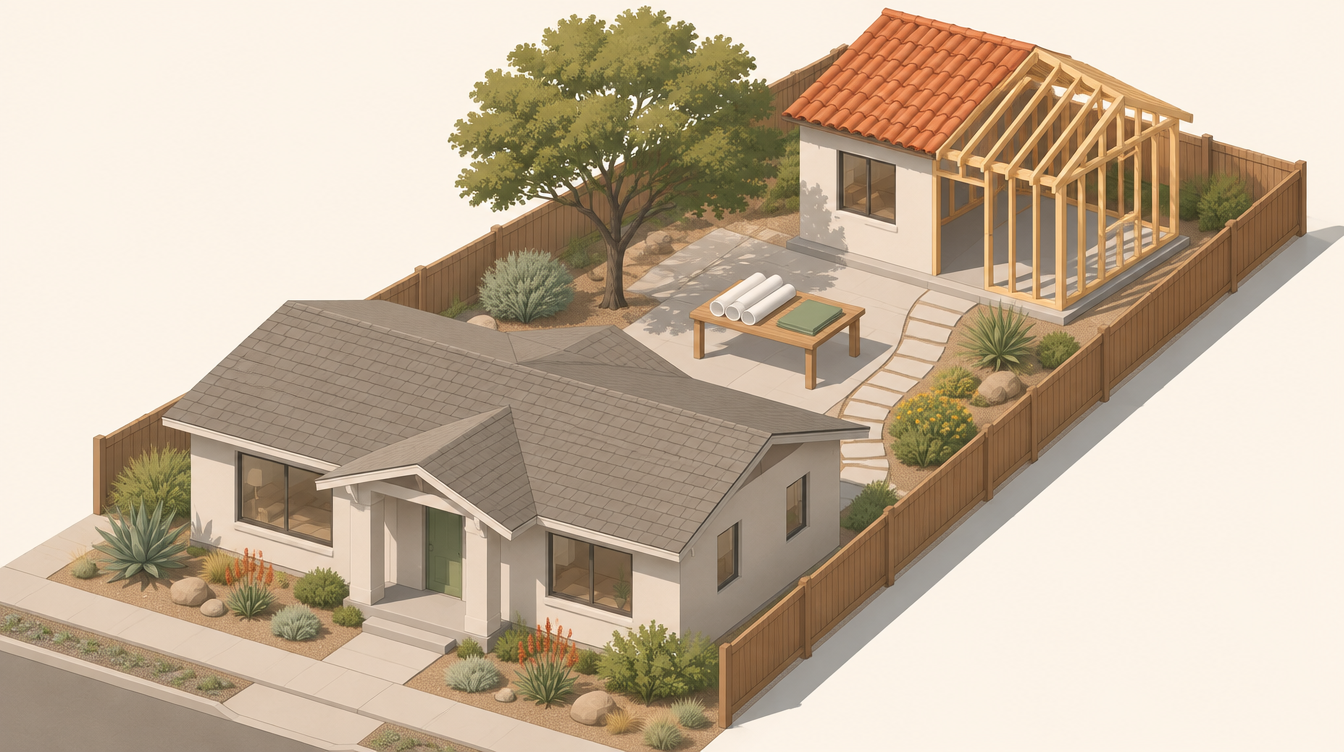
AI-generated illustration for A-du Insights. It shows no real project, address, or person.
Compiled from each lender's and agency's own public page, read November 18, 2026. Terms change; each lender's page has its latest guidelines.
The plan is picked and the cost estimate looks survivable. Then the lender asks three things before it asks about rates: do you live there, are you a member, and where are your permits? Of the five listings in A-du's Financing and Lending directory, three lenders size the loan on what your home will be worth once the ADU is built, and none has an ADU loan made just for Los Angeles or San Diego.
The short version:
- Most ADU loans are for your primary residence, and credit unions lend only to members, so where you live decides which lenders you can even apply to.
- Patelco, KeyPoint and Redwood lend on the home's value after the ADU is built (Patelco and KeyPoint up to 90 percent), so an appraisal on paper plans is part of the deal.
- Projected rent helps less than you'd hope: KeyPoint counts up to 75 percent of it, and Fannie Mae counts ADU rent only from a unit that already exists.
Step 1: Be the borrower they lend to
If you're a homeowner pricing a backyard unit, start here, because it rules lenders in or out before any paperwork. Patelco lends on primary residences in California, and anyone can join through the Financial Fitness Association. KeyPoint's ADU page says "CA Bay Area," and membership runs by county, employer, family or the same association. Monterra lends on an existing, permitted, owner-occupied single-family home that can take an ADU, with membership in San Mateo, Alameda, Contra Costa, Santa Clara and San Francisco Counties. Redwood Credit Union lends on primary residences in Sonoma, Mendocino, Lake, Napa, Marin, San Francisco, Contra Costa and Solano Counties.
RenoFi is the outlier. It is not a lender; its partner lenders make the loans and decide who qualifies.
Step 2: Bring the paperwork they read
RenoFi's ADU page publishes the most complete list, and it reads like everyone else's unwritten one: your two latest pay stubs, two years of W-2s, proof of homeowners insurance, your latest mortgage statement, bank and investment statements, contractor information, plans and contracts, and a detailed cost estimate for the appraisal.
Monterra goes further on timing. Before you apply, it wants plans and a project manager, all permits and approvals, and zoning that allows the ADU. That is the part most homeowners have backwards. They shop the loan first and the permit second, and a lender like this one won't start until the city has finished.
Step 3: Know how the loan gets sized
Because the ADU doesn't exist yet, these lenders price the house as if it did. Patelco's line of credit runs from $10,000 to $400,000, up to 90 percent of the value after construction, with two years of interest-only payments while you build and 20 years of repayment after. KeyPoint lends up to 90 percent of future value, pays draws to your contractor, and lists about $2,000 to $3,000 in fees. Redwood lends up to $500,000 on future value, interest-only during construction, then converts to a regular loan with no new credit check.
The practical meaning: the appraiser reads your plans and your cost estimate, not your backyard. A plan with a real, site-specific number gets a real appraisal. A napkin sketch gets a napkin.
Step 4: Don't bank on rent you don't have yet
KeyPoint counts up to 75 percent of the projected rent from the ADU you're building. Patelco says it will consider projected rent, without a percentage. The big agency programs are stingier. Fannie Mae counts 75 percent of ADU rent, capped at 30 percent of qualifying income, and only from an ADU that already exists. FHA uses the same 75 percent and 30 percent cap, and 50 percent on a 203(k), under HUD Mortgagee Letter 2023-17. For a new build, rent usually helps only at a lender that counts it on paper, like KeyPoint.
Where people get stuck
Location. Every lender above lends on California homes, but only Patelco and RenoFi's partners reach Los Angeles and San Diego. KeyPoint's membership area includes Sacramento, Placer and El Dorado Counties while its ADU page says Bay Area, so a Sacramento homeowner should ask before applying.
Public money. As we covered when CalHFA's ADU Grant paused, the state program is out of funds, and CalHFA's own page has said so since December 28, 2023. We found no open city or county ADU loan or grant for Los Angeles, Oakland, San Jose or Santa Clara County.
The product itself. If you're still choosing between a home equity line, a construction loan and a cash-out refinance, our June comparison of the three still holds. The lenders here mostly sell the first two.
The cross-street check. New York and San Diego tried public ADU lending; the Bay Area runs on credit unions. HPD's Plus One ADU program offered owners who live in the home up to $395,000 in loans and grants, with income limits and rent limits for 15 years, and stopped taking applications on June 12, 2026. The San Diego Housing Commission runs an ADU Finance Program for the City of San Diego with income and rent limits, but its pages disagree on whether funds are available. In the Bay Area, nobody caps your rent in exchange for the loan; the price is membership and a full permit file.
Our read: for most California homeowners the ADU loan now comes from a credit union lending on the finished value, not from a public program, and the borrowers who get through fastest are the ones who arrive with permits in hand and a priced plan, not a rate quote.
A-du's ADU financing page lists what each of these lenders publishes, by area, with a link to each lender's own page for its latest guidelines, and every plan in A-du's build marketplace shows an estimated build cost for your lot.
If the San Diego Housing Commission confirms new funding, it will be the only open public ADU loan on this list.
Thinking about an ADU?
Will an ADU fit your lot?
Enter your address to see pre-approved plans ranked for your lot, with build-cost ranges. Then request a free test fit on the plan you like.
The ranking is a quick estimate from county records. A test fit checks it.