California's 2026 ADU Handbook: Permit Clocks, Fee Caps, JADU Changes
Chris Koss, AIA|Published: May 28, 2026
Last updated: September 25, 2026
California's 2026 ADU Handbook dropped on April 7 with updates covering SB 543's 60-day permit deadlines, AB 462's coastal approval window, and new JADU owner-occupancy rules under AB 1154.
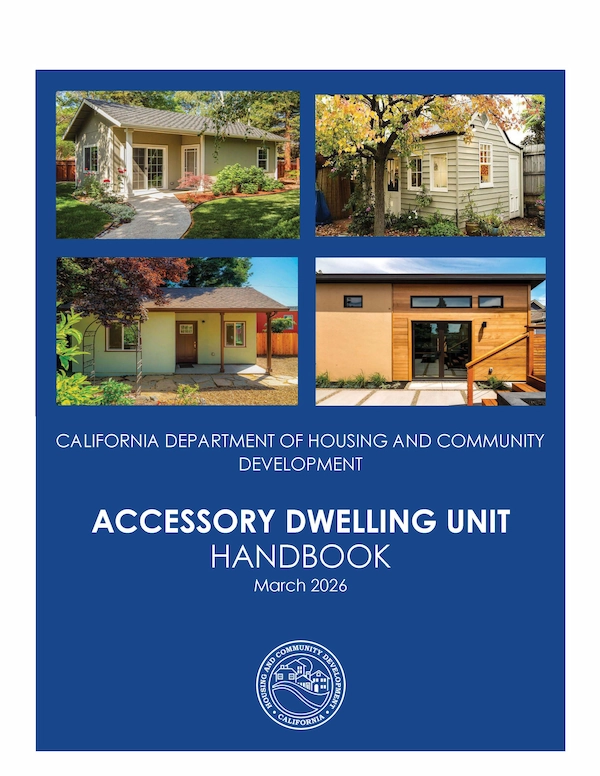
The 2026 ADU Handbook cover, released April 7 by California's Department of Housing and Community Development.
On April 7, 2026, California's Department of Housing and Community Development released the 2026 ADU Handbook, an updated reference absorbing four bills signed by Governor Newsom in fall 2025: SB 543, AB 1154, AB 462, and SB 9. The handbook covers law changes across three effective dates: June 30, 2025, October 10, 2025, and January 1, 2026. If you are permitting an ADU in Los Angeles, San Jose, or anywhere along the California coast, three provisions in particular change your timeline and your cost math.
The permit clock under SB 543
Before SB 543, the 60-day approval clock already existed, but local permit offices had wide discretion over how long to take deciding whether an application was complete. SB 543 draws hard lines. From the date a homeowner submits, the local agency now has 15 business days to return a completeness determination and list any missing items. Once the agency marks the application complete, a 60-day approval or denial clock starts. If the agency misses that 60-day window, the application is automatically deemed approved under California Government Code Section 66317(a).
If you are a first-time ADU client, document your submission date and track the 15-business-day completeness window. Most applicants do not know they can point to that clock. If you submit a clean package and the city goes quiet past the deadline, that is not a gray area under current law. SB 543 also exempts any ADU or JADU of less than 500 SF from school developer fees entirely, separate from the impact fee cap described below.
The coastal fix under AB 462
Coastal jurisdictions have a separate permitting layer: the Coastal Development Permit. Before AB 462, a CDP review for an ADU had no hard deadline, meaning a project in Santa Monica, Encinitas, or Malibu could sit in the coastal review queue for years while meeting every state standard. AB 462 was passed as an urgency measure and took effect on October 10, 2025. Any local agency with a Certified Local Coastal Program must now approve or deny a completed CDP application for an ADU within 60 days. The same auto-approval mechanism in Government Code Section 66317 applies if they miss it.

JADU rule changes under AB 1154
The JADU provisions in the 2026 handbook are the ones most likely to catch homeowners and tenants off guard, because they cut both ways.
Owner-occupancy, narrowed. California law has long required that homeowners live on-site when they create a JADU (a unit of up to 500 SF within an existing single-family home). AB 1154 narrows that requirement. Owner-occupancy is now triggered only if the JADU shares a bathroom with the main residence. If the JADU has its own bathroom, the owner is not required to live on-site under state law. For owners who want to create a JADU and eventually rent both the main house and the JADU as separate units, this removes the previous constraint.
Short-term rental prohibition. The corresponding change: all JADUs under state law must now be rented on terms longer than 30 days. No short-term rental platforms. If you are a tenant renting a JADU and your lease requires a term longer than 30 days, this is the statutory basis for it. From a lender's perspective, ruling out short stays also makes JADU rental income more documentable for cash-flow underwriting.
The impact fee cap, clarified
Impact fees for ADUs have two thresholds in current California law, and they differ by unit type. For a standard ADU: no impact fees on any unit with 750 square feet or less of interior livable space. For a JADU: no impact fees on any unit with 500 square feet or less. For ADUs over 750 SF, fees can still be charged but must be proportional to the primary dwelling based on square footage, not assessed as if the ADU were a fully separate parcel.
Impact fees in California typically include park fees, transportation fees, and similar development fees. Utility connection fees and capacity charges are not impact fees under the ADU statute and follow separate rules, and school fees are waived only for units under 500 SF. These add up quickly on a larger unit in high-cost cities. The 750 SF threshold covers a broad majority of garage conversions and most standard plan configurations statewide. If you are designing close to that threshold, running the fee math before you push past it can meaningfully change your project budget.
What else the handbook covers
The full 2026 handbook runs well beyond these provisions. It addresses SB 9 updates, ministerial approval requirements, owner-builder options, fire safety rules, and limits on how local agencies can restrict ADU height and setbacks. HCD also launched a searchable Housing Accountability Unit Letters Dashboard, covering almost 1,200 technical assistance and enforcement letters sent to local jurisdictions since 2021 on compliance with state housing laws, including ADU ordinances. If your city has historically added illegal conditions to ADU approvals, that dashboard shows whether HCD has already flagged it.
If you are a tenant evaluating a JADU in Eagle Rock, Culver City, or anywhere in unincorporated LA County, read the JADU sections of the handbook before you sign. The new owner-occupancy threshold, the bathroom-sharing test, and the rule that rentals run longer than 30 days all affect what a compliant lease looks like and what your rights are as a renter.
Ready to model the actual permit fee load before your first appointment? A-du's permit fee calculator pulls current fee schedules from LADBS, San Jose, San Diego, Long Beach, and other California jurisdictions so you can build a realistic cost picture going in.