In San Diego, the City Rewards Affordable ADUs. The County Doesn't.
Chris Koss, AIA|Published: August 27, 2026
Last updated: September 25, 2026
Inside San Diego city limits, one affordable ADU can earn bonus market-rate units. In the unincorporated county, that lever disappears: same state floor, no bonus program, and a different permit counter entirely.
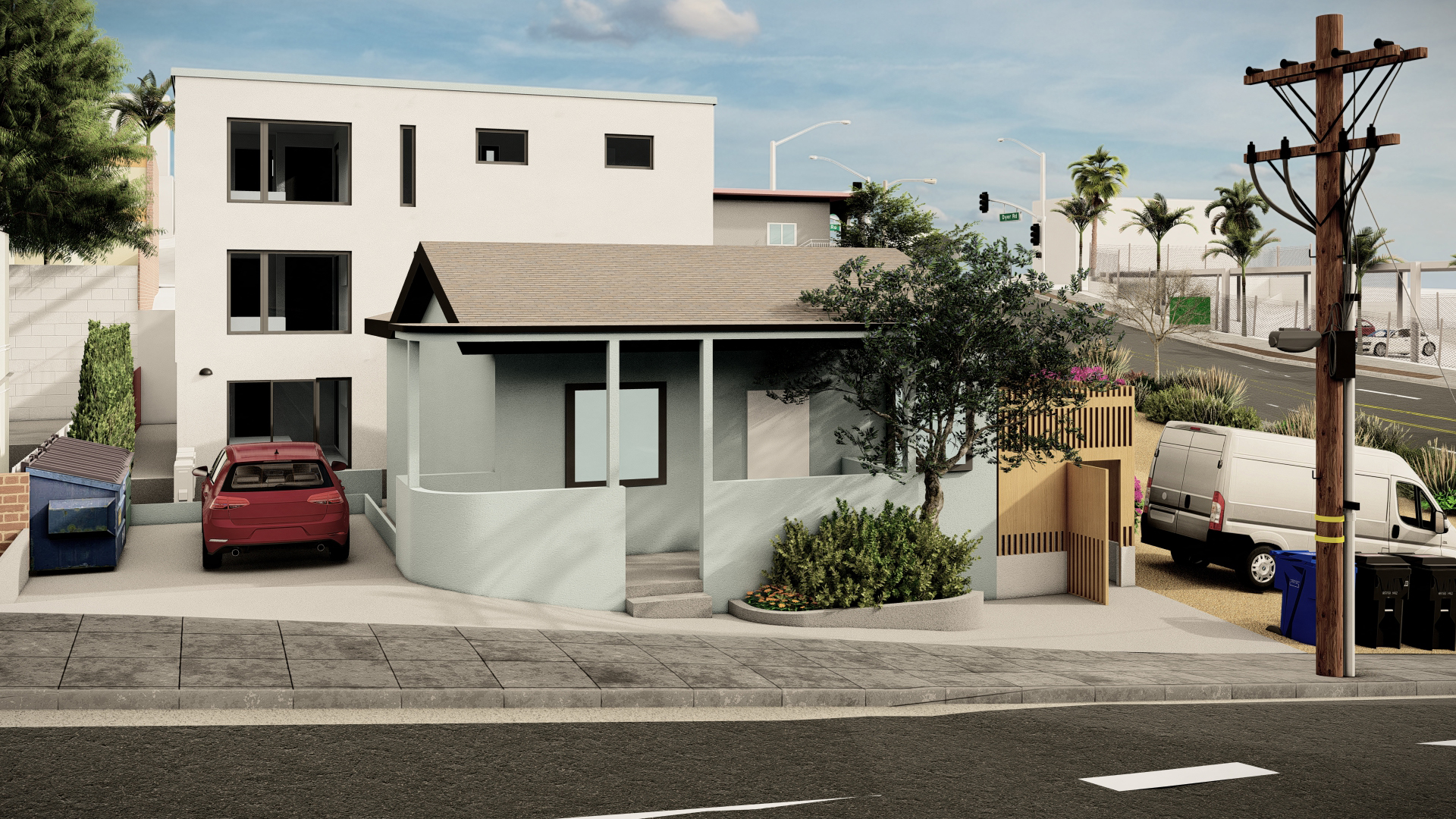
A San Diego bonus-ADU project, the kind of density the City program can add and the unincorporated county cannot. Photo via the UC Berkeley Terner Center for Housing Innovation.
Two houses can sit a five-minute walk apart in greater San Diego and answer to two completely different ADU rulebooks, and the only thing that decides which one is yours is the address. Inside city limits, the City of San Diego runs an ADU Bonus Program that lets one deed-restricted affordable unit earn bonus market-rate ADUs on your lot; in the unincorporated county, Planning and Development Services offers no bonus at all, just the state floor: on a single-family lot, a converted ADU, a detached ADU, and a junior ADU. Same county, same state law underneath, two different permit counters and two very different ceilings.
The short version:
- If your parcel is inside the City of San Diego, you file with the Development Services Department and you can tap the ADU Bonus Program; if it is unincorporated, you file with the County's Planning and Development Services, which has no bonus program.
- The City's bonus lets one affordable ADU (deed-restricted for very low, low, or moderate income for 15 years) earn a bonus market-rate ADU, and inside a Sustainable Development Area (the City's program page still says Transit Priority Area) the trade can repeat, though single-family-zoned lots are now capped at four to six ADUs and JADUs by lot size.
- Both tracks sit on the same California floor: ministerial approval, a 15-business-day completeness clock under SB 543, and no impact fees on an ADU up to 750 square feet. The floor is identical; the ceiling is not.
First, figure out which counter is even yours
This is the step people skip, and it is the one that sets everything else. A San Diego mailing address does not tell you who permits your ADU. Incorporated parcels inside the City of San Diego go to the City's Development Services Department under Municipal Code Section 141.0302 and Information Bulletin 400. Unincorporated parcels, which cover a large share of the county's land and plenty of places with San Diego mailing addresses, go to the County's Planning and Development Services. Look up your jurisdiction before you draw a single line. If you are a first-time ADU client, this one lookup will save you a wasted pre-application meeting at the wrong desk.
The state floor both share
Start with what is the same, because it is a lot. California law forces both the City and the County to approve a conforming ADU ministerially, with no discretionary hearing and no neighbor veto. Both must clear a completeness determination within 15 business days under SB 543. Both must allow a converted ADU, a detached ADU and a junior ADU on a single-family lot, cap the detached unit at 1,200 square feet, hold setbacks to four feet, and waive impact fees on anything up to 750 square feet. A homeowner reading only the state handbook would see two identical programs. The state handbook is not where these two diverge.
Where the City pulls ahead: the ADU Bonus Program
The City of San Diego's ADU Bonus Program is the whole reason a San Diego lot can carry more homes than an identical lot one jurisdiction over. Deed-restrict one ADU as affordable to a very low, low, or moderate income household for 15 years, and the City lets you add a bonus market-rate ADU. Inside a Transit Priority Area, the City's page states one bonus unit is available for every affordable unit with no stated limit on the total. That page is out of date: the amended code uses a walking-distance Sustainable Development Area for the repeatable trade, and since the 2025 reforms a single-family-zoned lot is capped at four ADUs and JADUs (8,000 square feet or less), five (8,001 to 10,000) or six (over 10,000), per Information Bulletin 400. That single lever is what put ten and twelve units in a single San Diego backyard, and it is also what drew the backlash and the tightening we covered when the City reworked the program and one 136-unit project shrank to 125. The program now carries a fee on the smallest bonus units, a parking requirement outside transit areas and that lot-size cap. It is contested, and it is still far more than the county offers.
The City has one more advantage the County does not match: the San Diego Housing Commission runs an ADU Finance Program that lends construction money and hands technical help to lower-income City homeowners. On plans, the two are closer than they look. The City accepts pre-reviewed Standard and Permit-Ready ADU building plans, and the County offers its own pre-approved detached ADU plans, which it describes as about 85 percent complete.
City versus County, line by line
| Feature | City of San Diego | Unincorporated County |
|---|---|---|
| Permit counter | Development Services Department | Planning and Development Services |
| Base allowance | 1 converted ADU + 1 attached or detached ADU + 1 JADU (single-family) | 1 converted ADU + 1 detached ADU + 1 JADU (state floor) |
| Bonus program | Yes (Section 141.0302) | None |
| Pre-reviewed plans | Standard and Permit-Ready sets | County pre-approved detached ADU plans |
| Public financing | SDHC ADU Finance Program | None |
| Sell ADU as a condo (AB 1033) | Adopted | Adopted March 4, 2026 |
Where people get stuck. The trap is assuming the bonus travels with the San Diego name. It does not; it stops at the city line. Owners in unincorporated communities read about ten-unit backyards, sketch a plan, and only then learn their parcel answers to a county track with no bonus at all. The second trap is the transit map: the City's repeatable bonus only applies inside a Sustainable Development Area, and lot size now caps the total on single-family-zoned lots, so two City lots can carry very different ceilings too. Confirm your jurisdiction, then your Sustainable Development Area status and lot size, before you fall in love with a unit count.
The cross-street check. San Diego's split is not unique, and seeing how other markets handle it sharpens the point. Los Angeles has the same city-versus-county fork, LADBS on one side and Regional Planning on the other, each with its own free plan catalog, which we walked through when we mapped LA's two counters. New York City runs the opposite model: one Department of Buildings track citywide under City of Yes, no county layer at all. Washington went further still and simply mandated the outcome, ordering every city in an urban growth area to allow two ADUs on every lot under HB 1337, so a Seattle owner never has to ask whether a bonus program reaches their block. San Diego's answer, a discretionary local incentive bolted onto the state floor, is the most generous and the most geographically uneven of the three.
Our read: the bonus program is the entire game in San Diego, and the county track is essentially state law with a county stamp. Until the unincorporated county adopts an incentive of its own, a lot's ADU ceiling is set less by its size than by which side of a city line it happens to sit on.
The county is not standing still on everything. It adopted its own AB 1033 ordinance to let owners sell an unincorporated ADU as a condominium on March 4, 2026, and on August 19, 2026 the Board added a right of first refusal for existing tenants and co-owners, an owner-occupancy affidavit for buyers, and a public posting period before each sale, effective September 18, 2026. That is the one place the county offers something the City's program does not.
If you want to see the fee stack for your exact jurisdiction before you commit, run the numbers through A-du's permit fee calculator and compare a City parcel against a county one side by side.
Watch how the county's new tenant purchase right, effective September 18, 2026, plays out: it gives the unincorporated track a headline feature the City has not written yet.
Elsewhere on the ADU beat
- Seattle is expanding its pre-approved backyard-cottage catalog again, with new designs due to land this fall, reports The Urbanist.
- San Diego County supervisors first cleared the separate-sale ordinance in a unanimous vote, as Times of San Diego reported.