Meet Pip, the LA ADU That Stops at 750 Square Feet
Chris Koss, AIA|Published: October 5, 2026
Meet Pip, the ADU in our Los Angeles yard. It stops at 750 square feet on purpose: at 750 or less, California charges no impact fees. Here is what the line covers, what it does not, and how LA already builds.
Pip is one of the characters we draw for A-du Insights. Meet the whole cast on the yard page.
Every Los Angeles lot has a back third that is usually lawn, and for the next few Mondays we are introducing the cast that lives there, starting with the smallest one. Pip is the ADU, and Pip stops at 750 square feet on purpose: in California, an ADU with 750 square feet of interior living space or less pays no impact fees.
The short version:
- Under Government Code 66311.5, as rewritten by SB 543, a city cannot charge impact fees on an ADU with 750 square feet of interior livable space or less. Above 750, impact fees must be proportional to the ADU's size relative to the main house, and starting January 1, 2027, on a lot with up to two ADUs, they apply only to the area above 750.
- The line covers impact fees only. Plan check and permit fees still apply at any size, and school fees start at 500 square feet.
- Most of Los Angeles already builds under the line: 55.9 percent of City of Los Angeles ADU permits since 2020 were for units under 750 square feet, and the median permit is 684 square feet.
Who Pip is
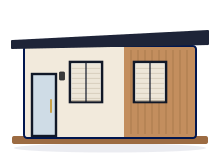
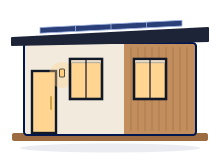
Pip starts as a pencil line at the back of the lawn and ends as a small house with its lights on. It is eager, and a little small for its ambitions. Like everyone in the yard, it has no face. It acts the way a real building does: its blinds rise, its porch lantern comes on, and it leans a little when the news is good.
Every character in the yard carries one rule, checked against its source. Pip carries the one that shapes more backyard homes in Los Angeles than any floor plan does.
Why Pip stops at 750
An impact fee is what a city charges new construction for the parks, roads and sewer capacity it will use. California took small ADUs out of that math. Under SB 543, which rewrote Government Code 66311.5 as of January 1, 2026, a local agency cannot impose impact fees on an ADU with 750 square feet or less of interior livable space. Cross the line and the fees come back, scaled to the ADU's size relative to the main house and, through the end of 2026, charged on the whole unit, as the state's ADU Handbook lays out.
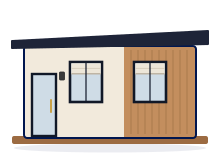
Through the end of 2026, one square foot is the whole difference. A 750-square-foot unit and a 751-square-foot unit can share a floor plan, a foundation and a contractor, and still land on opposite sides of the fee schedule.
One square foot
What changes between a 750 and a 751 sq ft ADU.
| Fee | 750 sq ft | 751 sq ft |
|---|---|---|
| Plan check and building permit | Apply | Apply |
| Impact fees | None | Proportional to the ADU's size relative to the main house. From Jan 1, 2027, on a lot with up to two ADUs, only the space over 750 is charged |
| School fees | Apply (500 sq ft and up) | Apply (500 sq ft and up) |
| Utility connection, new construction | Proportional to size or fixtures | Proportional to size or fixtures |
Gov. Code 66311.5 as amended in 2025 and by SB 1117 (Ch. 809, Stats. 2026, effective Jan 1, 2027); school fees under Education Code 17620 as amended by SB 543. Checked Oct 2026.
See the dollar figures for your cityThat is why, when we priced a 750-square-foot build in July, the tape measure mattered more than the plan set: drawing the same unit at 800 square feet can, under the rule in force through 2026, add impact fees that run into the thousands, depending on the jurisdiction.
What the line does not cover
The 750 exemption is about impact fees only. Plan check and building permit fees still apply at any size. Utility connection fees for new construction must be proportional to the unit's size or its plumbing fixtures. And school fees run on their own threshold: an ADU with less than 500 square feet of interior livable space does not trigger them, so a 700-square-foot unit clears the impact fee line and still owes the school district. In Los Angeles Unified territory that fee is $5.38 a square foot, as we covered in August.
The cross-street check. The 750 line is California law, so it reaches a San Francisco or San Diego owner exactly as it reaches one in Los Angeles. Washington took a different route: under HB 1337, a city there can still charge an ADU impact fees, capped at half of what the main house would owe. A small backyard cottage in Seattle pays half. A small ADU in Los Angeles pays nothing.
How Los Angeles already builds
Most of the city's ADU permits are Pips. Of the ADU permits the City of Los Angeles issued from January 2020 through July 2026, 33.1 percent were for units under 500 square feet and another 22.8 percent for units from 500 to 749, so more than half came in under the line. The median permit is 684 square feet. Those counts come from the Backyard Census, our tally of LADBS permit records.
Our read: 750 is the most valuable design constraint in a California ADU, and the permit data says Los Angeles already knows it.
What changes in 2027
Governor Newsom signed SB 1117 on September 29, 2026, and it changes what happens above the line. Starting January 1, 2027, on a lot with no more than two ADUs, an ADU over 750 square feet pays impact fees only on the area above 750, not on the whole unit, so a 900-square-foot unit is charged on 150 square feet. Pip's own rule does not move: at 750 or less, the impact fee is still zero. What gets cheaper is growing past it.
If you are sizing a unit against the line, A-du's permit fee calculator shows what each fee costs in your city before you commit to a square footage.
Next Monday: Big House, the 1924 Craftsman at the front of the lot, and the junior unit that can go inside it. The whole cast is on the yard page.