Alameda County Will Help Seniors Build an ADU, Then Sell the House
Chris Koss, AIA|Published: October 23, 2026
Alameda County is designing a program that helps seniors build an ADU, move in, split the lot under SB 9, and sell the original house. The catch: a three-year affidavit, a buyer next door, and 2027.
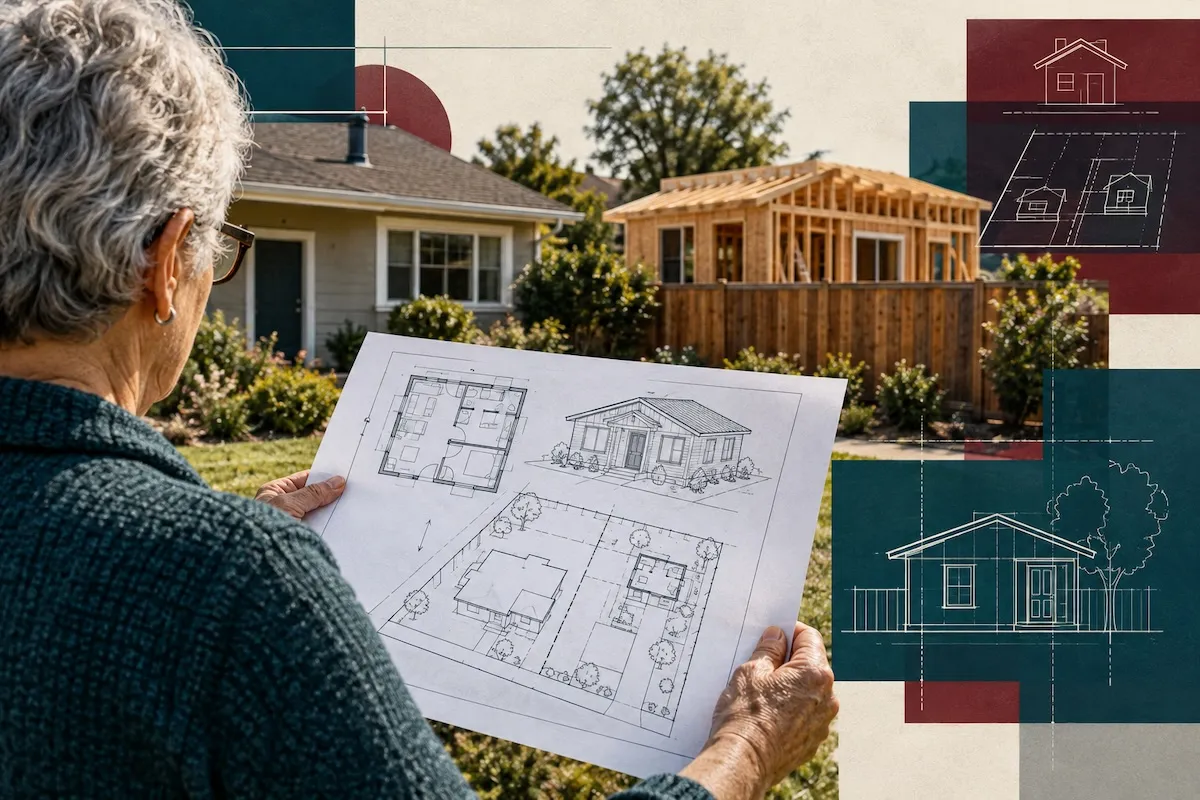
Illustration: HousingWire.
Most ADU pitches to older homeowners end with a tenant out back and a rent check. Alameda County is drafting a different ending: the senior builds the ADU, moves into it, splits the lot under SB 9, and sells the original house, with the sale proceeds repaying the construction loan. The county is aiming for 10 ADUs in the first phase and 50 within the following two years, with outreach expected to begin in early 2027, HousingWire reported on October 21, following a San Francisco Chronicle story.
The short version:
- Alameda County's housing department is designing a program in which eligible seniors finance and build an ADU, move into it, divide the land into two parcels, and sell the original home.
- The plan rests on state law: SB 9 lot splits, which require the applicant to sign an affidavit promising to live on the property for at least three years, and Proposition 19, which lets homeowners 55 and older carry their property tax base to a replacement home.
- The pilot is small (10 ADUs first, 50 over the next two years), the county is still looking for an administrator, and outreach is not expected before early 2027.
What the county is actually proposing
The idea grows out of the county's SHIFT program (Scalable Housing Infill Funding Toolkit), which Alameda County Housing and Community Development describes as a pilot built on "standardized, prepermitted designs and streamlined development processes." The county has selected Inspired ADUs, an Oakland firm, as its design partner, and says SHIFT will make "strategic use of recent state legislation including SB 9 and SB 4." The county also says every pre-permitted design will be made publicly available. On October 12, the department flagged the senior version of the program on its own site.
The senior track is aimed at a specific household. Michelle Starratt, director of the county's housing department, described the outcome to the Chronicle this way, as quoted by HousingWire: "That senior is then walking away with a smaller unit, a right-sized unit that they then can live in, hopefully more accessible, and we have created an opportunity for a new family to have a home." The pitch is not rental income. It is equity, released once, with the owner staying on the same block.
That distinction matters if you are a homeowner in your sixties or seventies who has looked at ADUs and walked away. Being a landlord at 75 is a job. Selling the big house and keeping the garden is a decision.
From the text
The load-bearing statute is SB 9's urban lot split, codified at Government Code Section 66411.7. Two sentences decide whether the senior version works.
"A local agency shall require an applicant for an urban lot split to sign an affidavit stating that the applicant intends to occupy one of the housing units as their principal residence for a minimum of three years from the date of the approval of the urban lot split." (Gov. Code Section 66411.7(g)(1))
For this program, the affidavit is a feature rather than a hurdle: the senior is the one moving into the ADU, so the three-year occupancy promise is the whole point. The second sentence is the one buyers will read. The same section says a local agency "shall not be required to permit more than two units on a parcel created through the exercise of the authority contained within this section." The family who buys the original house is buying a parcel that a city may cap at two units, so its own future ADU is not a given.
The tax piece
The other half of the math is property tax. Under Proposition 19, as summarized by the Board of Equalization, a homeowner at least 55 years old can transfer the base year value of a principal residence to a replacement home purchased or newly constructed within two years of the sale, anywhere in California, up to three times. If the replacement is worth no more than the original (100 percent of its value when the replacement is built before the sale), the base year value moves without adjustment.
On paper, a newly built ADU worth less than the house next to it fits that test neatly. Whether a county assessor treats a freshly split parcel and a just-finished ADU the way the chart suggests is a question the program will have to answer; the county says it plans to address legal and practical complications as the program develops. If you are weighing a similar move on your own, ask the assessor before you file the lot split, not after.
Who wins, who hesitates
The senior. A smaller, ideally more accessible home on familiar ground, a construction loan repaid from the sale, and, if Prop 19 applies, the old property tax base carried across the new property line.
The buyer. A house in an established neighborhood that would otherwise have stayed off the market, with a catch the county itself names: local officials told the Chronicle that buyers may have concerns about the relationship with an older neighbor who used to own the place. Your seller now lives behind your back fence.
The heirs. HousingWire notes that some homeowners may be reluctant to sell the family home or give up an asset they hoped to pass down. A program that turns one inheritance into two smaller ones, one of them already sold, will lose some families at the kitchen table.
The cross-street check. The same idea plays differently in the markets we cover. In Los Angeles, the city's draft ADU ordinance would allow the separate sale of ADUs, a reversal we covered last month, but that path is a condominium sale of the unit, not a lot split, and it is still a draft. In San Francisco, a 2025 ordinance lets owners of single-family homes and some small properties sell in-law units built after May 1, 2025 as condos, Mission Local reported. Alameda County is reaching for SB 9 instead, which produces two separate parcels rather than a condominium. SB 9 is state law, so nothing in the mechanism belongs to one county; what is local is the willingness to administer it.
Our read: the design is the easy part, and SHIFT already has a design partner and a pre-permitted plan pipeline. The hard part is the sequence of the transaction: a senior has to carry a construction loan, live through a build in the backyard, record a split, and then find a buyer who is comfortable with the previous owner next door, all before the loan comes due. A 10-unit first phase is the right size to learn where that sequence breaks. We expect the model to spread only if the county publishes what it learned, the same way it has promised to publish its plans.
This is also not a new instinct in Alameda County. An Oakland architect built his mother a 265-square-foot backyard home this summer; the county is now trying to make that family-scale move available to people who are not related to an architect.
If you are a first-time ADU client sketching a downsizing plan of your own, A-du's build marketplace shows pre-approved ADU plans from city and county catalogs and licensed architects, filtered by what your city approves, with an estimated build cost for each.
The next marker is the county naming its administrator; until then, the senior track is a well-argued plan with no one yet holding the clipboard.
Elsewhere on the ADU beat
- Los Angeles held its virtual public hearing on the Missing Middle LA draft ordinances, including the ADU update, on October 1, with written comments accepted through October 16, Larchmont Buzz.
- Portland's Building Code Guide 00-10 for ADUs, approved August 18, requires a licensed electrician for new ADU electrical service, City of Portland.
- An Irvine homeowner rents a backyard cottage for $3,000 a month, enough to cover $1,600 in loan payments, in a national look at garage and basement ADUs, Bloomberg.