LA Said No to ADU Condos. Its New Draft Says Yes.
Chris Koss, AIA|Published: September 28, 2026
Last updated: October 1, 2026
LA's draft ADU ordinance would let owners sell a backyard unit as a condo and add up to six ADUs near transit, but only with a lender's consent. The public hearing is October 1, and none of it is law yet.
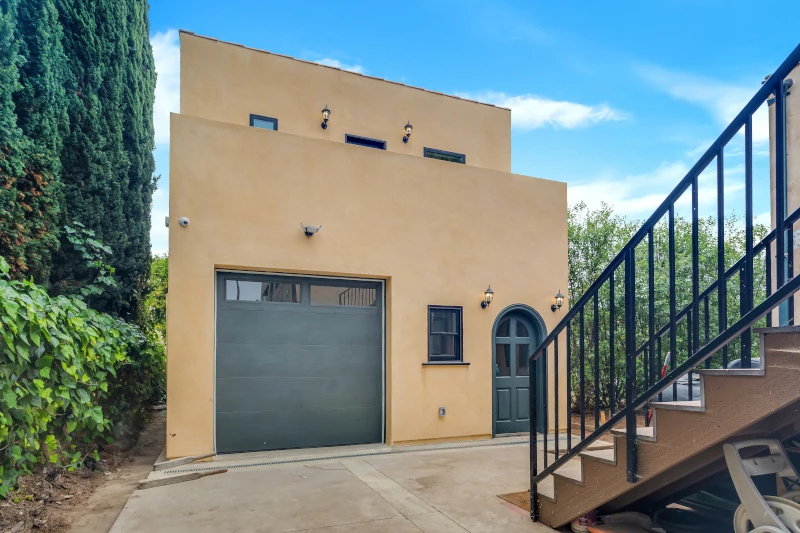
A two-story detached ADU over a garage in West Adams, the 1,200-square-foot type the draft keeps legal. Photo: CALI ADU.
Since its 2019 ADU ordinance, the City of Los Angeles has told every ADU owner the same thing: you can rent the backyard unit, but you can never sell it on its own. The draft rewrite of LA's ADU ordinance, heading to a virtual public hearing on October 1, 2026, would reverse that by opting into California's ADU condominium law, and it adds a bonus program that lets some lots hold up to six ADUs.
The short version:
- City Planning's draft ADU ordinance, part of Mayor Bass's Missing Middle LA package, would let an LA house and its ADU be split and sold as separate condominiums, with lender consent and a safety inspection required first.
- A new ADU Bonus Program would add three feet of height, an extra "Opportunity ADU" on lots of 7,500 square feet or more in Higher Opportunity Areas, and up to six ADUs per lot near transit when one unit is deed-restricted affordable.
- None of it is law yet. The 2019 ordinance still governs until the City Council adopts the rewrite, which follows a City Planning Commission hearing.
From the text
The current code says an LA ADU "may be rented but shall not be sold." The draft ordinance posted by Los Angeles City Planning adds this path in its new subsection on sale or conveyance:
"Condominium. An existing or proposed ADU and associated primary dwelling may be subdivided and approved for separate conveyance as condominiums pursuant to this Section if all the following requirements are met:" (Draft LAMC Section 12.22 A.33(l)(2), Los Angeles City Planning)
Note the word "existing." Unlike San Francisco's version, the LA draft does not limit the condo path to units built after a cutoff date. An ADU finished in 2021 would qualify on the same terms as one permitted next year.
What changes
The condo path. The requirements come straight from the state's opt-in law. The condos must be created under the Davis-Stirling Act and the Subdivision Map Act. Before the condo plan is recorded, the ADU needs a safety inspection, shown either by a city certificate of occupancy or a housing quality standards report from a HUD-certified inspector. And no map or plan can be recorded "without the lienholder's consent," which the draft says a lender "may refuse to give." If an HOA already covers the property, its board has to sign off too. The city, for its part, may not use an ADU condo map to demand street dedications, new improvements, or fixes to old nonconforming conditions.
The Opportunity ADU. The draft allows "one additional ADU of any type" on lots of 7,500 square feet or larger in a Higher Opportunity Area, outside the hillside fire zones the draft calls Fire Restriction Areas. A 7,500-square-foot lot is a standard 50-by-150 parcel, common across the Valley and the Westside, so the threshold is not exotic. Whether your block counts as a Higher Opportunity Area is the real test, and it is a mapping question, not a size one.
The Affordable ADU Bonus. On a parcel in a Transit Priority Area that is also a Moderate or Higher Opportunity Area, a project that reserves at least one ADU as a restricted affordable unit gets one ADU or JADU per 1,500 square feet of lot area, up to six, each capped at 1,200 square feet. On that same 7,500-square-foot lot, that is five units behind the house. It is an alternative to the regular ADU rules, not a stack on top of them, and it is off the table in Fire Restriction Areas, Historic Preservation Overlay Zones, the A and RA zones, and anywhere a designated historic resource would come down.
The smaller wins. The Bonus Program adds three feet of height to detached state ADUs, so a 16-foot unit can go to 19, enough for a pitched roof or a sleeping loft. The draft waives parking for any efficiency unit, studio, or ADU under 500 square feet. And it writes the state's pre-2020 legalization rule into city code: an unpermitted ADU or JADU built before January 1, 2020 "shall be approved" unless a city agency finds a correction is needed for health and safety, the rule we walked through when California's AB 2533 amnesty took hold.
One catch sits in the Bonus Program's opening line: "one of the following shall be approved." Read literally, a project gets one bonus, not a menu. A design-build firm that read the redline line by line, CALI ADU, flagged the same wording and expects it to be clarified. Until it is, do not design a project that needs two bonuses at once.
Who wins, who waits
First-time ADU clients on large lots in high-resource neighborhoods win the most: a second detached unit and a plausible exit by sale. Owners of older ADUs win something new, since the draft's "existing or proposed" language puts built units on the condo path. Owners with a mortgage wait on their bank.
If you're a tenant in an LA ADU, the draft carries protections you should know before a landlord files. Any tenant lawfully living in the unit at the time of a condo application must get notice of intent to convert, an exclusive right to purchase under the city's existing condo-conversion rules in LAMC Section 12.95.2, and eligibility for relocation assistance before any termination of tenancy. A tenant who is a family member of the owner, or who pays no rent, does not count as an eligible tenant.
The cross-street check. When San Francisco opted in, it drew a hard line: only ADUs whose applications were filed on or after May 1, 2025 can become condos, and on an existing property the unit must be detached, as we laid out in our July read on SF's condo ordinance, whose headline said LA would not follow. LA's draft has no such cutoff, which makes it broader for owners and a bigger question for tenants already living in older units. San Diego County adopted its AB 1033 ordinance in March 2026. Washington took the decision away from cities entirely: HB 1337 requires a unit-ownership path statewide, so a Seattle owner does not wait on a council vote the way an Angeleno does.
Our read: the condo clause is the headline, but the lienholder-consent rule means your lender, not City Planning, decides whether it is real for your lot. The draft lets a lender refuse outright or consent on whatever terms it sets, so we expect the first LA ADU condos to come from owners with little or no mortgage, not from the typical refinanced household.
What to watch
The draft is a proposal, not a promise. The October 1 hearing is a staff-level session, the City Planning Commission takes it up next, and the Mayor's office has said the Missing Middle ordinances go to the City Council after public input is incorporated. Until adoption, the 2019 ordinance and state law control. If your project depends on the height bonus, the Opportunity ADU, or a condo sale, design for it now but do not submit on it until it is law.
Pricing a second unit or a two-story build against today's rules is exactly what A-du's build marketplace is for, from pre-approved plans to a permit-ready build.
The public hearing was set for October 1, 2026. The lender conversation will take longer.
Elsewhere on the ADU beat
- Unincorporated LA County's own 2026 ADU ordinance amendment, including limits on ADUs on subdivided lots, is still in draft evaluation with no hearing scheduled, per LA County Planning.
- Governor Newsom signed AB 956 (two detached ADUs) and SB 1117 (impact fees above 750 square feet) on September 29, 2026; both take effect January 1, 2027. California YIMBY tracked both bills to the Governor's desk.