One Affordable ADU Buys a Market-Rate One in San Diego. For a Fee.
Chris Koss, AIA|Published: July 26, 2026
Last updated: September 25, 2026
San Diego still trades one affordable ADU for a market-rate bonus unit, but single-family lots are now capped at four to six ADUs and JADUs. The 2025 reforms now in effect added a Community Enhancement Fee and parking to the smallest units, and the coast is frozen.
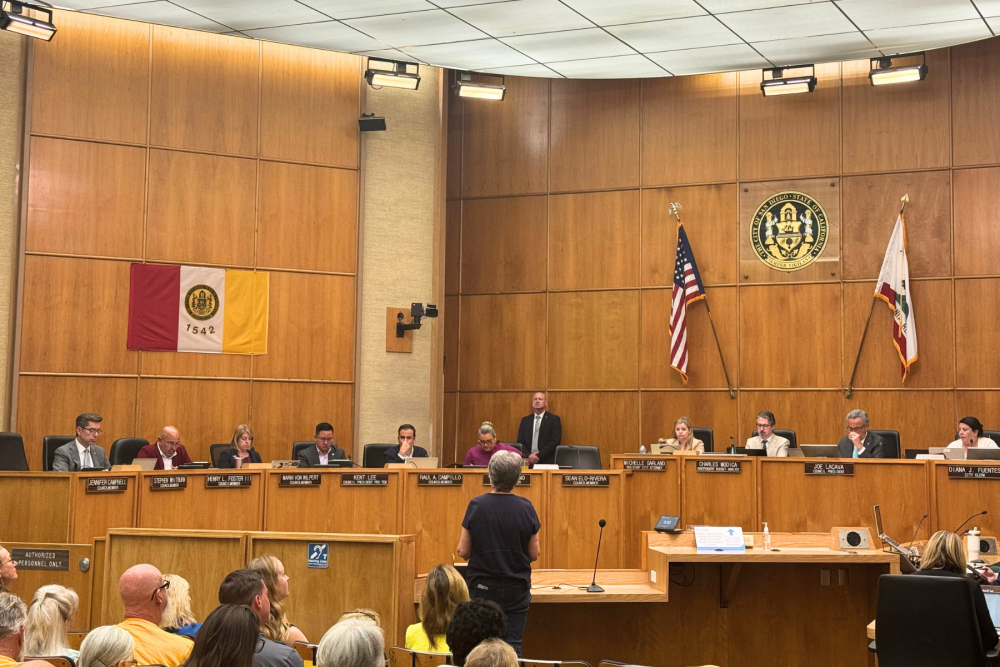
The San Diego City Council chamber, where the ADU reforms passed in June 2025. Inside San Diego.
Build one deed-restricted affordable ADU on your San Diego lot and the city hands you the right to build a market-rate one beside it, and near transit you can keep stacking those pairs, up to four to six ADUs and JADUs in total on a single-family lot. That trade, the ADU Home Density Bonus Program, is still the most generous ADU deal in California. It is also narrower and pricier than it was a year ago: a package of 25 reforms the City Council adopted in June 2025 is now in effect across the city, everywhere except the coast.
The short version:
- San Diego still trades one affordable ADU for one market-rate bonus ADU, and inside a Sustainable Development Area (the code's walking-distance zone around major transit stops) you can repeat the trade, though single-family-zoned lots are now capped at four to six ADUs and JADUs in total, depending on lot size.
- The June 2025 reforms added a Community Enhancement Fee on bonus and affordable ADUs under 750 square feet, required one off-street parking space per bonus or affordable unit outside transit areas, and barred the program from the lowest-density RS-1 zones except in the city's high- and highest-resource areas.
- The changes took effect 30 days after passage everywhere but the Coastal Zone, which stays on the old rules until the California Coastal Commission certifies them, expected sometime in 2026.
The trade, and why it pencils
Here is the mechanic that made San Diego different. State law already lets most single-family lots hold one JADU, one converted ADU, and one detached ADU. San Diego's ADU Home Density Bonus Program sits on top of that: for every unit you deed-restrict as affordable for 15 years, you earn one additional market-rate ADU. Inside a Sustainable Development Area (the zone the code measures by walking distance, up to a mile, from a major transit stop), the city set no ceiling on how many times you can run the trade, which is how single San Diego lots have ended up holding far more homes than a standard California parcel. (The city's program page still calls that zone a Transit Priority Area; the amended code and Information Bulletin 400 use the newer term.) The market-rate rents carry the build. The affordable units are the toll you pay to keep stacking.
The reforms did not kill that trade. They fenced it and taxed it.
What the June 2025 reforms added to your ledger
Five changes move the math. None of them is a clean dollar figure the city will quote you, which is the point: the cost hides in land, in parking, and in a fee schedule.
| Reform | What it requires | What it costs you |
|---|---|---|
| Lot-size cap | Single-family-zoned lots may hold at most 4 ADUs and JADUs (8,000 square feet or less), 5 (8,001 to 10,000) or 6 (over 10,000), bonus units included | The biggest change: stacking that once had no ceiling near transit now stops at four to six units on a single-family-zoned lot |
| Community Enhancement Fee | A per-unit fee on bonus and affordable ADUs under 750 square feet | A new line item on exactly the small units the program was built to produce |
| Parking | One off-street space for each affordable and bonus ADU outside a Transit Priority Area | Roughly 160 square feet of lot per unit you can no longer build on or plant |
| Zone limits | No Bonus Program in the lowest-density RS-1 zones, except in the highest and high-resource areas | Whole swaths of single-family San Diego are off the table |
| Fire setbacks | Minimum four-foot side and rear setbacks in High and Very High Fire Hazard Severity Zones | Less buildable width on hillside and canyon lots |
The fee. The city has not published a single sticker number, because the Community Enhancement Fee runs off a schedule tied to unit size and location, with the money earmarked for neighborhood infrastructure in communities of concern. Read the fine print before you treat a 500-square-foot bonus unit as free money. It is not.
The parking space. One required off-street space sounds trivial until you draw it. A standard stall is about 9 by 18 feet, or 162 square feet, before the drive aisle to reach it. On a typical San Diego lot that is the difference between fitting a fourth unit and a third, which is the whole point in a program that pays you in extra units. If your lot sits inside a Transit Priority Area, the parking requirement drops, which is one more reason the transit map now sets your budget.
The cross-street check. No other market we cover runs this particular lever. Los Angeles gives you the state ADU allowances and nothing like a density-for-affordability bonus, so an LA lot tops out where the state math stops. Washington's HB 1337, which we covered last week, guarantees two ADUs on nearly any lot statewide, flat, with no affordability toll and no owner-occupancy string, but also no path to stack a fifth or sixth unit the way a large San Diego lot near transit still can (six is now the ceiling on a single-family-zoned lot over 10,000 square feet). San Diego's deal is richer at the top and more conditional at the bottom: you can build more here than almost anywhere in the country, but only if you can carry the affordable units, the fee, and the parking. The reforms tilted that balance toward the "only if."
The same ordinance quietly folded in Assembly Bill 1033, the condominium-conversion path that lets you subdivide an ADU and sell it separately from the main house. We walked that mechanic when San Diego County adopted its own separate-sale ordinance; the city version now gives Bonus Program builders a real exit, not just a rent roll. And the coastal freeze is no footnote. As we flagged when SB 1077's coastal guidance landed mostly on paper, the Coastal Commission moves on its own clock, and the bill itself gave it until July 1, 2026 to publish ADU guidance for local coastal programs. Until it certifies San Diego's amendments, a lot west of Interstate 5 plays by the old, more generous rules, which cuts both ways depending on what you are trying to build.
Our read: the reforms trimmed the program at exactly the wrong edge. The Community Enhancement Fee and the parking space both land hardest on the sub-750-square-foot units, the small, cheap-to-build homes that made the affordability trade pencil in the first place. Fence the lowest-density zones if the politics demand it. Taxing the smallest units is how you quietly shrink the supply the program was supposed to create.
So here is the decision this changes. If you are a San Diego homeowner weighing the Bonus Program, price the fee and the parking before you count the bonus unit as income, and check whether your lot is inside a Sustainable Development Area (for stacking) or a Transit Priority Area (for the parking exemption), how many units its lot size allows, and whether it sits outside the excluded RS-1 zones before you draw anything. The program still works. It just asks more questions first.
If you want to see how these line items stack against a straight ADU permit, A-du's permit fee calculator breaks a San Diego permit into the same pieces the city charges in.
The next move belongs to the Coastal Commission. Until it acts, the most valuable ADU lots in San Diego, the ones near the water, are the ones still waiting to learn which rulebook they live under.
Elsewhere on the ADU beat
- San Diego's council approved the package on a narrow 5-4 vote after months of neighborhood backlash, FOX 5 San Diego.
- New York City published proposed DOB and HPD rules to implement its own ancillary dwelling units under City of Yes, NYC Department of Buildings.
- Seattle folded its ADU standards into a broader middle-housing overhaul this year, Seattle Office of Planning and Community Development.