As of August 17, Your NYC Basement ADU Needs a Radon Certificate
Chris Koss, AIA|Published: August 24, 2026
Last updated: September 25, 2026
New York City just added a step to below-grade ADU permits: as of August 17, a basement or cellar unit in an Alteration-CO or New Building filing in DOB NOW must carry a certified radon and vapor test before it can reach a certificate of occupancy.
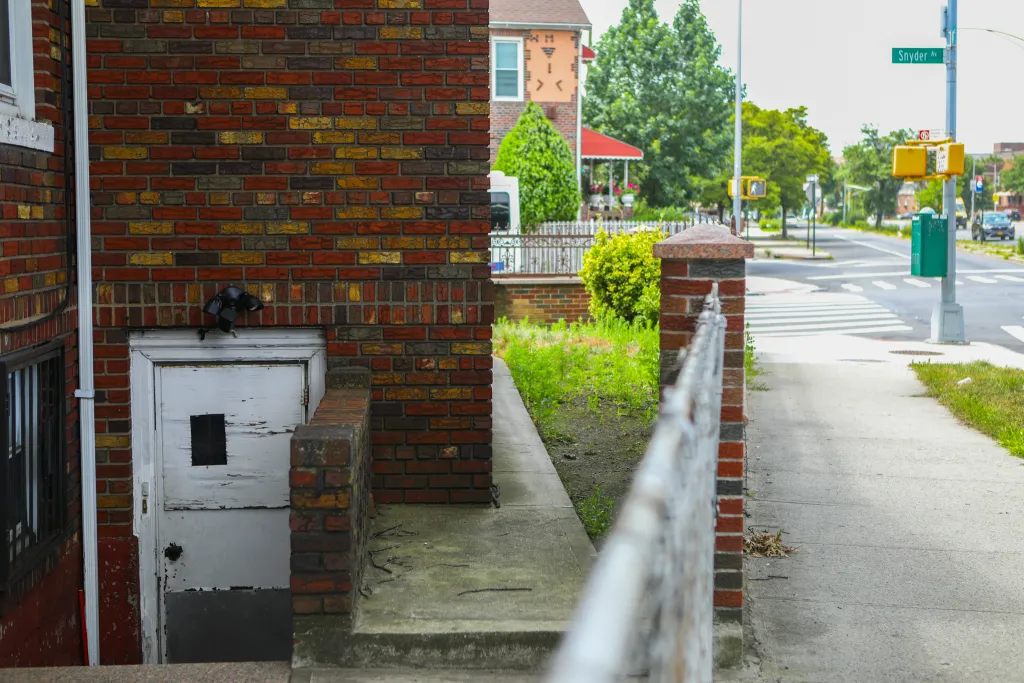
Rows of small homes in East Flatbush, Brooklyn. A 2024 city survey found the most homeowner interest in legal basement units in Queens and Brooklyn. Photo via THE CITY.
New York City spent two years writing the rules that let a homeowner turn a basement into a legal apartment. Now it wants to know what the air down there is made of. As of August 17, 2026, a basement or cellar ancillary dwelling unit filed with the Department of Buildings, whether it is carved out of an existing one- or two-family home or built into a newly erected single-family home, must carry a certified radon and vapor test, kept under the Health Department's Chapter 40 ceiling of 2 picocuries of radon per liter of air, before the unit can reach a certificate of occupancy.
The short version:
- Effective August 17, 2026, Alteration-CO and New Building filings in DOB NOW: Build that include a basement or cellar ADU must include an approved DOHMH Radon and Vapor Level Certificate.
- The test has to be run by professionals (a certified radon tester for radon, and a qualified environmental professional or certified industrial hygienist for vapors), not a drugstore kit, and it must clear Chapter 40's limits for radon and organic chemical vapors.
- It lands on the path that is actually open, new below-grade units, while the larger pilot to legalize existing basement apartments still is not taking applications.
The requirement is small on paper and large in what it signals. Radon is a colorless gas that seeps up from the ground and pools in the lowest, least-ventilated space in a building, which in New York is almost always the basement or the cellar. The city's Health Department set the ceiling at 2 picocuries per liter, half the 4 picocuries at which the federal Environmental Protection Agency tells homeowners to install a mitigation system. If you are the homeowner filing a new basement or cellar ADU this fall, this is one more line on your certificate stack, and one you cannot clear yourself.
From the text. The Health Department proposed the standard in June 2025 as a new Chapter 40 of Title 24 of the Rules of the City of New York and adopted it that October. The June proposal described its purpose this way:
...to establish rules for the certification required by a qualified environmental professional regarding the maximum levels of radon and certain organic chemical vapors in a basement or cellar apartment in the process of obtaining a temporary or permanent Certificate of Occupancy...
The pincite is 24 RCNY Chapter 40, tied to sections U202.9 and U202.10 of Local Law 127 of 2024. The August 17 date is the operational half: the Department of Buildings' July 31 service notice makes the certificate a required document on Alteration-CO and New Building filings in DOB NOW that place an ADU in a basement or cellar, to be uploaded before the final certificate of occupancy. The notice adds that, under DOB's ADU rule (1 RCNY 105-08), the requirement also reaches ADUs built into newly erected single-family homes.
What actually changed
Nothing about your right to build. The change is a gate inside the filing software. A basement or cellar ADU is created two ways in New York: as new construction or an alteration that ends in a certificate of occupancy, and as a legalization of an apartment that already exists and already has tenants. The August 17 rule attaches to the first path, the Alteration-CO and New Building jobs, where the city can demand the certificate before it signs off. The qualified professional collects a radon reading and, for vapors, a TO-15 laboratory air sample, then certifies the results to the Health Department, and that certificate rides along into DOB NOW.
Note the word laboratory. The rule does not accept the charcoal canister you leave on a shelf for three days and mail to a lab for twenty dollars. It calls for TO-15 sampling done by a qualified environmental professional or certified industrial hygienist, with the samples analyzed by a state-certified laboratory, which is a scheduled site visit and a real invoice. As we noted this week when the sprinkler clock started ticking on legalized basements, the below-grade unit keeps collecting requirements that an above-grade cottage never sees.
Who this protects, and who pays for it
The winner is the future tenant. A person renting a below-grade apartment cannot see radon, cannot smell it, and has no way to test the building before signing. The certificate moves that check upstream, to the moment the unit is built, where it belongs. That is the right instinct.
The cost falls on the homeowner and, quietly, on the thin bench of people allowed to do the testing. During the comment period, environmental firms told the Health Department the qualified-professional list is too narrow. ALC Environmental argued that certified industrial hygienists, who run indoor-air studies for a living, were left off in favor of engineers and geologists whose training is site remediation, not air quality. Five Star Environmental asked the more basic question: what license does a radon tester even need, given the state issues none specific to the task. The department added certified industrial hygienists for vapor testing, and it answered the radon question by accepting testers certified by AARST, the National Radon Safety Board, New Jersey, or Pennsylvania. If you are filing this fall, line up a certified tester early.
Our read: the radon certificate is the right call and a modest line item, but it is guarding a door that most of the demand cannot yet walk through. The city itself notes that the pilot to legalize existing basement apartments is not accepting applications until DOB promulgates the rules. So the gate mostly meets the trickle of brand-new below-grade units, not the tens of thousands of families already living underground, who are exactly the people a radon test would protect first.
The cross-street check. This is a distinctly New York problem, and the map explains why. New York's ADU opportunity is disproportionately below grade, because the housing stock is basements and cellars under one- and two-family homes in Brooklyn, Queens, and the Bronx. In Los Angeles and San Diego, the typical ADU is a detached backyard cottage or a garage conversion at grade, and radon never enters the permit stack at all; California's ministerial approval checklist asks for setbacks and fire ratings, not an air sample. Washington is the one market where radon even surfaces in home building, and it took the opposite tack, writing radon-resistant construction into the code so the mitigation is built in rather than tested for after the fact. New York chose the test. For a city whose new units live in the ground, that is the more honest choice.
What to watch
Two dates matter next. The first is whenever DOB finally promulgates the Local Law 126 rules and opens the legalization pilot, at which point the radon certificate stops being a niche step for newly created units and becomes a requirement pressing on real occupied apartments, with a one-year clock after the temporary authorization to prove the air is clean. The second is the newer cellar path: under Local Law 80 of 2026, a one-family home can now be built with a cellar ADU from the start, and those filings walk straight into the August 17 requirement. Watch whether the certifier bottleneck the environmental firms warned about shows up as a scheduling delay once volume climbs.
If you want to see the whole certificate stack before you file, run your address through A-du's permit fee calculator, which itemizes the New York filing costs a below-grade unit actually triggers.
The real test of this rule is not the chemistry. It is whether New York can open the legalization door fast enough that the air check protects the people who need it most, and not just the few who are building new.
Elsewhere on the ADU beat
- Housing experts gave New York's basement-legalization rules low marks for complexity, Brownstoner reports.
- A map of where the city's first legal basement conversions are most likely to appear, from Gothamist.
- San Francisco refreshed its State ADU Program guidance in a new director's bulletin, posted by SF Planning.