This Couple Built Their Own Portland ADU. The Waiver Costs 10 Years.
Chris Koss, AIA|Published: August 29, 2026
Last updated: September 25, 2026
An architect and a construction engineer built a 624-square-foot home in their Portland backyard for $221,580. Oregon let them build by right; Portland waived the fees, if they skip short-term rentals for 10 years.
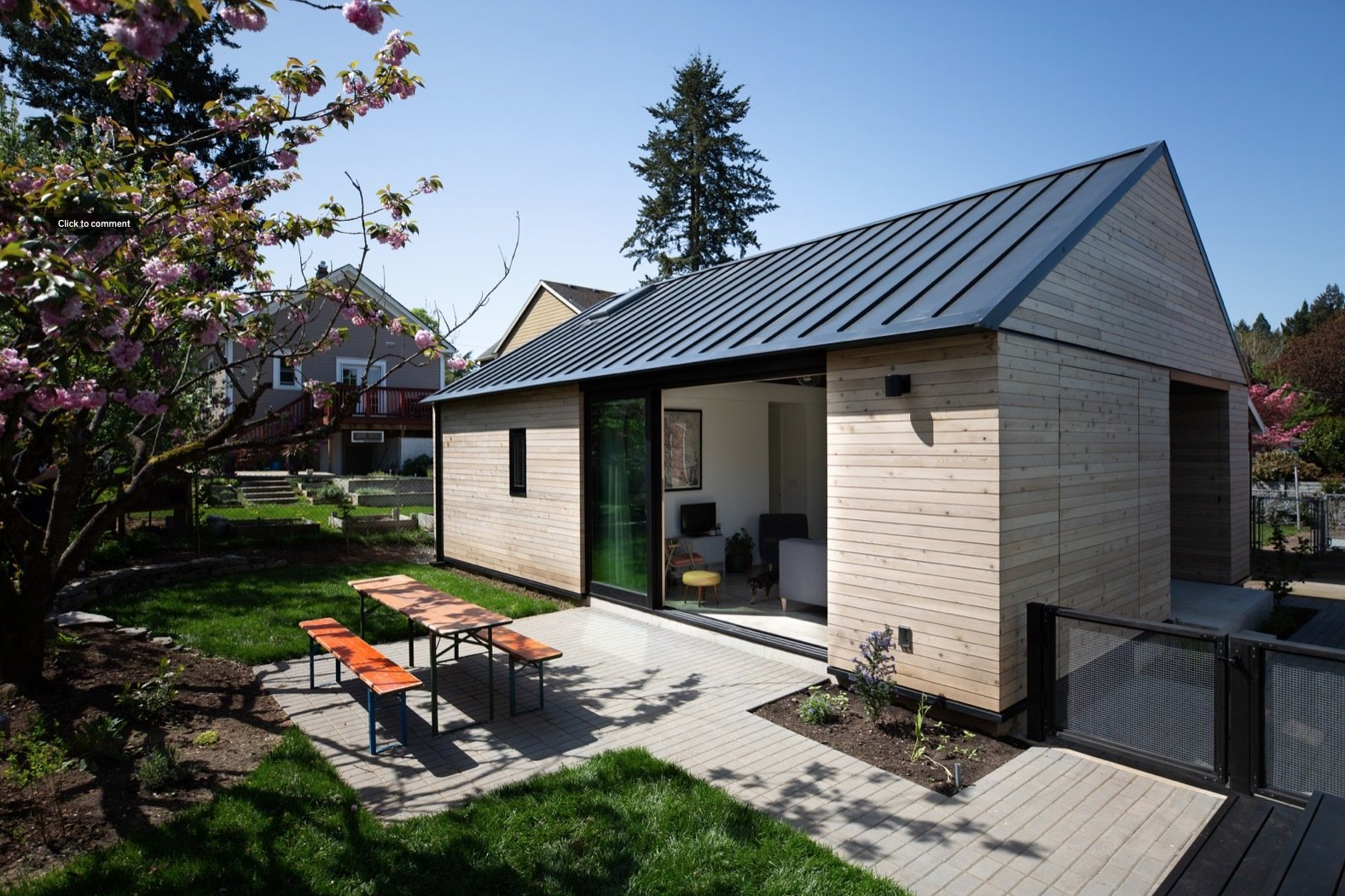
Their 624-square-foot backyard home in Southeast Portland. Dwell.
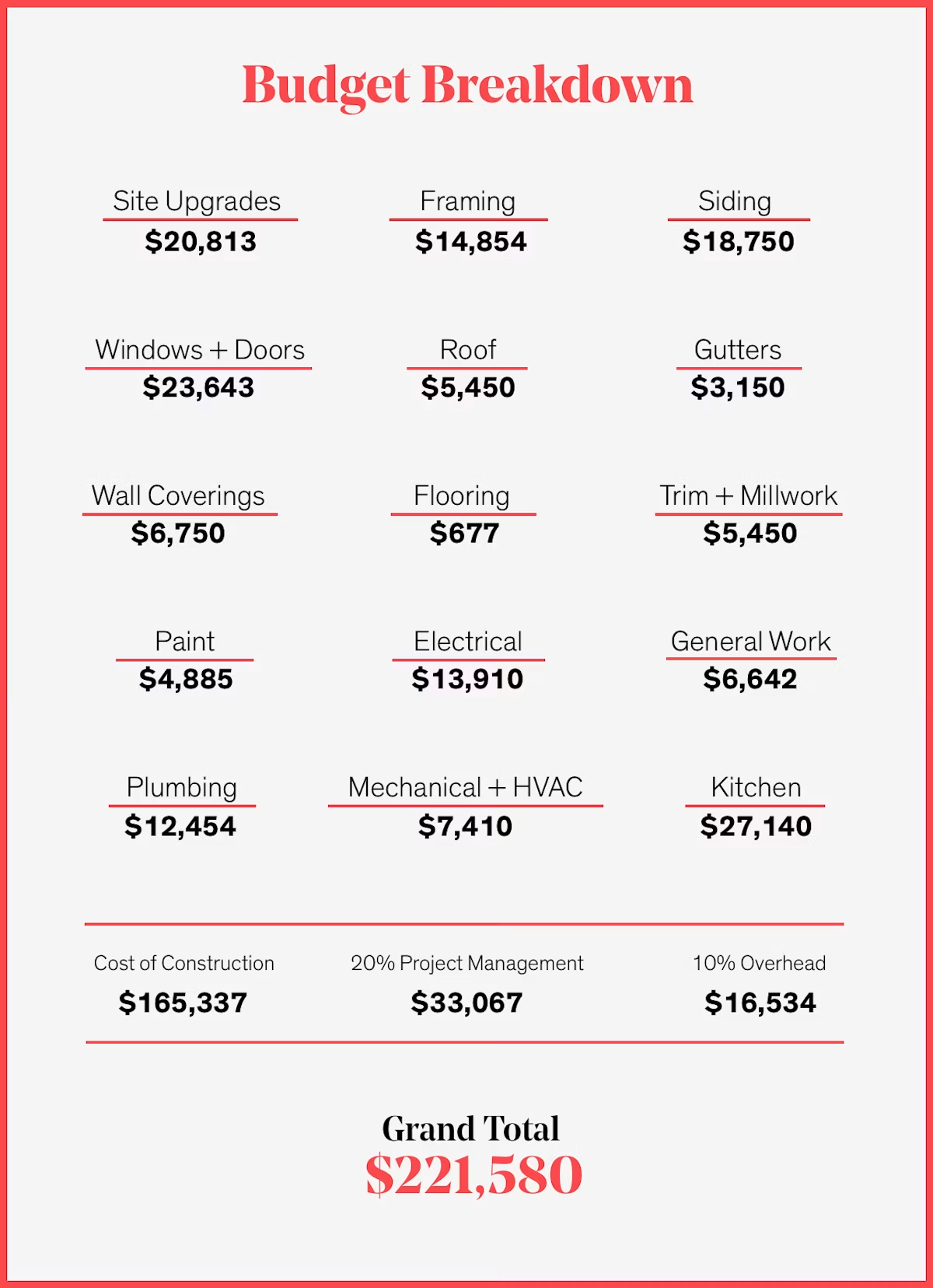
Scott Mooney designs buildings for a living; when he and Lauren Shumaker wanted one of their own, they built it in the backyard they already had. Their 624-square-foot, two-bedroom home in Southeast Portland cost $221,580, and it exists because Oregon spent a decade turning a second small home on a single-family lot into something you build by right, not something you beg for.
The short version:
- Oregon's SB 1051 (2017) forces every city over 2,500 people to allow at least one ADU on a single-family lot, and HB 2001 (2019) stripped out owner-occupancy mandates and most off-street-parking requirements statewide.
- Portland waives its system development charges on an ADU, but the waiver binds the whole property to a 10-year covenant against short-term rentals; break it early and you owe 150 percent of the current SDC fees.
- Mooney and Shumaker's build ran $221,580 in 2018 for 624 square feet; today's Portland budgets run higher, but the rulebook that let them build is broadly the one a Portland owner still uses.
The decision problem
Mooney and Shumaker were not chasing rental income. They wanted a small, low-energy house they had designed themselves, and the back half of their 5,000-square-foot lot in the Richmond neighborhood was the cheapest land they would ever build on, because they already owned it. If you are a first-time ADU client weighing a backyard build, that is the quiet advantage every ADU starts with: the lot is a sunk cost. They worked the project through with builders Kevin Smith and Taylor Thompson of Taylorsmith Sustainable Construction, keeping the footprint tight and the envelope efficient rather than buying their way out of a small plan with more square footage.
The regime, read through one backyard
Here is what Oregon law handed them before they drew a single line. Under SB 1051, Portland has to allow an ADU on a lot like theirs. Under HB 2001, the city cannot make them live on site to keep the unit, and cannot force them to pour a parking pad they never wanted. A detached backyard cottage in Portland can run up to roughly 800 square feet, sit about five feet off the rear lot line, and clear permitting through the city's residential code without a discretionary land-use hearing. Ministerial approval is the boring part. Boring is exactly what you want.
The money. The number that actually moves a Portland ADU budget is the system development charge, the city's one-time fee for the load a new home puts on sewers, water, parks, and streets. Portland waives it for an ADU, and the waiver is not small. What it costs you is a promise.
An approved waiver results in a binding 10-year agreement. ... The covenant states the ADU and the house will not be rented as a short-term rental for 10 years. City of Portland, ADU SDC Waiver Program.
Signed and recorded, the covenant runs with the property for 10 years from final inspection, and it does not just cover the ADU. During that decade nothing on the parcel, not the main house, not a single spare bedroom, can go on a short-term rental platform. Revoke it early and Portland charges 150 percent of the current SDC fees, the same penalty as breaking it outright. As we covered in Portland's SDC math for ADUs, that trade, avoided fees now against a decade of no short-term rentals, is the real Portland ADU decision. Mooney and Shumaker, building a home to actually live in, gave up nothing they wanted.
The constraint was real: 624 square feet on a lot they still had to share with the main house. Their answer was to design for daylight and a tight, well-insulated envelope instead of chasing rooms, which is the move nearly every good small ADU makes once the owner stops fighting the square footage and starts working with it.
The cross-street check. Portland's waiver-for-a-covenant model is not how the rest of the West Coast pays people to build backyard homes. California's statewide fee break is narrower, covering only impact fees on ADUs of 750 square feet or less; its marquee subsidy was the up-to-$40,000 CalHFA ADU grant, which ran dry and has sat closed since 2023, so a Los Angeles or San Diego owner building above 750 square feet today pays impact fees scaled to the main house, with no state grant to offset them. Washington took the structural route instead: HB 1337 caps ADU impact fees at half the single-family charge and bars owner-occupancy rules outright, closer to Oregon than to California. The through-line is that Oregon and Washington rewrote the defaults so the fees and the strings shrink for everyone, while California mostly wrote checks and then stopped writing them. A Portland owner keeps the subsidy as long as they keep the promise.
Where they landed: a home they own outright, in a city that, for once, got out of the way. Our read: Portland's SDC waiver is the most generous ADU subsidy on the West Coast that you have to give something up to get, and the thing you surrender, a decade of short-term-rental income, is worth real money to a landlord and almost nothing to an owner who plans to live there or rent by the month. The waiver is not really a housing subsidy. It is a filter that pays people to build homes instead of hotels.
If you are mapping a backyard build of your own, A-du's build marketplace lists Oregon designers and crews who work inside the SDC-waiver and residential-permitting rules every day.
The open question for Portland is not whether you can build, but whether the waiver survives the next budget cycle intact; the covenant math only works while the city keeps offering the trade.
Elsewhere on the ADU beat
- Seattle is refreshing its pre-approved backyard-cottage catalog, with new designs now expected to reach the ADUniverse gallery in January 2027, via Seattle OPCD.
- New York City published proposed rules to legalize existing basement and backyard apartments under its City of Yes plan, via 6sqft.