Washington Opens Rural Land to ADUs. Skip the Permit, Pay Triple.
Chris Koss, AIA|Published: November 2, 2026
Washington counties can now allow one detached ADU per rural parcel under HB 1345, up to 1,296 square feet within 150 feet of the house. Build one without a permit and the fee can triple.
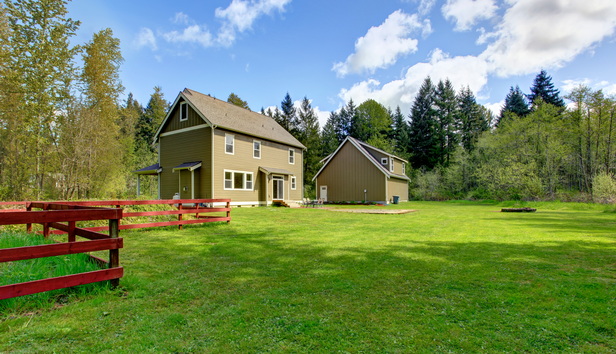
A rural Washington home with a detached outbuilding, the photo MRSC ran with its summary of HB 1345. Photo via MRSC.
For years the answer to "can I put a cottage for my mother on my five acres outside town?" depended on which Washington county you lived in. Since June 11, 2026, Washington's 28 fully planning counties may allow one detached ADU per parcel outside urban growth areas under HB 1345, capped at 1,296 square feet, sited within 150 feet of the main house, and backed by penalties of at least triple the permit fee for anyone who builds one without asking.
The short version:
- HB 1345 (Chapter 231, Laws of 2026) lets Washington counties planning under the Growth Management Act allow one detached accessory dwelling unit per rural parcel; it took effect June 11, 2026, and it is optional for each county.
- The rural unit is capped at 1,296 square feet, must share the main house's driveway, must sit within 150 feet of it, needs metered water and a septic system documented to handle the load, and is barred on nonconforming lots under one acre.
- Counties that opt in must run a voluntary amnesty at no less than double the normal permit fee, fine non-volunteers at least $1,000 with at least triple the fee if the unit stays, and bar cited owners from new ADU permits for at least three years.
From the text
The size rule is the one most rural owners will feel first, and it is written so that the county cannot be more generous than its own addition rules allow.
The gross floor area of the detached accessory dwelling unit may not exceed the gross floor area of what could be authorized by the county as an expansion of the principal unit to create an attached accessory dwelling unit; however, in no case may the gross floor area be greater than 1,296 square feet. Floor areas exclude garages, porches, and unfinished basements.
Engrossed House Bill 1345, Sec. 1(1)(f), as passed by the Legislature, 2026 Regular Session
What changed
Washington's big ADU law, HB 1337, which we covered when its fee cap and parking rules landed, only reaches inside urban growth areas. Out past the growth boundary, the Growth Management Act tells counties to keep development "not urban in nature," and that left the rural cottage to each county: allowed under some counties' own ordinances, which HB 1345 leaves in force, and off the table in others. The final bill report lists the vote: 86 to 5 in the House, 33 to 15 in the Senate.
HB 1345 does not order any county to do anything. It says counties "may allow" detached ADUs outside urban growth areas, then lists what has to be true if they do. Read as a homeowner's checklist, the parcel-level conditions are:
- One ADU, total. No parcel may have more than one accessory dwelling unit, attached or detached. Inside an urban growth area, HB 1337 guarantees two. Out here, one.
- Water and septic first. The unit must meet state water-supply requirements and any county or Department of Ecology groundwater mitigation, the combined household draw stays inside the domestic-use limit in RCW 90.44.050, and each dwelling's water use must be metered. You must document that the existing or proposed septic system can handle the extra demand.
- Close to the house. Same driveway as the main house, and within 150 feet of it. That is about half a football field, which rules out the cabin down by the creek.
- Size. No larger than whatever the county would let you add onto the house as an attached ADU, and never more than 1,296 square feet. For scale, that is a 36-by-36-foot footprint, closer to a small two-bedroom house than a studio.
- The old house can be the ADU. If you build a new single-family home on the parcel, the existing house can become the accessory unit, provided it meets the same limits.
- No small nonconforming lots, no lot splits. The unit is barred on nonconforming lots under one acre, and you cannot subdivide a parcel to get around any of this.
Then come the strings on the county. Every opting-in county has to track and report completed rural ADU permits to the Department of Commerce each year, fold those numbers into its comprehensive plan, amend that plan for this purpose no more than once every five years, and cap the share of its rural population growth assigned to these units: 10 percent in a rural county, 7 percent everywhere else.
Who wins and who loses
If you are a homeowner on acreage in a county that opts in, you win a by-the-rules path to a second household on land that already has a well, a septic field, and room. Multigenerational families are the obvious beneficiaries. The 1,296-square-foot ceiling is generous next to most urban ADU caps, and the existing-house provision is a smart one: build the new house you want, keep the old one for a parent.
If you already built one without a permit, your bill went up. In an opting-in county, coming forward means a permit penalty of at least double the normal fee. Waiting to get caught means a civil infraction of at least $1,000, plus either removal or at least triple the fee to keep the unit, plus a three-year ban on new ADU permits. That is a stick sized for a problem the Legislature clearly believes is common.
Short-term rental investors may lose too, depending on the county. MRSC's summary of HB 1345 and its companion bill urges counties to review their short-term rental rules before opting in, so the new units go to long-term residents, and points to Chelan County, which caps short-term rentals at a share of housing stock by subarea.
Our read: this is a permission slip with a lot of homework attached, and we expect most counties to move slowly. A county that opts in takes on annual reporting, a five-year plan cadence, a population cap, and an enforcement program it has to staff. The counties most likely to say yes are the ones already fielding requests for rural cottages, or already living with unpermitted ones, because for them the enforcement tools are half the point.
The cross-street check. California went the other way on the same problem. As we covered in August, California's AB 2533 offers amnesty to owners of ADUs built without permits before 2020; Washington's rural deal makes even the volunteer pay at least double the fee. Oregon is the closer comparison: across the Columbia, Washington County, Oregon adopted Ordinance No. 912A on April 28, 2026, allowing one rural ADU per lot in its AF-5, AF-10, and RR-5 districts, capped at 900 square feet, generally on lots of two acres or more, with vacation occupancy prohibited. Same idea, smaller unit, and a direct short-term rental ban where Washington State's law leaves that question to each county.
What to watch
The law is optional, so the real news will arrive one county at a time, as ordinances. If you own rural land, the first call is to your county planning department to ask whether it intends to adopt rules under HB 1345, and the second is to a well and septic professional, because those two reports decide whether your lot qualifies before any floor plan does. First-time ADU clients usually start with the drawings. Here, start in the dirt.
When your county does open the door, A-du's build marketplace lists pre-approved ADU plans from city and county catalogs and design firms, with an estimated build cost for each, a quick way to see what fits under 1,296 square feet before you pay anyone to draw.
Watch for the first annual county reports to the Department of Commerce; they will be the first hard count of how many rural Washington cottages this law actually produces.
Elsewhere on the ADU beat
- Santa Clarita's Planning Commission approved ADU rule changes that add a second class of larger units, now headed to the City Council, The Signal.
- From April, a San Diego County judge sided with a Carlsbad condo HOA that blocked an owner's garage-to-ADU conversion, Times of San Diego.