Rural Washington Gets a Statewide ADU Rule. If the County Opts In.
Chris Koss, AIA|Published: July 29, 2026
Last updated: September 25, 2026
Washington HB 1345 lets counties allow a detached cottage on rural land outside the urban growth boundary under one set of state rules, where before it was left to each county. The catch: your county has to opt in first.
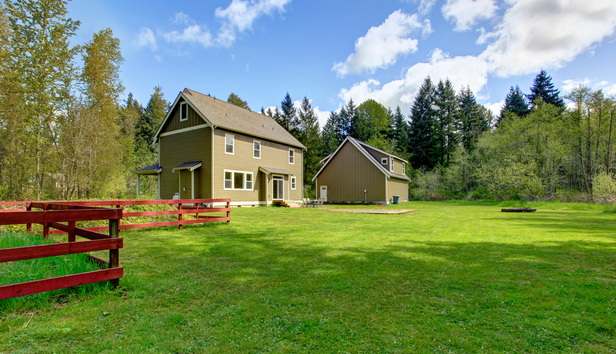
A detached accessory dwelling unit on rural land, the kind HB 1345 now puts within reach outside the growth boundary. Photo via MRSC.
For years, whether you could put a second small home for an aging parent or a farmhand on acreage past the city line depended on your county. Some already allowed one: King County's rules, for example, allow a detached ADU in its Rural Area zones on a lot that meets the zone's minimum size. But there was no statewide rule, so the answer varied at every county line. That changed on June 11, 2026, when HB 1345 took effect and gave Washington counties a uniform state framework for permitting one detached accessory dwelling unit, capped at 1,296 square feet, on rural parcels outside an urban growth area.
The short version:
- HB 1345 (Chapter 231, Laws of 2026) lets any county planning under the Growth Management Act allow one detached ADU per parcel outside an urban growth area. It is voluntary, and no county is required to say yes.
- The unit is capped at 1,296 square feet, must sit within 150 feet of the main house, share its driveway, be metered for water, and come with proof the septic can take the load.
- Nonconforming lots under one acre are shut out, lot splits to dodge the rules are barred, and a county may route no more than 7 to 10 percent of its rural population target into these units.
If you own rural land in Washington and have wanted a cottage on it, this is the first state law that lets any county say yes to a detached one under the same rules, and section 1(4)(a) leaves in place the rural ADU ordinances some counties adopted before it. The word doing the work is "lets." HB 1345 hands counties the option, not a mandate, and it wraps that option in a long list of conditions that read like they were negotiated one worry at a time. They were.
From the text
The operative grant is short. The limits attached to it are not.
Counties that are required or choose to plan under this chapter may allow detached accessory dwelling units outside of urban growth areas if the county meets the requirements in subsections (2) and (3) of this section ... in no case may the gross floor area be greater than 1,296 square feet.
That is Section 1 of Engrossed House Bill 1345, which adds a new section to chapter 36.70A RCW, the Growth Management Act. The bill cleared the House 86 to 5, the Senate 33 to 15, and Governor Bob Ferguson signed it on March 27. You can track the full history on the Legislature's bill page.
What actually changed
Washington's state ADU rules have, until now, stopped at the growth boundary. Last week we covered how HB 1337 forces cities to allow two ADUs per lot, drop owner-occupancy rules, and cap impact fees, all of it inside urban growth areas where the state wants density. Rural land was left out on purpose. The Growth Management Act exists to keep housing from sprawling across farm, forest, and resource land, so a detached ADU on a five-acre parcel outside town sat uneasily with the whole framework, and the counties that allowed one did so under their own local rules.
HB 1345 threads that needle. It does not open rural Washington to development. It opens it to exactly one modest unit per parcel, tethered within 150 feet of the existing house, on the same driveway, drawing metered water under the same withdrawal limits that already govern a rural well. That 150-foot tether matters more than it sounds: it is closer than half a football field, so the cottage clusters against the main house rather than spreading across the back of the lot. The 1,296-square-foot ceiling is a real two-bedroom, not a shed, but it is a hard cap that excludes garages, porches, and unfinished basements from the count.
Who wins, who waits
The winners are the households the bill's sponsors kept naming: a rural worker who cannot afford a separate lot, a senior who wants to stay near family, a first owner priced out of a full house. On a conforming parcel of an acre or more, in a county that opts in, a detached cottage now has a clear state path to a permit.
The people who wait are owners in counties that neither allowed rural cottages before nor have adopted rules under the new law yet. Participation is a choice each county makes through its own development code, so your address decides your rights twice over: first the state has to allow it, then your county has to adopt it. Owners on nonconforming lots under an acre are out regardless. And anyone hoping to carve the parcel and sell the cottage separately should read subsection (1)(k), which bars subdividing to escape the limits. This is added housing on the land you already hold, not a path to two saleable lots.
There is a stick, too. A county that opts in has to run a voluntary compliance process for unpermitted units, and owners who skip it face a civil infraction of at least $1,000, permit penalties of double or triple the normal fee, and a three-year ban on any new ADU permits. Washington learned from a generation of unpermitted rural cabins; this law tries to pull them into the light rather than pretend they do not exist.
The cross-street check. This is where Washington now stands apart from its neighbors. Or it would, except that Oregon got there first: since 2021, ORS 215.495 has let an Oregon county opt in to one ADU on a rural residential parcel of at least two acres, capped at 900 square feet and within 100 feet of the house, a close cousin of HB 1345. New York City's City of Yes is entirely urban and, as we have reported, disqualifies most lots before rural even enters the conversation. Washington did not just add an ADU program. It moved the line the program is allowed to cross, cautiously, much as Oregon did for its counties in 2021.
Our read: this is a permission slip, not a housing mandate, and its impact will be slow and uneven by design. Between the opt-in requirement, the one-acre floor, the septic and water tests, and a population-target cap that lets a county count no more than 7 to 10 percent of rural growth toward these units, the law is engineered to trickle. Expect a handful of counties, Chelan among the first, to adopt rules this year, and expect the real story to be measured in the annual permit counts each county must report to the Department of Commerce, not in a rural building boom.
What to watch
Three things. Which counties opt in, and how strict they draw their local code on top of the state floor. The five-year cap on comprehensive-plan amendments, which means a county that gets its rural ADU allocation wrong is stuck with it for a while. And the Commerce reporting data itself, the first hard measure of whether rural Washingtonians actually build these, or whether the conditions make the right theoretical. If you are weighing a rural build, the practical first step is a call to your county planning department to ask two questions: do you already allow rural ADUs, and have you adopted HB 1345 yet?
If a rural cottage is on your horizon, A-du's build marketplace can line up the surveyor, septic evaluation, and permit-ready plans this law now requires before a shovel moves.
The next comprehensive-plan cycle is when this stops being a Chelan County curiosity and becomes a statewide map of who said yes.