Oregon ADU Rules: Eugene Wanted a 7,500-Square-Foot Lot. It Lost.
Chris Koss, AIA|Published: November 13, 2026
Eugene blocked a backyard ADU over lot size, alley access and occupancy limits, and lost in court. Here is what Oregon cities can still require of your ADU, and what state law takes off the table.
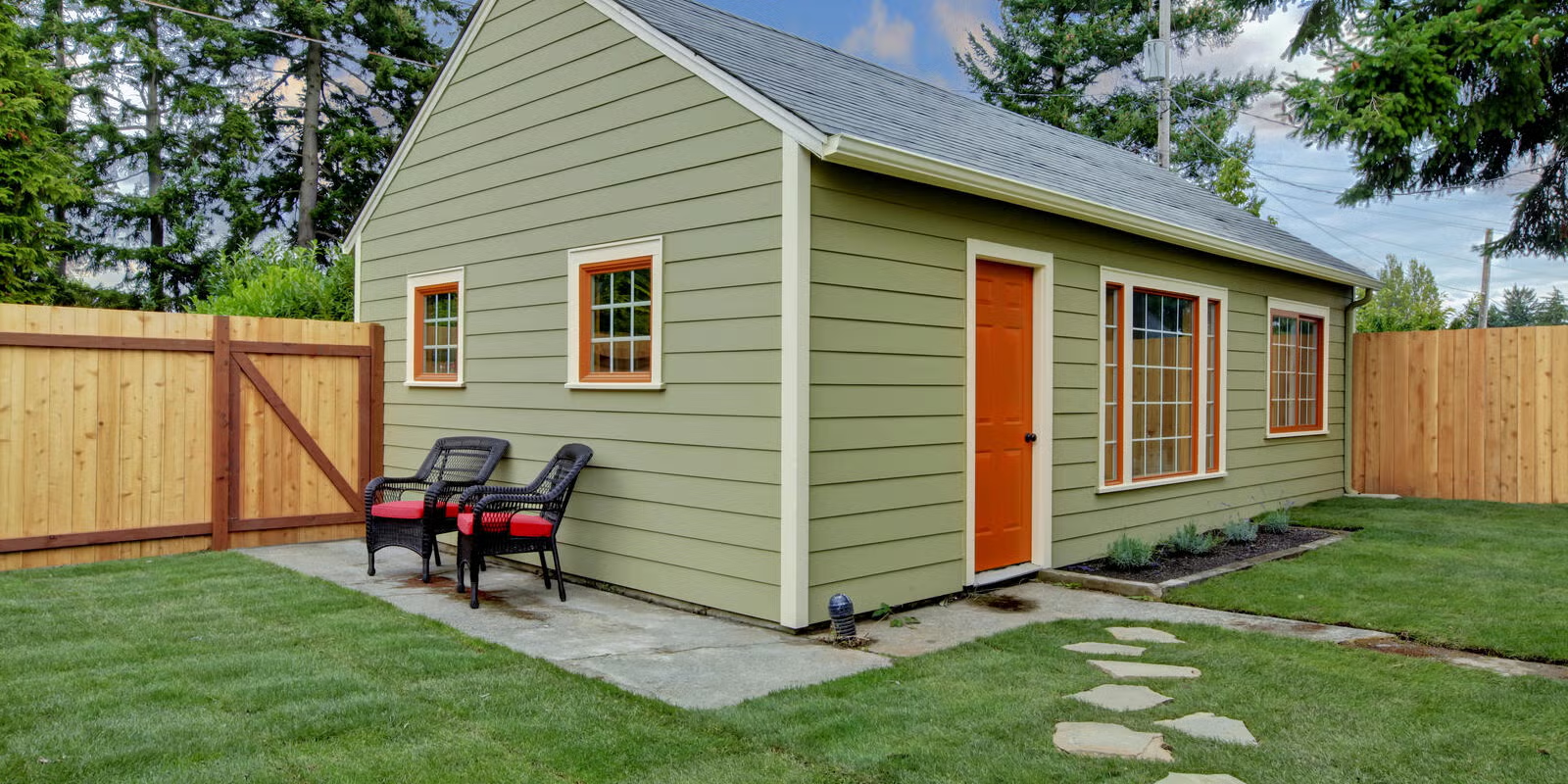
A detached backyard ADU, from the City of Portland's accessory dwelling unit permit guide. City of Portland Permitting & Development.
A Eugene homeowner asked the city whether he could build a detached ADU behind his house, and the answer was a list of code sections that added up to no, from a 7,500-square-foot minimum lot size to a ban on lots reached only by an alley. Oregon law lets a city regulate an ADU only through "reasonable local regulations relating to siting and design," and the state Court of Appeals ruled in 2020 that siting means where the unit sits on your lot, not whether your lot gets one at all.
The short version:
- Every Oregon city over 2,500 people, and every county over 15,000, must allow at least one ADU for each detached single-family home inside the urban growth boundary (ORS 197A.425, the law SB 1051 created in 2017).
- Cities may regulate siting and design, but they may not require the owner to live on site or require extra off-street parking. Short-term vacation rentals are the exception.
- In Kamps-Hughes v. City of Eugene, minimum lot sizes, minimum lot dimensions, alley-access bans and occupancy limits were all struck down as applied to ADUs, because none of them governs where the unit goes on the lot.
If you are a homeowner planning a backyard cottage in Oregon, this is the walkthrough for the moment a planner tells you your lot does not qualify. Most of the time the planner is reading a rule the state already took off the table. Here is how to tell.
Step one: confirm the state guarantee reaches your lot
The mandate began as Senate Bill 1051 in 2017 and now lives at ORS 197A.425, renumbered from ORS 197.312(5). Three tests decide whether it covers you. Your city has more than 2,500 residents, or your county more than 15,000. Your lot is inside the urban growth boundary. Your zone allows detached single-family houses. Clear all three and the city must allow at least one ADU per detached house. The statute counts interior, attached and detached units as ADUs, so a basement apartment and a backyard cottage start from the same guarantee.
From the text
(B) “Reasonable local regulations relating to siting and design” does not include owner-occupancy requirements of either the primary or accessory structure or requirements to construct additional off-street parking.
Subsection (2) carves one exception. A city may still require owner occupancy or off-street parking for "vacation occupancies," the short-term rentals defined in ORS 90.100. Long-term rentals and family use ride on the general rule.
Step two: sort every rule the city cites into two piles
Kamps-Hughes is the sorting tool. Eugene's code barred new ADUs on lots reached only by an alley, required a minimum lot of 7,500 square feet (roughly a 60-by-125-foot lot), required minimum lot dimensions of 45 feet by 45 feet, and capped occupancy in the ADU. According to the League of Oregon Cities' summary, the Land Use Board of Appeals held that rules "relating to siting" are only those that regulate an ADU's "location or placement on the property," and threw out all four. Eugene appealed, the League filed an amicus brief on the city's side, and the Court of Appeals affirmed (305 Or App 224).
The court's reasoning turned on two small words in the statute: "at least one" ADU for "each" single-family dwelling. Read the city's way, a large share of houses could never site an ADU, which breaks the one-to-one ratio. The court also called the city's goals, limiting density and traffic and preserving neighborhood character, "essentially policy arguments against ADU development in existing residential neighborhoods." Eugene argued, in effect, that siting meant whether. The court read the word as where.
Pile one, likely enforceable. Setbacks from property lines, height limits, how many structures fit on the lot, design standards for taller detached units, and hazard rules. Portland's own ADU permit guide is a fair model: the ADU must be smaller than the main house, detached units over 15 feet tall face design requirements, and a site with a slope of 20 percent or more, or in a landslide area, needs a geotechnical report.
Pile two, worth challenging. Anything that decides whether your lot qualifies at all: minimum lot area, minimum lot width or depth, access type, occupancy caps, owner-occupancy, and new parking spaces. If a rule would shut out your lot no matter where on it you placed the unit, it probably belongs here.
Our read: Kamps-Hughes is the most useful case an Oregon ADU applicant can carry to the permit counter, and it is underused because it lives in a 2020 appellate opinion instead of on city handouts. When a planner cites a rule, ask one question: does this decide where on my lot the unit goes, or whether my lot gets one? The second kind is the city's problem, not yours.
Step three: know what HB 2001 adds around the ADU
The 2019 middle housing law, now ORS 197A.420, changes what the main house can be. Cities of 25,000 or more, and every city and county inside a metropolitan service district such as Metro in the Portland region, must allow duplexes, triplexes, quadplexes, cottage clusters and townhouses wherever detached houses are allowed, plus a duplex on every such lot. Cities outside a metro district with 2,500 to 25,000 residents must allow a duplex on each lot. Cottage clusters are defined as at least four detached units per acre, each with a footprint under 900 square feet, around a common courtyard.
The siting-and-design limit carries over with sharper teeth. Middle housing rules may not, "individually or cumulatively, discourage the development of all middle housing types permitted in the area through unreasonable costs or delay." The LOC itself flagged that the Kamps-Hughes reading could reach HB 2001, since both laws use the same phrase.
Where people get stuck
The usual snag is not the zoning code. It is the permit history of the house you already own. Portland tells applicants that unpermitted past work must be permitted as if it were new, and that ceiling height, egress windows, insulation and stairs can make a garage or basement conversion expensive or impossible. None of that is a siting rule. All of it is real.
The cost ledger
Winning the zoning argument does not make the unit free. On Portland's system development charge page, adding an ADU is listed as a trigger for SDCs from Environmental Services, Parks, Transportation and Water. Three line items soften it. Newly created housing units permitted from August 15, 2025, through September 30, 2028, may be exempt under certain conditions. The Transportation SDC is waived for an ADU whose owner records a covenant barring short-term rental for 10 years, the same vacation-rental line the statute draws. And SDCs that do apply can be paid in installments over 5, 10 or 20 years, secured by a lien, or deferred for a $50 finance fee plus interest. That covenant is ten years of giving up the short-term rental option, so decide it before you sign, not at the cashier window.
The cross-street check. Oregon wrote a floor and a test; its neighbors wrote longer lists. Washington's HB 1337 requires at least two ADUs per lot inside urban growth areas, bans owner occupancy, and lets a detached ADU be sold as a condominium, as we walked through in September. Oregon's statute guarantees one ADU per house and leaves a second unit to local choice or to HB 2001's middle housing. California, by contrast, regulates the money directly: an ADU of 750 square feet or less owes no impact fees, and starting in 2027 a larger one is charged only on the space above 750, a line Oregon's statute never draws. An Oregon owner gets a cleaner legal argument; a Washington or California owner gets more of the specifics written down.
If you are still choosing a design, A-du's build marketplace lists pre-approved ADU plans from city and county catalogs and design firms, with an estimated build cost for each, so you can price a unit before you walk it through your city's siting rules.
Watch the next round of city code updates: every Oregon jurisdiction still carrying a minimum lot size for ADUs is one permit application away from its own Kamps-Hughes.
Elsewhere on the ADU beat
- Montgomery County, Maryland's council voted 10-1 to send County Executive Marc Elrich a bill that drops the owner-occupancy rule for ADU rental licenses, Bethesda Magazine.
- A roundup of the California housing laws taking effect in 2027, including the ADU impact fee and utility connection reforms, Holland & Knight.
- Waltham, Massachusetts' zoning board heard its first ADU case under the city's new rules and approved a larger unit closer to the side lot line, Waltham Times.