Your Oregon HOA Cannot Ban Your ADU Anymore. Starting 2027.
Chris Koss, AIA|Published: August 10, 2026
Last updated: September 25, 2026
A 2025 Oregon law voids the deed and homeowners association covenants that quietly ban backyard homes, and it reaches even the decades-old ones. The catch: the ban does not lift until January 1, 2027.
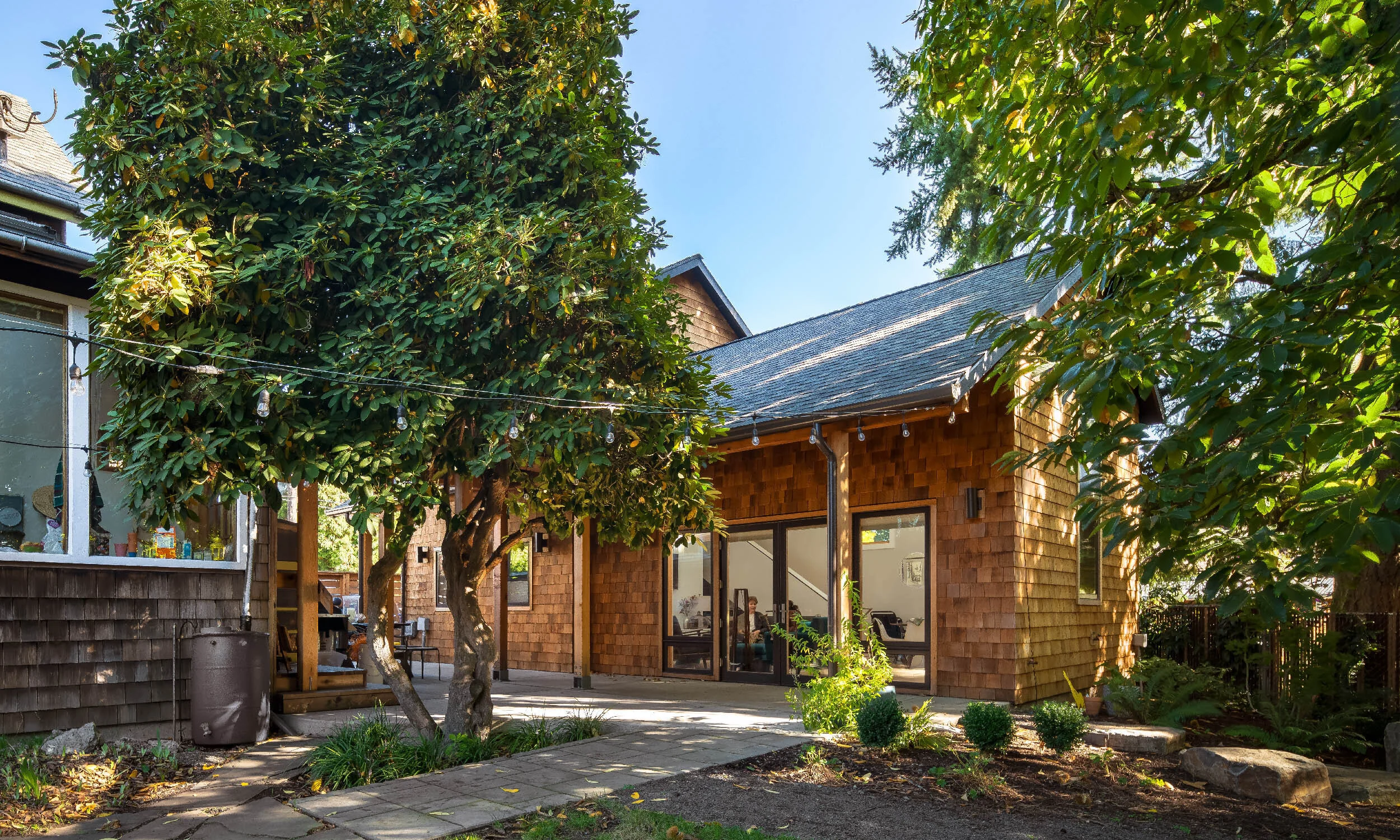
The Farmhouse ADU, a two-bedroom accessory dwelling in Portland's Woodstock neighborhood. Photo via Propel Studio Architecture.
For years, an Oregon homeowner could clear every zoning hurdle for a backyard cottage and still lose to a single line in a subdivision deed written in 1978. A state law signed last summer, House Bill 2138, makes those private restrictions unenforceable: starting January 1, 2027, no recorded covenant and no homeowners association rule in Oregon can ban an accessory dwelling unit that the public zoning already allows.
The short version:
- HB 2138 (2025) makes Oregon's ban on private anti-housing restrictions retroactive. Recorded deed covenants and HOA governing documents can no longer prohibit ADUs, middle housing, or added density, even ones written decades before the state started legalizing these homes.
- The covenant provisions become operative January 1, 2027, and the Land Conservation and Development Commission must adopt the implementing rules by January 1, 2028.
- The restriction only falls where the housing is consistent with public zoning. A voided covenant does not create ADU rights your lot never had; it removes a private veto over rights the zoning code already granted.
From the text
Makes retroactive the prohibition on private restrictions, including restrictions in governing documents of planned communities, that would limit middle housing, accessory dwelling units or housing density. Becomes operative January 1, 2027.
That is the measure summary for HB 2138, chaptered as Oregon Laws 2025, Chapter 476, and carried at the request of Governor Tina Kotek. The operative words are "makes retroactive." Read the rest slowly, because the whole fight is in that one adjective.
What actually changed
Oregon has been chipping at this for eight years. SB 1051 in 2017 required cities to allow an ADU on almost every urban single-family lot. HB 2001 in 2019 went further and legalized duplexes, triplexes, fourplexes, and cottage clusters, and it barred private covenants from blocking any of it. But 2019 drew a quiet line: the covenant ban applied to restrictions created after the law took effect. A CC&R recorded in 1985 that said "no secondary dwellings" kept its teeth.
HB 2138 erases that line. It reaches backward into every recorded deed restriction and every set of HOA bylaws on the books, and it strips out the language that would stop a zoning-compliant ADU or middle-housing unit. If you are a first-time ADU client whose title report flagged a decades-old covenant, that clause is the thing HB 2138 is aimed at. As we noted when we walked through Portland's system development charge math, the money questions are usually where an ADU project lives or dies. The covenant question is different: it decides whether the project is allowed to exist at all.
Who wins, and who waits
The winner is the owner sitting on a buildable lot inside a restrictive planned community: the Bend subdivision, the Lake Oswego association, the Beaverton development where the recorded rules still say no. For that owner, the private veto is gone as of 2027, and a zoning-compliant ADU stops being a lawsuit waiting to happen.
The person who waits is everyone, because 2027 is not now. The bill declared an emergency and took effect on passage last summer, but the covenant provisions were deliberately delayed to January 1, 2027, and the LCDC rules that tell local planners how to apply all of this are not due until January 1, 2028. So the letter your HOA sent last month is already a dead letter in substance, but your permit counter will not necessarily treat it that way until the rules land.
Our read: the covenant ban in your HOA file is living on borrowed time, but the borrowed time runs to 2027, and the machinery that makes it enforceable at the counter is not scheduled until 2028. This is a win you cannot build on yet, only plan around.
The cross-street check. Oregon just did, by statute and retroactively, the thing California is still arguing about in court. California has taken its own runs at HOA power over accessory units, but a San Diego County judge recently held that the state ADU law does not automatically override a common-interest development's rules, which is exactly the gap Oregon closed by hand. We covered that decision when the Carlsbad ruling landed. Washington sits somewhere in between: HB 1337 bars declarations and HOA governing documents created after July 23, 2023 from imposing ADU restrictions inside urban growth areas that a city could not impose, but by its terms it does not reach older recorded covenants the way HB 2138 explicitly does. If you are comparing regimes, the tell is retroactivity: Oregon is the only one of the three that says the word out loud.
What to watch
The live action is at the Department of Land Conservation and Development, where the Middle Housing rulemaking is underway through 2026 ahead of that 2028 deadline. The rules will decide the practical questions HB 2138 left open: how a homeowner proves a covenant is now void, what a title company writes on a policy, and how a planner at a Bend or Hillsboro counter is supposed to read a CC&R that the statute has quietly hollowed out. Watch whether the commission gives owners a clean, documented path or leaves the burden on each homeowner to argue it lot by lot.
If you are mapping what your own Oregon lot can hold before the rules firm up, A-du's build marketplace is a reasonable place to start pricing the project you were told you could not have.
The covenant is already losing. The only open question is how loudly the state will say so when the rules arrive.
Elsewhere on the ADU beat
- San Diego adopted a package of 25 ADU and JADU reforms, including a new Community Enhancement Fee on bonus and affordable units under 750 square feet, Inside San Diego.
- Seattle opened its ADUniverse pre-approved plan gallery to a new round of designs, with the expanded catalog now expected to launch in January 2027, Seattle Office of Planning and Community Development.