Four Zones Where San Francisco's Pre-Approved ADU Plans Can't Go
Chris Koss, AIA|Published: July 23, 2026
Last updated: September 25, 2026
San Francisco pre-approves detached ADU plans, but its own program bars them on slope, liquefaction, Maher, and flood lots, often the cheaper parcels a first-time owner can afford. Read your dirt first.
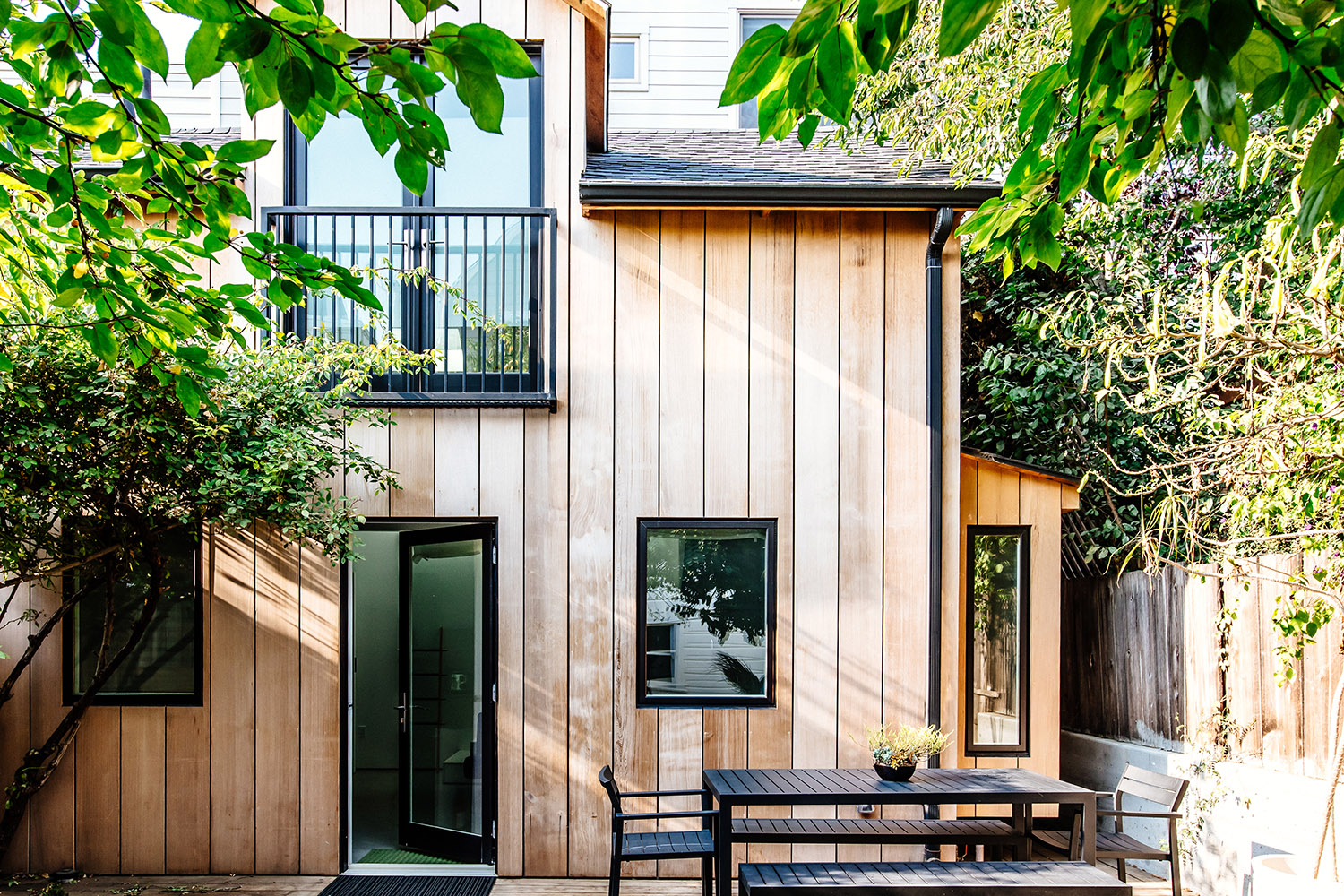
A 556-square-foot rear-yard cottage in the Mission, one of the flat, made-ground neighborhoods where San Francisco's soil rules get interesting. Yama Architecture.
San Francisco pre-approves detached ADU plans drawn by private designers. Whether you can use one depends less on your budget than on your dirt. The city's own program states that its pre-approved plans cannot be used in slope protection areas, landslide and liquefaction zones, Maher hazardous-soil zones, or flood zones, four categories that quietly settle feasibility before an architect draws a single line.
The short version:
- San Francisco's pre-approved ADU plans are barred on four kinds of lots: slope protection areas, landslide and liquefaction zones, Maher hazardous-soil zones, and flood zones. Check the Property Information Map before you fall for a plan.
- Adding an ADU can trip the city's earthquake-safety requirements on its own, and a wood-frame multifamily building may owe a mandatory soft-story retrofit first.
- On a hillside or made-ground lot, budget for a geotechnical report and possibly a third-party engineering or Structural Advisory Committee review before your permit moves.
From the text
"Due to geography and soil conditions in some parts of San Francisco, pre-approved ADU plans cannot be used in slope protection areas, landslide and liquefaction zones, Maher Zones, and in flood zones." SF.gov, Pre-Approved ADU Plans program.
That one sentence does a lot of work. When we walked through San Francisco's pre-approved plan program and its fine print, this was the fine print. The plans are drawn by private designers for a tidy 25-foot lot on stable ground, and they are not a free city handout: the designer pays DBI a flat $2,408 to review each one and stays responsible for every site-specific project. The moment your parcel carries a known hazard, the pre-approved template stops being a shortcut and becomes a starting sketch you still have to engineer.
What the exclusion actually screens for
Each excluded category maps to a real condition the city has already mapped. Liquefaction and landslide zones come from the California Department of Conservation Seismic Hazard Zones Map for San Francisco, the one dated November 17, 2000, which flags the made ground and old creek beds that can turn to slurry in a quake. Slope protection areas cover the hillsides. Maher zones cover soil that is known or suspected to be contaminated, which the city defines broadly to include historical industrial sites, land near freeways, and anywhere with current or former underground storage tanks. Flood zones cover what they say.
You do not have to guess which bucket you are in. The city's Property Information Map lists a parcel's environmental flags, and the same page spells out the consequence: a project that disturbs 50 cubic yards of soil, roughly four dump-truck loads, in a Maher area may have to run a site assessment and mitigation before it breaks ground. If you are a first-time SF ADU client, this is the check to run in week one, not week ten.
The seismic surprise: your ADU can trip the retrofit clock
Here is the part that catches people. San Francisco's earthquake-safety rules list "adding an accessory dwelling unit" as one of the construction triggers that can require seismic improvements, right alongside big horizontal additions and major structural alterations. Add a garden unit and, depending on the building, you may have bought yourself a structural upgrade. On top of that, some wood-frame multifamily buildings still owe a mandatory soft-story retrofit under the city's program, and it is far cheaper to fold that retrofit into your ADU permit than to do it twice. The city will confirm the plan "is appropriate for the site-specific location," which is a polite way of saying the pre-approved plan was never the whole plan.
Who wins and who loses
The winners are the flat, dry, interior lots: a standard 25-foot parcel in a western neighborhood with no hazard flags, where the pre-approved plan is exactly the fast path it promises. The losers are the lots that need help most. The made ground of the Mission and SoMa tends to sit in liquefaction territory; the industrial legacy around Bayview and Dogpatch tends to draw Maher review; the hillside parcels above Noe Valley and Bernal Heights carry slope rules and geotechnical reports. Those are frequently the more affordable parcels, which is the cruel twist. Our read: the pre-approved plans are a head start for the easy lots and a shrug at the hard ones, and the hard ones are often the cheaper land a first-time owner can actually buy.
The cross-street check. Every metro has a version of the soil gauntlet, but the shape differs. In Los Angeles the constraint is more often above ground than below it: as we covered when LA designers were bending ADU plans around overhead power lines, the site condition that eats your budget there is clearance and hillside grading, not liquefaction. In New York City the ground story is a flood story: the City of Yes ADU rules exclude flood-risk zones from the basement and cellar pathway outright, so a Canarsie or Rockaway owner is screened out for water before soil ever enters the conversation. San Francisco is the metro where the exclusion list runs longest, because the same 49 square miles stacks quake, slope, made ground, and industrial legacy on top of each other.
What to watch
If your lot is clean, use a pre-approved plan and move. If it is flagged, the sequence that saves money is boring and correct: pull the Property Information Map, email DBI's Technical Services Division about your specific hazard, and get a geotechnical report scoped before you commit to a design, because on a slope or made-ground lot the foundation, not the finishes, is where the money goes. Until the city opens its pre-approval program to the hazard-zone lots it currently bars, the hardest lots stay a custom-engineering problem. That is the gap worth watching.
If you would rather not project-manage a geotechnical engineer, a structural engineer, and a plan checker on your own, A-du's build marketplace matches SF owners with teams that have already cleared these exact site reviews.
The next real opening for San Francisco is not another 25-foot template. It is a pre-approval path that already answers the soil question, and today's program does not offer one.
Elsewhere on the ADU beat
- Los Angeles County is weighing its own free ADU standard-plan program, separate from the city's catalog, Urbanize LA.
- The city comptroller laid out a roadmap to speed up New York's stalled basement-legalization effort, City Limits.
- A field guide to where NYC's first legal basement conversions are actually surfacing, Gothamist.