Seattle Rewrote Its ADU Code. The Pre-Approved DADU Plans Are Catching Up.
Chris Koss, AIA|Published: July 28, 2026
Last updated: September 25, 2026
Seattle's pre-approved DADU plans still get you a permit in about six weeks, but the catalog was drawn under a zoning code the city rewrote in 2025. Here is how to use it without inheriting the old rules.
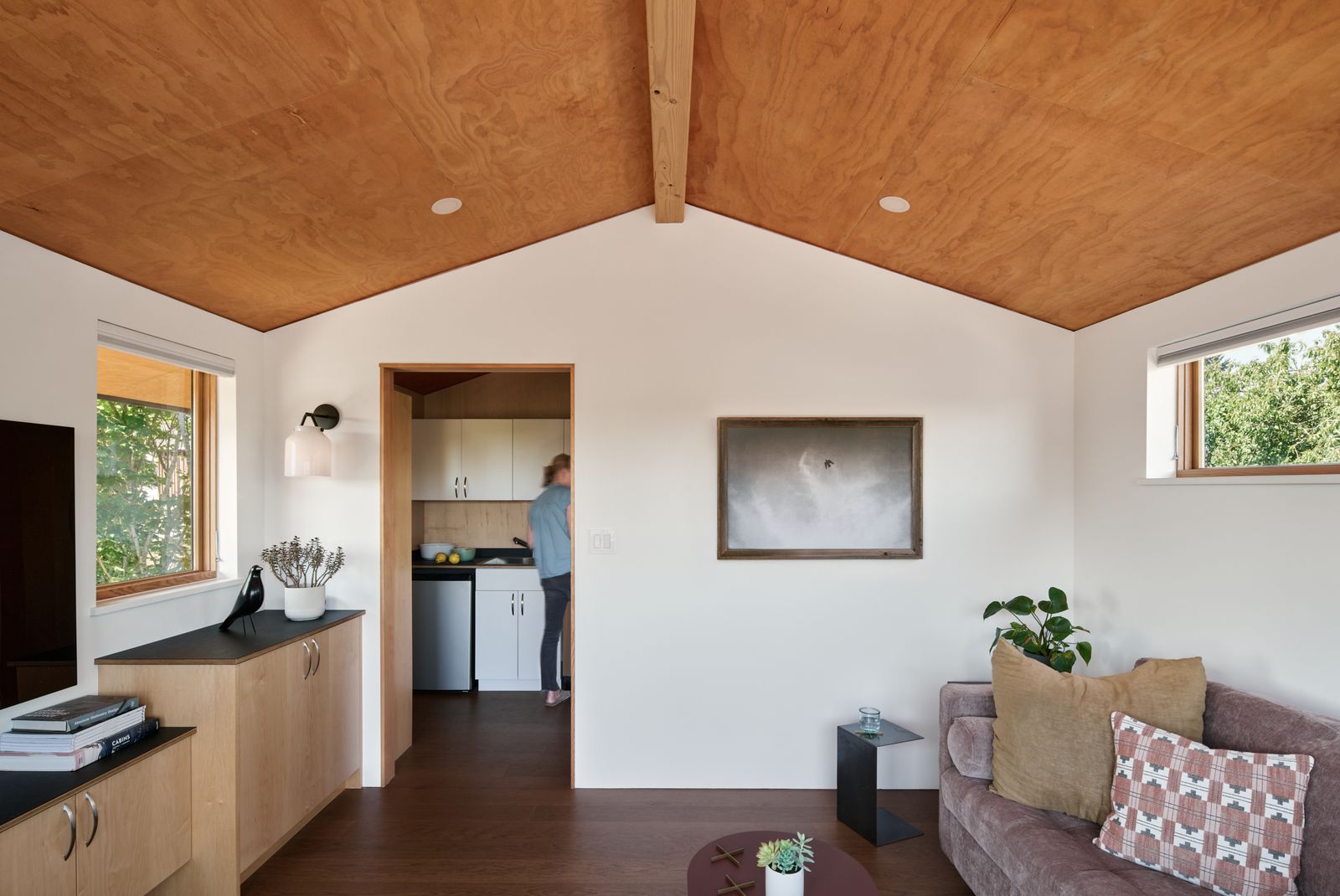
A tiny kitchen and bath tucked into the upper floor of a Ballard backyard cottage by Studio Zerbey Architecture and Interiors. Dwell.
If you own a Seattle lot and want a backyard cottage, the city offers a finished set of plans you can license from the designer for no more than $1,000 under the current gallery's terms, and a building permit can follow in as little as 2 to 6 weeks. But the pre-approved designs in Seattle's ADUniverse gallery were drawn under a zoning code the City Council rewrote in 2025 to meet Washington's statewide ADU mandate, and the city has just closed submissions on the replacement catalog it started building this summer.
The short version:
- Seattle's ADUniverse pre-approved DADU plans still cut permit review to roughly 2 to 6 weeks, versus months for a custom set the counter has never seen.
- The current gallery predates Ordinance 127211, the May 2025 law that revised Seattle's ADU rules to comply with state House Bill 1337, and the city now flags parts of ADUniverse as out of date.
- Seattle's call for new ADU and middle-housing designs closed July 15, 2026; a refreshed gallery is now expected in January 2027, so mid-2026 is an awkward moment to pick a plan.
What a pre-approved plan actually gets you
A pre-approved plan is a full DADU design, drawn by a local architect or designer and already checked by the city against the building, residential, and energy codes. Because the plan cleared that review once, your permit skips the slowest part of the queue. Seattle says most pre-approved projects get a permit in 2 to 6 weeks, where a custom set can sit in plan check for months. For a first-time owner, that is the difference between one construction-loan rate lock and two.
The catalog lives on ADUniverse, the city's ADU portal, alongside a feasibility tool that estimates whether your lot can take a cottage at all. Using a plan from the current gallery costs a designer licensing fee capped at $1,000 (the city's guide for the replacement gallery sets the limit at $1,500 per unit for most plans); you also pay permit fees, the designer's site-adaptation work, and the build. If you are a Seattle homeowner comparing a catalog plan against a custom design, the honest case for the catalog is speed and certainty, not a wider set of choices.
Why the catalog is a moving target this year
Here is the wrinkle. In May 2025 the City Council adopted Ordinance 127211, which changed Seattle's ADU rules to satisfy House Bill 1337, the state law requiring Washington cities to allow at least two ADUs per lot, drop owner-occupancy, and cap ADU impact fees. A month later, Ordinance 127219 brought in interim Neighborhood Residential zoning to meet HB 1110, the middle-housing law. Both took effect June 30, 2025. The pre-approved gallery, though, was assembled under the code those ordinances replaced.
The city is not hiding it. Its own project page warns that as ADUniverse is updated to reflect the new state requirements, some sections may be out of date. That is why Seattle put out a call for fresh ADU and middle-housing designs and, after an extension, closed submissions on July 15, 2026. A rebuilt gallery is now expected in January 2027, per the city.
Where people get stuck
The trap is assuming pre-approved means approved-for-your-lot. It does not. A plan cleared under the old code still has to land on your parcel under the current Neighborhood Residential standards, which govern setbacks, height, and lot coverage. If a design in the gallery was drawn for yesterday's rules, the site-specific sheets your designer prepares are where the reconciliation happens, and that is billable time. Before you fall for a plan, pull the city's tip sheets on attached and detached ADUs and confirm the design pencils out under the zoning your address carries today, not the zoning the drawing assumed.
The cross-street check. Seattle's problem is almost the opposite of California's. Los Angeles built its LADBS Standard Plan catalog on top of a stable statewide ministerial-approval law, so while individual plans expire and get replaced, its catalog of roughly 90 designs, more than 50 of them currently approved, is not being rebuilt from scratch; San Francisco's DBI pre-approved plans are thin but sit on the same settled state framework. Seattle's catalog is being rebuilt precisely because the ground under it, the zoning code itself, moved a full year ago. New York is the sharpest contrast: its brand-new ADU for You library launched into a regime where the Regional Plan Association found only about 12 percent of one- and two-family lots even qualify, so a New York owner's first question is eligibility while a Seattle owner's is currency. Same tool, three different failure points.
The cost ledger
The money case for a pre-approved plan is real but narrow. You save the design fee on the base plans and, more to the point, you save review time, which on a construction loan is interest you never pay. HB 1337 helps here too: it caps a city's ADU impact fees at half the charge for a single-family house, which in a fee-heavy jurisdiction can be several thousand dollars kept in your pocket. What the catalog does not save you is the site work, the utility connections, or the designer's hours reconciling an old drawing with new zoning. Budget the plan as a discount on process, not on construction.
Our read: a pre-approved plan is only as current as the code beneath it, and Seattle's is a year out of date until the refreshed gallery lands. Through the rest of 2026, treat the existing catalog as a fast starting point to verify against the new Neighborhood Residential rules, not a guarantee that the drawing still fits your lot. As we noted when Washington's two-ADU mandate took hold, the state changed what is allowed faster than any single city could redraw its plan set, and Seattle is the first place that gap shows up at the counter. It is the same lesson the California pre-approved programs learned more slowly: a plan catalog is a living document, and its value expires with the code.
If you are weighing a catalog plan against a custom cottage, A-du's build marketplace lets you line Seattle designers and their pre-approved sets up against the rules your specific lot carries now.
Watch for the refreshed ADUniverse gallery, now expected in January 2027; the designs chosen from July's call are what will set Seattle's pre-approved plan menu for the next code cycle.
Elsewhere on the ADU beat
- San Diego's City Council adopted a sweeping package of ADU and density-bonus reforms, including a new Community Enhancement Fee, Inside San Diego.
- New York City's ADU for You platform is pulling homeowners into a program where most lots still do not qualify, Brick Underground.