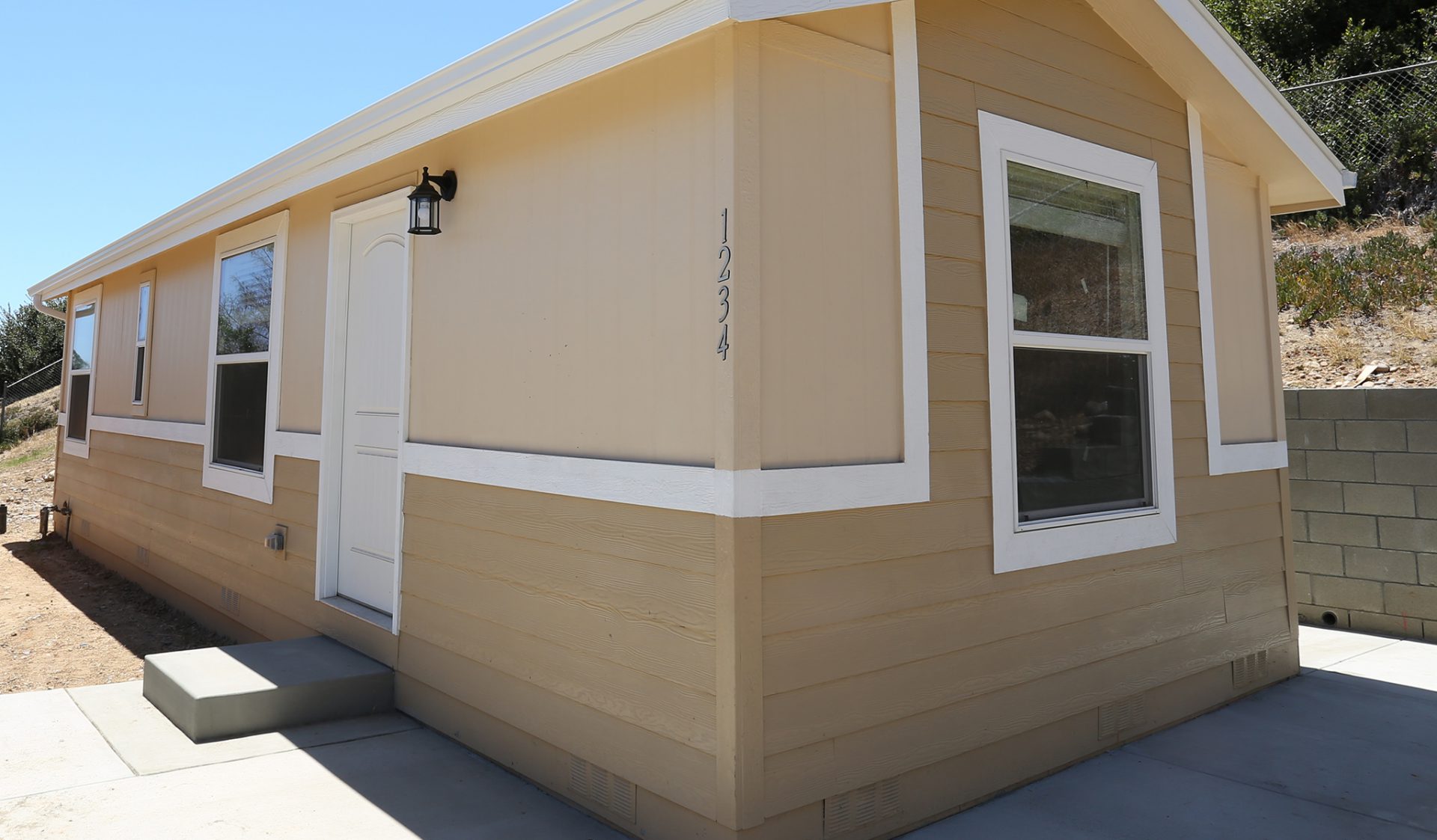
ADU Rules in San Diego
The bonus program that made San Diego famous and what the 2025 cap left of it, why a coastal parcel follows different rules than the one behind it, where the free county plans are, and what a permit actually costs.
ADU rules in San Diego are set by California state law plus San Diego Municipal Code 141.0302 in the city, and the county zoning ordinance in unincorporated areas.
Two San Diego specifics dominate everything else: the ADU Home Density Bonus, substantially restricted in 2025, and the Coastal Overlay Zone, where those restrictions do not yet apply.
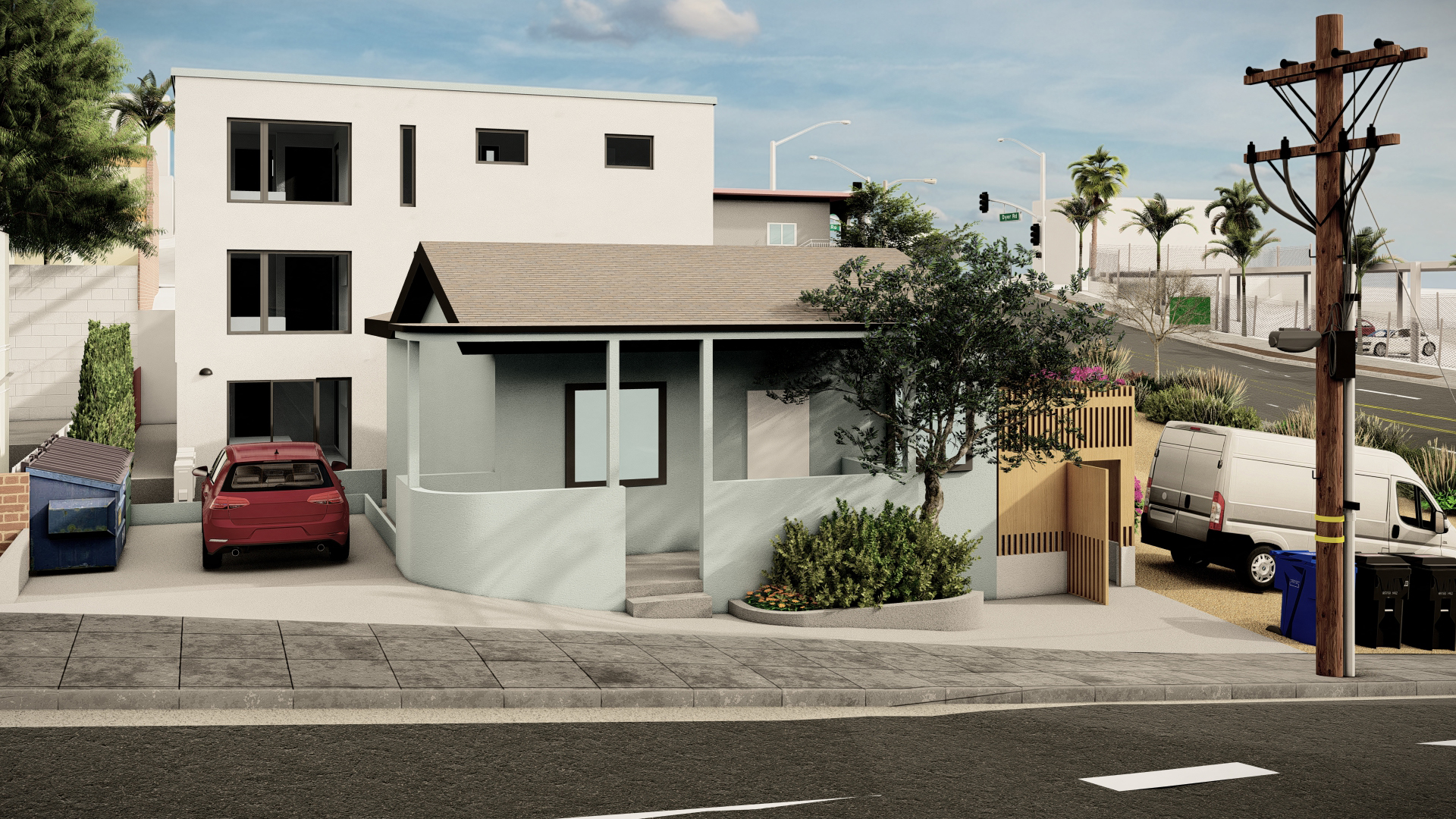
Two ordinary lots in Pacific Beach were going to hold 136 rental homes. Each about 450 square feet, each pitched to investors at roughly $3,000 a month, all of it legal because San Diego’s ADU bonus program had removed any ceiling on how many accessory units a lot near transit could carry. That project became the program’s flashpoint: a judge halted it, the City Council capped the program by lot size, and by July 2026 the developer had redrawn it at 125 units in six buildings, with the neighbors still suing. If you are a homeowner here weighing one extra unit, that fight set the rules you now build under.
San Diego went further than any other large California city in encouraging ADUs, then pulled much of it back. If you are reading an article written before late 2025, it is describing a program that no longer exists in that form. Here is where the rules stand as of September 2026.
The ADU Home Density Bonus, after 2025
The bonus program lives at San Diego Municipal Code 141.0302(d). The bargain is simple: deed-restrict one ADU as affordable and the city lets you build another at market rate. Until 2025 there was no limit on the number of bonus units inside a Sustainable Development Area, which is the provision that made San Diego famous and, in Pacific Beach, notorious.
Ordinance O-21989, effective August 22, 2025, changed that. The current program:
- A hard cap by lot size. In a base zone that permits single dwelling units but not multiple dwelling units, four ADUs and JADUs in total on a lot of 8,000 square feet or less, five from 8,001 to 10,000, six at 10,001 and above, counting the state-law units. The one-for-one exchange inside a Sustainable Development Area still appears in the text, but the cap now sits on top of it.
- Base zones excluded. Several RS-1 single-dwelling zones are outside the program unless the premises is in a High or Highest California Tax Credit Allocation Committee opportunity area when the application is deemed complete and is designated residential in a land use plan.
- Fire access conditions. In High and Very High Fire Hazard Severity Zones the lot has to front an improved public street with at least two evacuation routes, and may not front a cul-de-sac or have only one point of ingress or egress. Note that this is a condition, not a ban: the program was not repealed in those zones.
- Sprinklers and parking. Automatic fire sprinklers in every affordable and bonus ADU, and one off-street parking space for each one located outside a transit priority area.
- An agreement and a fee. A recorded bonus agreement with the San Diego Housing Commission setting the affordability term, ten years for very low and low income and fifteen for moderate, and a community enhancement fee based on the floor area of the affordable and bonus units.
A further ordinance, O-22109, effective July 15, 2026, made smaller changes in the 2026 land development code update, among them exempting state-law ADUs from the Climate Action Plan consistency rules, and did not loosen any of the above.
The coastal split, which almost nothing else mentions
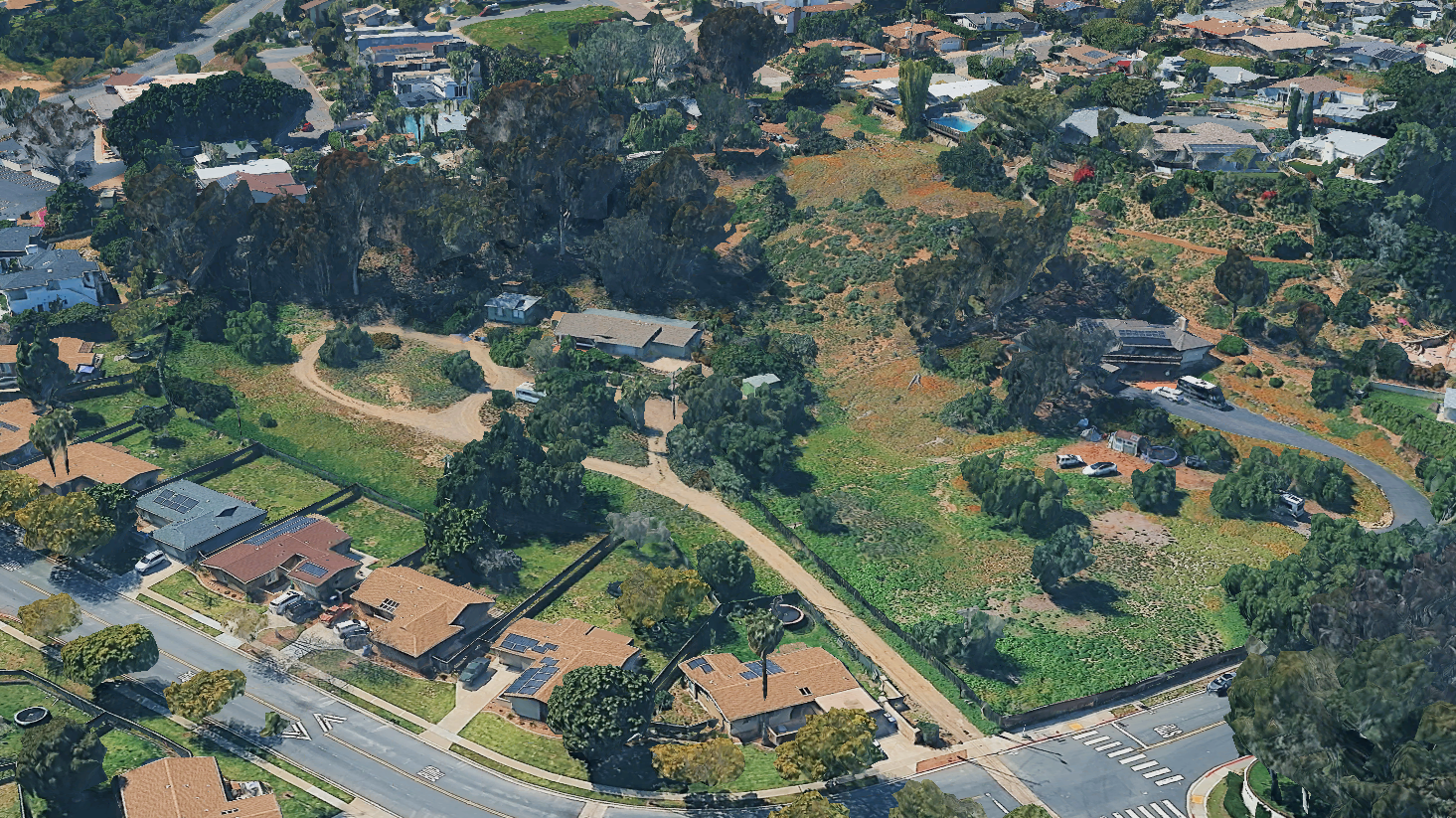
This is the most consequential thing on this page. The city code carries editor notes on O-21989 and O-22109 saying they do not apply within the Coastal Overlay Zone until the California Coastal Commission certifies them as a Local Coastal Program amendment, and the city’s own Information Bulletin 400 lists the 2025 bonus program amendments among the rules not in effect in the Coastal Overlay Zone. The certifications arrive one ordinance at a time, years apart. Per the city’s code update tracker, Housing Action Package 1.0 took effect in the coastal zone on September 12, 2024, Housing Action Package 2.0 on March 11, 2026 and the 2024 code update on September 10, 2026. The 2025 bonus program amendments and the 2026 code update are still waiting; the city anticipates certification in 2026 and 2028 respectively, and the Coastal Commission granted itself a one-year extension on the 2025 amendments in October 2025.
So two lots on the same street can be governed by different text, and the Pacific Beach project above is a coastal one. The city has not published a consolidated version of what the coastal version of the bonus program currently says, which means anyone telling you confidently what you can build on a coastal parcel is reasoning from the inland rules. Check whether your parcel is in the zone on the city’s Coastal Overlay Zone map and, if it is, confirm the applicable standards with Development Services before paying for a design.
A coastal parcel usually also needs a Coastal Development Permit. Bulletin 400 states one is required for any ADU or JADU not completely contained within the existing primary structure, or that adds habitable area, or that converts non-habitable space; a JADU does not categorically need one. Since September 7, 2022, an ADU or JADU in the non-appealable area of the zone can have its coastal permit issued administratively with the building permit, when the findings in SDMC 126.0708(c) are met, instead of through a separate discretionary coastal permit, and the city’s decision is not appealable to the Coastal Commission. And since AB 462 took effect on October 10, 2025, coastal review of an ADU runs concurrently with the ADU permit, must be decided within 60 days, and does not require a public hearing. Our Santa Monica guide covers the same statute from the Los Angeles side.
Pre-approved plans: the county has them, the city does not
California requires every local agency to run a pre-approved plan program, and an application using a pre-approved plan gets a 30-day decision rather than 60, for a detached unit, while the plan is current with the building code cycle. You own a lot in North Park, you want a detached studio in the back, and someone told you a pre-approved plan makes the permit fast. It can, once you understand what pre-approved buys you here, because San Diego’s two halves comply differently.
- The County of San Diego publishes standard dwelling unit plans: eight in total, six of which may be built as an ADU, from 600 to 1,200 square feet, free to download as large-format PDF and CAD. The county describes them as roughly 85 percent complete, and leaves the project-specific information to the owner, who will usually complete it with a contractor or a design professional.
- The City of San Diego publishes none of its own. It accepts plans pre-approved by the County of San Diego, Chula Vista and Encinitas, and says plainly that you must contact the plan provider to find the cost of licensing it. A pre-approved plan in the city is a faster review, not a free drawing set.
A-du’s plan catalog carries the published San Diego region catalogs alongside the Los Angeles and New York City ones, with the pre-approving jurisdiction shown on each. If a catalog plan is not the point, the region has produced some memorable custom work: a 540-square-foot mass-timber unit assembled in twelve weeks, for one.
Unincorporated county: separate sale is now real
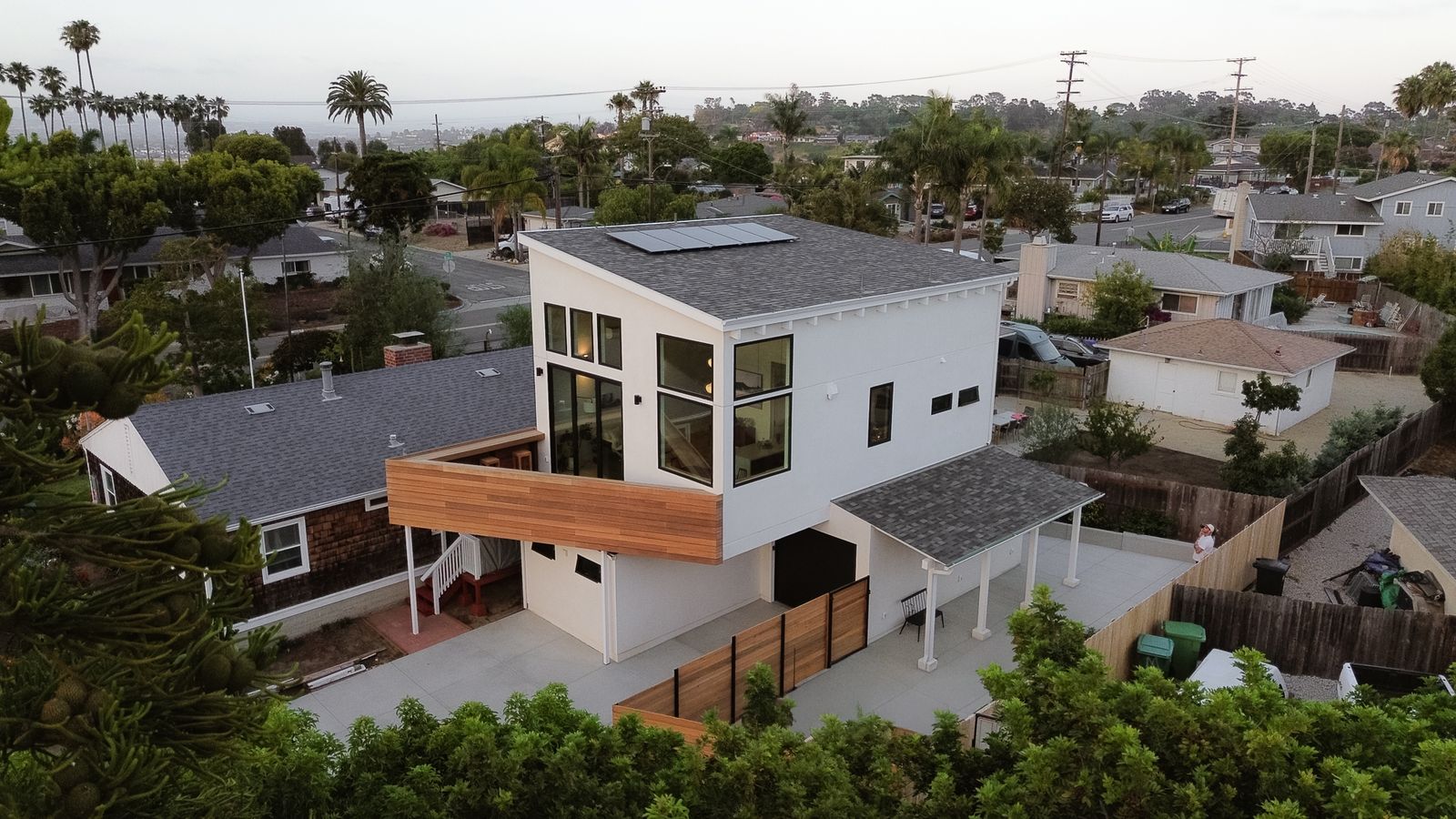
Sarah and Brant Barrah lost bidding war after bidding war on the coast until his parents offered them a garage in their Oceanside backyard. They spent about $732,000 turning it into a two-level home, and under state law that finished ADU can be rented on its own but never sold on its own, because Oceanside has not adopted the ordinance that would allow it. The county has. It adopted AB 1033 in March 2026, effective April 4, 2026, which lets an ADU in an unincorporated community be sold separately from the main house through a condominium conversion, joining a handful of California jurisdictions, the City of San Diego among them under SDMC 141.0302(f). A further amendment effective September 18, 2026 added conditions on those condo units: a right of first refusal for an existing tenant or another owner on the lot, an owner-occupancy affidavit from the buyer, and a required public posting period on each re-listing. The county has also been directed to report back on raising the allowable ADU size, so this is an area to re-check rather than assume settled.
What it costs
The unincorporated county publishes a clean number in its building permit fee schedule: an ADU carries a plan review fee and a permit fee, each a base amount plus a rate per square foot, with a lower plan review base for units eligible for over-the-counter review.
The city does not. Its construction permit fee schedule prices by project type as a base rate plus a per-square-foot increment, and a detached ADU sits on a different row above 500 square feet than below it, so crossing that line changes the rate band rather than just adding area. Read the current bulletin for your size, and expect impact fees, school fees and, for a bonus project, the community enhancement fee on top.
State law caps part of this regardless of jurisdiction: no impact fee at all on an ADU of 750 square feet or less of interior livable space, and no school facilities fee under 500 square feet. Connection fees and capacity charges are expressly outside that protection, which is where budgets are usually surprised. A-du’s permit fee calculator models Los Angeles County jurisdictions, San Francisco and New York City; it does not yet model San Diego, so the schedules above are the source here.
Renting it out
State law lets a city require that an ADU be rented for terms of 30 days or longer, and San Diego’s code phrases it as no rental term of less than 31 consecutive days. Short-term rental of an ADU is therefore out. Junior ADUs look like an exception in the city code, which says they are not subject to a local rental term, but state law closed that door on January 1, 2026: Government Code 66333(g) requires every JADU ordinance to make JADU rentals run longer than 30 days, and Bulletin 400 and the Treasurer’s short-term rental guidance apply exactly that. A JADU may not be used for short-term occupancy either.
Own a finished ADU here? Listing it on A-du is free. Building one? Browse pre-approved plans or read the build guide, whose order of operations is the same outside Los Angeles.
Frequently asked questions
- How many ADUs can I build on a San Diego lot?
- Under the current code the total number of ADUs and JADUs on a single-dwelling-unit lot is capped by lot size: four on a lot of 8,000 square feet or less, five from 8,001 to 10,000, and six at 10,001 and above. That cap arrived with Ordinance O-21989, effective August 22, 2025, and it is what ended the unlimited bonus ADU inside a Sustainable Development Area. Several base zones are also excluded from the bonus program unless the property is in a High or Highest state opportunity area and designated residential in a land use plan.
- Do the 2025 ADU rules apply in the coastal parts of San Diego?
- Not yet. The city code carries an editor note stating that the 2025 amendments do not apply within the Coastal Overlay Zone until the California Coastal Commission certifies them as a Local Coastal Program amendment, and the city bulletin lists them as not in effect there. Earlier ordinances have been certified one at a time: Housing Action Package 1.0 in September 2024, Housing Action Package 2.0 in March 2026 and the 2024 code update in September 2026. The city anticipates certification of the 2025 amendments in 2026. If your parcel is coastal, confirm which version of the bonus rules applies with Development Services before designing to either one.
- Does San Diego have free pre-approved ADU plans?
- The County of San Diego does, for unincorporated areas: eight standard dwelling plans, six of them usable as an ADU, free to download as PDF and CAD, and roughly 85 percent complete so project-specific information still has to be added. The City of San Diego publishes none of its own. It accepts plans pre-approved by the County of San Diego, Chula Vista and Encinitas, and you have to contact the plan owner to license the plan, so a pre-approved plan in the city is not free.
- How long does San Diego take to approve an ADU?
- State law requires a ministerial decision on a complete ADU application within 60 days, and a decision within 30 days where the application uses a plan the agency pre-approved within the current triennial building code cycle. The 30-day clock applies to detached units. Inside the Coastal Overlay Zone a coastal development permit is usually required as well, and since AB 462 took effect in October 2025 that review runs concurrently, carries its own 60-day deadline, and does not require a public hearing.
- Can I use my San Diego ADU as a short-term rental?
- No. The city code sets a minimum rental term of 31 consecutive days for an ADU, in line with state law, which lets a city require terms of 30 days or longer. Junior ADUs are covered by state law directly: since January 1, 2026 Government Code 66333(g) requires JADU rentals to run longer than 30 days, which the city bulletin and the Treasurer guidance apply, so a JADU cannot be used for short-term occupancy either, even though the city code says it imposes no local rental term on JADUs.
- What does an ADU permit cost in San Diego?
- There is no single number in the city. The construction permit schedule prices projects by type as a base rate plus an amount per square foot, and a detached ADU falls on a different row above 500 square feet than below it, so the size of the unit changes the rate band and not just the total. The unincorporated county does publish a clean figure: a plan review fee plus a permit fee, each a base amount plus a per-square-foot rate. Impact fees are separate and are waived by state law on a unit of 750 square feet of interior livable space or less.
This guide is general information, not legal advice, and it is not a substitute for the City of San Diego Development Services Department or the County of San Diego Planning & Development Services. Sources: San Diego Municipal Code 141.0302, Ordinances O-21989 and O-22109, Information Bulletins 400 and 501, the county zoning ordinance, plan library and fee schedule, and California Government Code 66310 and following as amended by SB 543, each linked above and read in September 2026. Project budgets are as published in the linked posts. San Diego ADU rules have changed repeatedly; confirm current requirements before you build or rent.