ADU Rules in the City of Los Angeles
Two doors into the same permit counter, and why the one you pick decides parking, size, height and whether a hillside lot is even eligible. Plus what the state found wrong with the city's ordinance, the free plan, rent stabilization, and fees.
An ADU in the City of Los Angeles is approved on one of two tracks: as an ordinance ADU under Los Angeles Municipal Code 12.22 A.33, with the city's local standards attached, or as a state ADU under Government Code 66323, which the city must approve without them.
Which track you file on decides parking, size, height and whether a hillside lot is eligible. It is the first decision in a Los Angeles ADU project and most guides never mention it.
Picture the permit counter at the Department of Building and Safety on Figueroa. Two homeowners walk up with drawings for a backyard cottage. One has 780 square feet, one story, four feet off the side and rear lines, on a hillside lot above Glassell Park. The other has 1,100 square feet on two floors, flat lot, Mid-City. Same counter, same afternoon, and they are not applying under the same rules. The first is a state ADU; the city has to approve it and may not ask for a parking space. The second is an ordinance ADU; the city’s own standards attach, parking included, and had that lot been in the hills the city would have said no. Nobody at the counter will explain this. The city’s own zoning memo does, in a table, and so does this page.
Los Angeles has finaled more than fifteen thousand ADUs, and it has done so under an ordinance the state has said does not comply with state law. Both things are true at once, and a homeowner can work around the second by choosing the right door. Here is how the pieces fit as of September 2026.
The ordinance, and what the state said about it
The city’s ADU rules are LAMC 12.22 A.33, added by Ordinance 186,481 and effective December 19, 2019, which in ADU years is a long time ago. State law has been amended every session since. On November 19, 2024 the California Department of Housing and Community Development sent the city nine pages of written findings that the ordinance does not comply, in seventeen numbered items. Most are housekeeping. Four change what you can build:
- The hillside fire zone ban. The ordinance prohibits ADUs on lots in both a Very High Fire Hazard Severity Zone and a Hillside Area, which describes a great deal of the city north of Sunset. State law lets a city designate such areas only on evidence about traffic flow, public safety, or water and sewer capacity, and HCD found the city had not adequately demonstrated it.
- One ADU per lot. State law entitles a single-family lot to a converted ADU, a detached new ADU and a junior ADU, in any combination. The 2026 amendment to the statute added the words "or any combination" to put this beyond argument.
- Two stories, and an outdated 16 feet. The ordinance caps a detached ordinance ADU at two stories, and describes the state-track detached unit as 800 square feet and 16 feet; state law now requires 18 feet within half a mile walking distance of a major transit stop or high-quality transit corridor, and in that case two more feet to match the roof pitch of the house, 20 in all. HCD found both non-compliant.
- Memos are not an ordinance. The city had been updating its practice through zoning administrator memoranda. HCD said those are not a substitute for amending the code.
The city’s response was another memorandum, ZA Memo 143, issued December 30, 2024 and revised August 1, 2025, which is what the department applies today. As of September 2026 the operative ordinance is still 186,481, alongside the department’s 2026 information bulletins. HCD has separately sent LADBS two technical assistance letters, on August 14, 2025 and March 24, 2026, answering a developer’s question about how units legalized under the pre-2020 amnesty statute count against the state-track allowances on a multifamily lot. If an ADU or JADU on your lot was built without a permit before 2020, you can ask a licensed architect to review it under AB 2533. State law provides that a non-compliant local ordinance is null and void and the state standards apply directly (Gov. Code 66316); whether that has been formally invoked against Los Angeles is not something this page will assert. What a homeowner can rely on is the next section, because it is the city’s own table.
Two doors, side by side
ZA Memo 143 sets the tracks out in parallel. This is the table to design from, and the right-hand column is the one most guides have never heard of.
| Standard | Ordinance ADU (LAMC 12.22 A.33) | State ADU (Gov. Code 66323) |
|---|---|---|
| Hillside fire zone lots | Prohibited where the lot is in both a Very High Fire Hazard Severity Zone and a Hillside Area. HCD found this non-compliant. | Prohibition does not apply. |
| Detached unit, maximum size | 1,200 square feet. | 800 square feet of livable space, four-foot side and rear setbacks. |
| Attached unit, maximum size | Half the floor area of the existing house, but never less than 850 square feet, or 1,000 with more than one bedroom; no percentage cap when built with a new house. | No size limit on a unit converted from existing space in the house. A converted detached accessory structure, a garage for instance, may grow by up to 150 square feet, for entry and exit only. |
| Height, detached | Two stories maximum. HCD found the story cap non-compliant. | 16 feet, or 18 feet within half a mile walking distance of major transit or on a lot with a multistory multifamily building, and in the transit case two more feet to match the roof pitch of the house, 20 in all. |
| Parking | One space, unless exempt: within half a mile walking distance of a bus or rail stop, a block from a car-share location, in a historic district, contained within the existing house or an existing accessory structure, where street permits are not offered to the ADU occupant, or filed together with a new house on the lot. | None. |
| Number per lot | One per lot. HCD found this non-compliant. | One converted, one detached and one junior ADU on a single-family lot, in any combination; on a multifamily lot, conversions of non-livable space up to a quarter of the existing units, at least one always, and up to eight detached units, not exceeding the number of existing units. |
| Other LAMC 12.22 A.33 standards | Apply. | Do not apply. |
The practical reading. A detached unit of 800 square feet or less, in a residential zone, can be filed as a state ADU and the city has to approve it without a parking space and without regard to the hillside prohibition. A project that needs more than 800 square feet, or a second story, files on the ordinance track and takes the local standards with it. Our read: if the design can live inside 800 square feet, file it as a state ADU and keep the other door in your pocket. The extra 400 feet the ordinance allows are real, but so is the parking space and the hillside question that come with them.
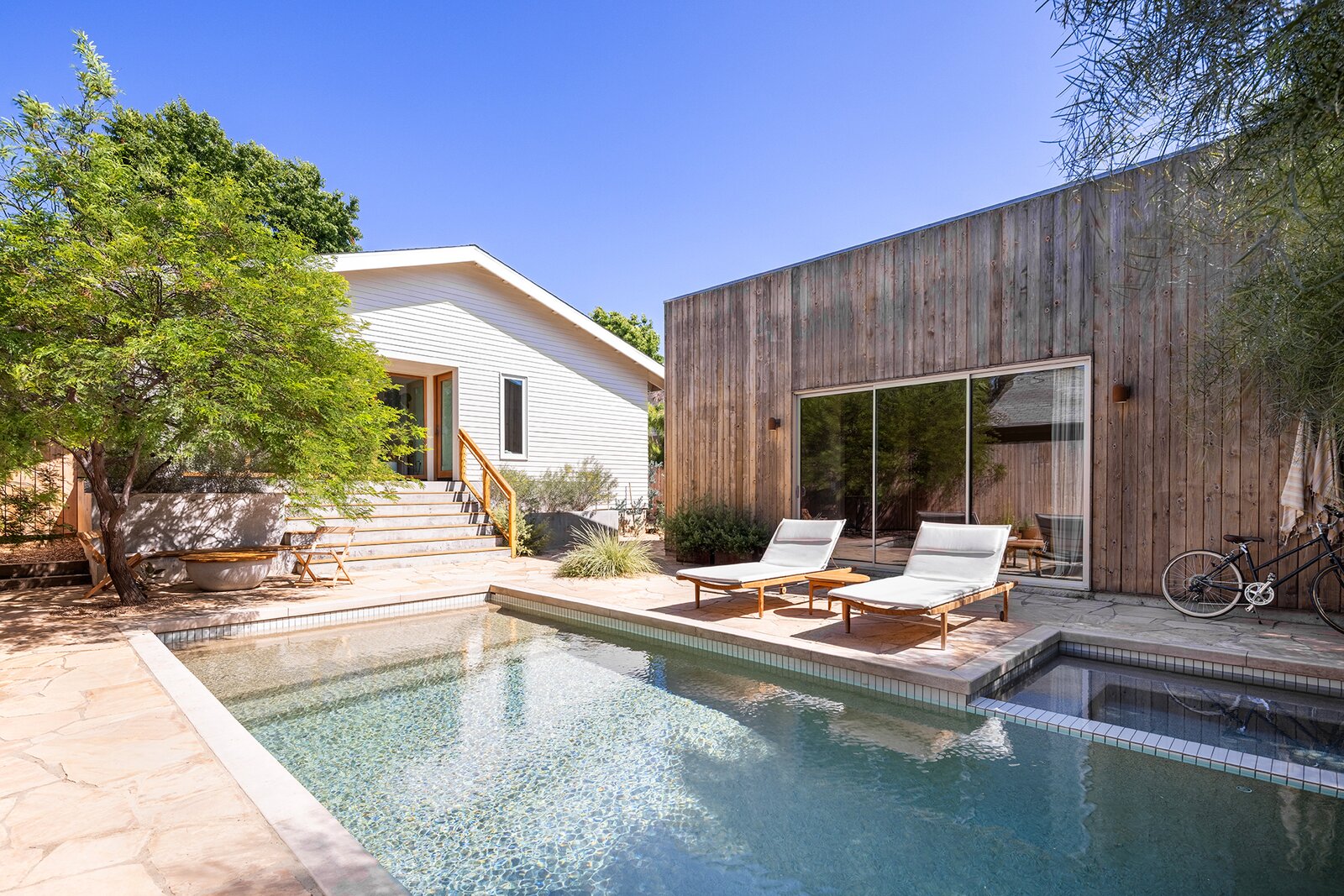
Both tracks have produced good houses. The unit above came in at $89,430 because the architect paid himself nothing; a 350-square-foot studio stacked on a Los Feliz garage cost $220,722 with the garage rebuilt under it, and a Silver Lake ADU traded its yard for a roof deck by going to two stories, which is an ordinance-track decision. The build guide walks the whole process in order, from the lot to the final.
What binds the city whichever door you use
The state baseline is on the Los Angeles County page. The parts that do the most work inside the city are the clocks and the fee limits, because they are where the department’s habits meet a statutory deadline. Since January 1, 2026 the department must decide within 15 business days whether an ADU application is complete and say so in writing with a list of everything missing, a rule SB 543 wrote specifically to stop completeness review from drifting; it must then approve or deny within 60 days of a complete application, or the application is deemed approved (Gov. Code 66317). No impact fee may be charged on an ADU of 750 square feet or less of interior livable space, and no school facilities fee under 500 square feet (66311.5). No owner-occupancy condition may be imposed on a standard ADU (66315). Those four sentences are worth more than the rest of the ordinance put together.
The Standard Plan Program, and the one free plan
LADBS pre-approves ADU designs drawn by private architects and engineers, so that a permit on one of them needs only a site-specific review: does it fit your lot, what does the foundation need. The city says the program shortens plan check; the statute puts a number on it, because a detached ADU application using a plan the city pre-approved within the current building code cycle must be decided within 30 days (Gov. Code 65852.27), and only for a plan pre-approved within the current triennial code cycle. The catalog turns over as plans are added, so picking one is still on you; our catalog walkthrough and the guide to the program are the places to start, and the plan catalog lists the current set alongside designs from licensed architects.
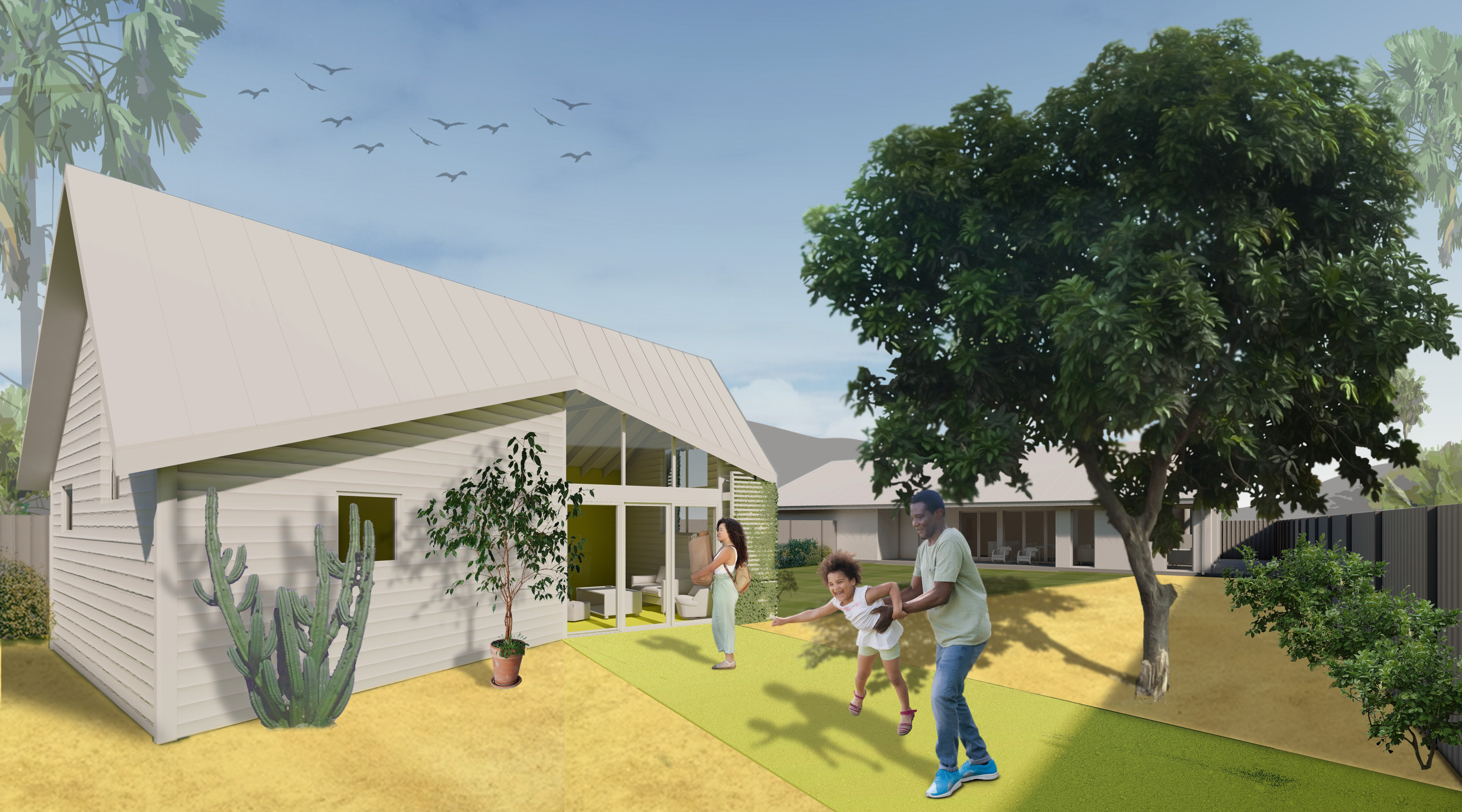
One design in the program is different from all the others. The YOU-ADU was commissioned by the City Council, designed by Lehrer Architects with the Bureau of Engineering, and is provided free to applicants: a one-story, one-bedroom, 455-square-foot unit with options. Every other standard plan is designed and owned by the listed firm and purchased from it. Free drawings are the cheapest line in an ADU budget, which is the point of the post about what the free plan actually costs to build.
Renting it: the RSO question
Here is the part that surprises owners after the unit is finished. The Rent Stabilization Ordinance applies to rental units in the city built on or before October 1, 1978, unless the parcel holds only one single-family home. A new ADU is not a 1978 unit. But the house it sits behind might be, and the moment there are two units on the parcel the single-family exemption is gone. The Los Angeles Housing Department publishes four scenarios for an ADU added to a pre-1978 house, and they are worth reading before you decide what kind of unit to build:
- A detached new ADU is generally not under the RSO, but building it can bring the pre-1978 house under it, because the parcel now holds two units.
- An attached new ADU is not under the RSO, but is subject to the Just Cause Ordinance, which regulates evictions and requires registration.
- A conversion of pre-1978 habitable space may put both units under the RSO.
- A garage or other non-habitable conversion is subject to the Just Cause Ordinance only, not the RSO.
Adding a unit also brings the parcel within the Los Angeles Housing Code, and the RSO requires a rent reduction if a housing service such as a parking space is taken from an existing tenant to build the unit. The department’s scenarios are written for a single-family house; a garage conversion inside an existing multifamily RSO building is a different case and one to put to the RSO determinations unit directly. Home-sharing is not allowed in RSO units. Our guide to renting out an ADU in Los Angeles covers the landlord side from there, and listing on A-du is free.
What the permit costs
LADBS building permit fees are based on the valuation of the project under Los Angeles Building Code 91.107, with separate electrical, plumbing and mechanical schedules. On top of the permit and plan check sits the state Building Standards surcharge, four dollars per hundred thousand dollars of valuation or fraction of it, with a one dollar minimum. Two city levies, the Dwelling Unit Construction Tax under LAMC 21.10.3 at two hundred dollars per new dwelling unit, new construction or conversion, and the Residential Development Tax under LAMC 21.13.3, are treated by LADBS as impact fees: neither is charged on an ADU under 750 square feet, and both are charged proportionately above that (Information Bulletin P/BC 2026-150). None of these is the number that sinks a budget. The utility connections are, and the line-by-line explanation of what each fee actually is says why. The free LA ADU permit fee calculator itemizes all of it with the citation on each line, and the state fee thresholds above are applied automatically by size.
Run a free test fit to see whether an 800-square-foot state ADU fits behind your house, see what your neighborhood has permitted, or list a finished ADU for rent, free.
Frequently asked questions
- What is the difference between an ordinance ADU and a state ADU in Los Angeles?
- An ordinance ADU is approved under the city code, LAMC 12.22 A.33, and carries the city standards: a one-space parking requirement unless exempt, a 1,200 square foot cap on a detached unit, a two-story limit, and a prohibition on lots in both a Very High Fire Hazard Severity Zone and a Hillside Area. A state ADU is approved under Government Code 66323, which requires the city to approve a unit meeting the objective state criteria, and the city standards do not apply to it. The state track gives you a detached unit of up to 800 square feet with four-foot side and rear setbacks and no parking requirement, anywhere in a residential or mixed-use zone.
- Can I build an ADU in the Los Angeles hills?
- On the state track, yes: the city itself confirms that the hillside and fire zone prohibition does not apply to a state ADU under Government Code 66323. On the ordinance track the city applies a prohibition on lots that are in both a Very High Fire Hazard Severity Zone and a Hillside Area. The state housing department found that prohibition non-compliant in November 2024 because the city had not shown the required public safety evidence, and as of September 2026 the ordinance has not been amended. Fire code and hillside grading requirements apply on either track.
- How many ADUs can I build on one lot in the City of Los Angeles?
- On a single-family lot, state law entitles you to one converted ADU, one detached new-construction ADU and one junior ADU, in any combination and in any order, which is three units. The city ordinance says one ADU per lot; the state found that provision non-compliant, and the 2026 amendment to state law added the words "or any combination" to the statute to settle it. On a multifamily lot the state track allows conversions of non-livable space up to a quarter of the existing unit count and up to eight detached units.
- Is my new Los Angeles ADU under rent stabilization?
- Usually not, but it can put the main house under it. The Rent Stabilization Ordinance applies to rental units built on or before October 1, 1978 unless the parcel holds only a single-family home. A new detached ADU is generally not covered, but building it can bring a pre-1978 main house into the ordinance because the parcel now has two units. A garage or other non-habitable conversion off a pre-1978 house is subject to the Just Cause Ordinance but not rent stabilization, while a conversion of pre-1978 habitable space may put both units under it. Check your case with the Los Angeles Housing Department determinations unit.
- Are the LADBS standard plans free?
- One is. The YOU-ADU, a 455 square foot one-bedroom designed for the city by Lehrer Architects with the Bureau of Engineering, is provided free to applicants by the Department of Building and Safety. Every other plan in the Standard Plan Program is designed and owned by the listed firm and purchased from it. Pre-approval is what you get either way: a plan the department has already checked, so plan check is shorter, and a 30-day decision under state law for a detached unit on a plan pre-approved within the current code cycle.
- How long does the City of Los Angeles take to approve an ADU?
- State law sets the clocks and they bind the city. Since January 1, 2026 the department must say in writing within 15 business days whether the application is complete and list every missing item. It must then approve or deny within 60 days of a complete application, or 30 days for a detached unit on a plan it pre-approved within the current code cycle, and an application it does not act on is deemed approved. Those clocks run on a complete application, so the time you spend on drawings and corrections is on top.
This guide is general information, not legal advice, and it is not a substitute for the Department of Building and Safety or the Department of City Planning. Sources: Ordinance 186,481, HCD’s findings of November 19, 2024 and technical assistance letters of August 14, 2025 and March 24, 2026, ZA Memo 143 Revision 1, LADBS Information Bulletin P/BC 2026-150, the LADBS and LAHD pages linked above, and California Government Code 66310 and following as amended by SB 543, each read in September 2026. Note that HCD’s letters cite Government Code section numbers that SB 543 renumbered on January 1, 2026: the impact fee section they call 66324 is now 66311.5, and the amnesty section they call 66332 is now 66311.7. City rules and state law both change often; confirm current requirements before you build or rent.